


Kaohsiung prosecutors have questioned 15 people in an investigation into the illegal excavation of gravel pits that were later backfilled with construction waste, polluting surrounding farmland in Kaohsiung’s Meinong District (美濃).
A man surnamed Wang (王), identified as a principal suspect, was detained on Monday for allegedy renting the farmland from landowners Wu Ching-wen (巫清文) and his wife, Shih Li-chun (石麗君), to operate the excavation-and-backfill scheme for profit, prosecutors said.
Wu and Shih are also regarded as key figures in the case. Both were previously granted bail, with Shih released on NT$1 million (US$33,221) and Wu on NT$800,000 bail, prosecutors said.
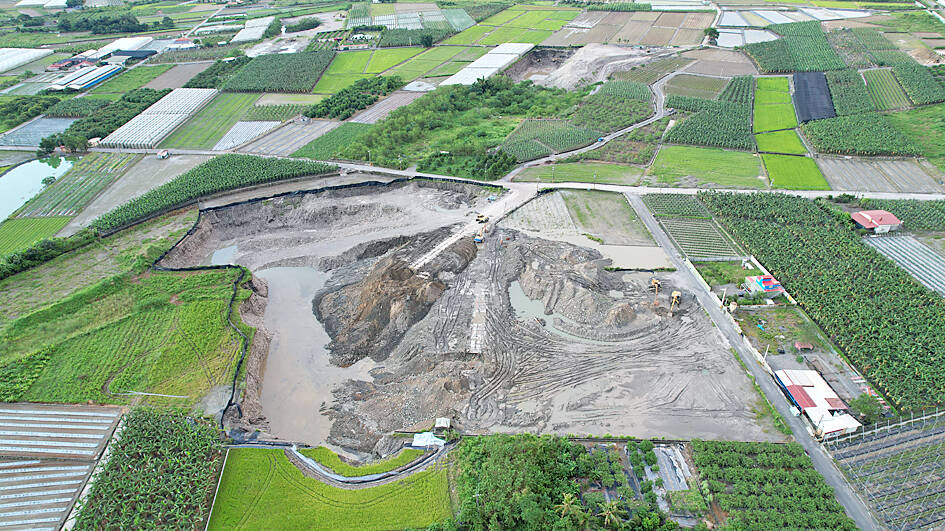
Photo courtesy of a member of the public
The trio and the other suspects face pending charges under the Waste Disposal Act (廢棄物清理法) and the Organized Crime Prevention Act (組織犯罪防制條例), after prosecutors said witness testimony and evidence indicated involvement by criminal syndicates operating in the construction, excavation and trucking sectors.
‘GRAND CANYON’
Local media have dubbed the case the “Grand Canyon of Meinong” (美濃大峽谷), after prosecutors discovered massive gravel pits spanning six hectares of farmland, with one pit reaching 20m deep.
The sites have since filled with foul, stagnant water, prompting residents to complain of soil, groundwater and stream contamination.
Prosecutors said that Wang, along with the landowner couple, knowingly engaged in illegal gravel excavation on the farmland as well as on adjacent state-owned plots.
The operation was unauthorized, conducted without permits and later concealed by backfilling, they said, adding that local residents reported seeing dump trucks entering the area, apparently carrying construction waste for illicit disposal in the pits.
Since launching the probe last month, prosecutors estimated that about 1.3 million cubic meters of gravel were illegally removed and sold to construction firms, generating profits of about NT$300 million.
Wang and the couple also allegedly earned millions more in a second phase of the scheme, by arranging for construction firms to dump waste material into the open pits, prosecutors said, adding that the suspects collected fees for each truckload, which included construction debris and industrial waste.
‘FAKE EXPOSE’
Kaohsiung City Councilor Cheng Meng-ju (鄭孟洳) of the Democratic Progressive Party (DPP) on Monday said Chinese Nationalist Party (KMT) Legislator Ko Chih-en (柯志恩) deceived the public by leading reporters on a “fake expose” of the polluted farmland in Meinong in July.
Cheng said that Shih, who accompanied Ko during the visit, was serving as an aide to independent City Councilor Chu Hsin-chiang (朱信強), who represents Meinong and nearby rural districts and had supported Legislative Speaker Han Kuo-yu (韓國瑜) of the KMT in his successful 2018 Kaohsiung mayoral campaign.
Cheng said that Ko colluded with Shih to fabricate an expose with the aim of shifting blame onto the Kaohsiung City Government, led by Kaohsiung Mayor Chen Chi-mai (陳其邁) of the DPP, while boosting Ko’s own publicity as she eyes next year’s mayoral race.
Ko denied that Shih was her aide, saying that the DPP was spreading malicious rumors and distorting the facts, while ignoring the environmental damage to the land.
Additional reporting by staff writer

FUKUOKA SITUATION: Japanese media reported that the pathogen is expected to be identified by the summer, while the CDC downplayed the idea that it was hMPV A “mysterious cold-like illness” reported in Japan’s Fukuoka Prefecture does not seem to be a new disease, but Japanese authorities have been asked about the situation, the Centers for Disease Control (CDC) said yesterday. The Fukuoka Prefectural Medical Association on Wednesday told a news conference that a “mystery cold” that has become a hot topic on social media is “highly likely to be caused by some kind of viral infection,” Japan’s KBC News reported. “Many people are experiencing symptoms starting with a sore throat, followed by a runny nose, phlegm and a severe cough,” KBC News reported, citing association officials. Health authorities are

Nvidia Corp CEO Jensen Huang (黃仁勳) arrived in Taiwan yesterday ahead of upcoming AI and technology events, saying he plans to meet with clients and Taiwan Semiconductor Manufacturing Co Chairman C.C. Wei (魏哲家) during his visit. After landing at Taipei Songshan Airport, Huang posed for photos with fans and handed out Yakult drinks to reporters and supporters waiting at the scene, saying he has “a lot to do” during the trip. Asked about reports that Nvidia’s planned headquarters site in Taipei’s Beitou Shilin Technology Park could break ground on May 27, Huang said that if the company holds an event, he would

The Ministry of Finance this afternoon announced the winning numbers for the March-April uniform invoice lottery. The winning number for the NT$10 million (US$318,060) special prize is 19531471, and the winning number for the NT$2 million grand prize is 85941329. Three numbers were drawn for the NT$200,000 first prize: 07225810, 20231230 and 83518781. Those with receipts matching the last seven digits of any of the first-prize numbers will win the NT$40,000 second prize, while those matching the last six digits will win the NT$10,000 third prize. Those whose receipts match the last five digits of the first-prize numbers can claim the NT$4,000 fourth prize,
Taiwan Travelogue (臺灣漫遊錄), which earlier this week became the first Taiwanese novel to win the International Booker Prize, is to be adapted into a television series through a Taiwan-Japan coproduction, producer Chang Chen-yu (張辰漁) said yesterday. Chang, a producer at World Softest Production Film Co, wrote on Facebook that the company had been searching for projects with international appeal that retain a strong Taiwanese identity after colleagues and Japanese partners strongly recommended the novel. After reading the book, Chang said he immediately decided to pursue the screen rights. “A great story has the power to transcend time and borders, and connect countless people,”


 RSS
RSS