


Taiwan is to issue new security guidelines next week in an updated civil defense handbook that, for the first time, would instruct citizens on what to do if they see enemy soldiers and clarifies that any claims of Taiwan’s surrender should be considered false.
The handbook represents the nation’s latest effort to prepare its population for potential emergencies in the face of escalating military pressure from China.
The bright red-orange handbook, designed for people of all ages, features cartoon characters representing Taiwan’s population on the cover and across its 29 pages, and tells Taiwanese to “protect each other and safeguard our beloved home.”

Photo: Fabian Hamacher, Reuters
“Whether it be natural disasters, epidemics, extreme weather or the threat of Chinese invasion, the challenges we face have never ceased,” the handbook says, offering guidance on how to find bomb shelters via smartphone apps and tips for preparing emergency kits for family members, including pets.
National Security Council Deputy Secretary-General Lin Fei-fan (林飛帆), who oversaw the updated handbook, said Taipei has taken inspiration from survival guides planned by fellow democracies.
“China’s ambitions for authoritarian expansion are being felt by countries around the world,” Lin said, adding that Russia’s invasion of Ukraine has also lent new urgency.
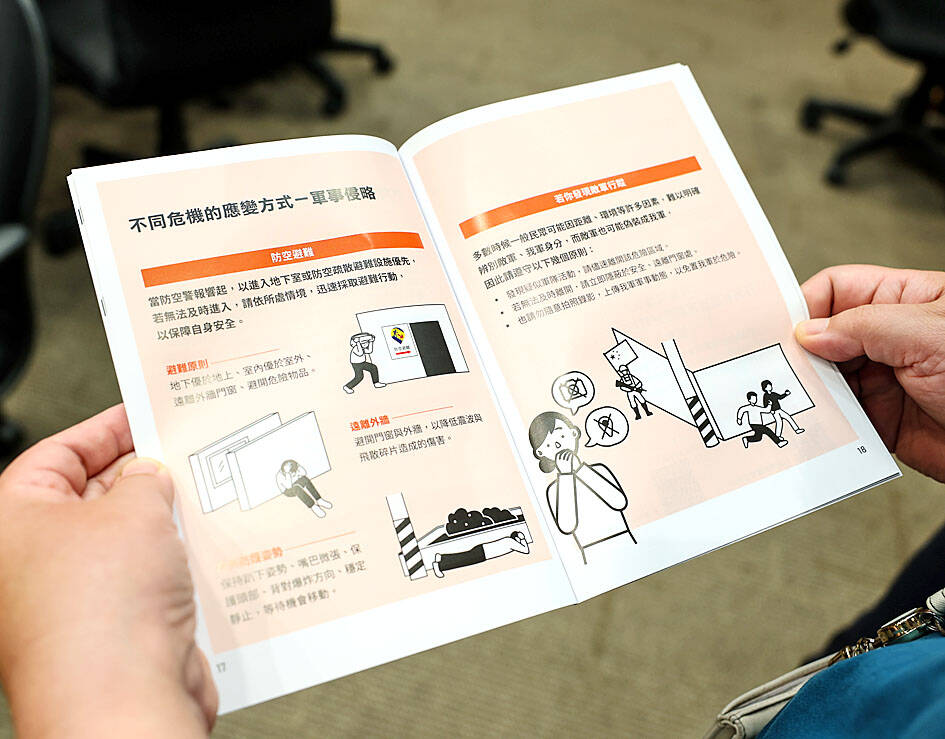
Photo: CNA
“The global situation — whether in Europe or the Indo-Pacific region — is not a distant concern. It is right at our doorstep,” Lin said.
The handbook, the first edition of which was published in 2022, gives a list of scenarios Taiwan might face, from sabotage of undersea cables, cyberattacks and inspections of Taiwanese vessels by an “enemy nation” as a prelude to conflict, to an all-out invasion. It also highlights the danger of ongoing misinformation campaigns against Taiwan, saying “hostile foreign forces” might exploit misinformation to divide and weaken the nation’s resolve with the help of deepfake videos and local collaborators.
“In the event of a military invasion of Taiwan, any claim that the government has surrendered or that the nation has been defeated is false,” it says.
At a time of war, when a suspected enemy presence is detected, people are advised to promptly leave the area or take cover in a safe location away from windows, and refrain from taking photos or videos and uploading them, it adds.
“That could compromise military movements, which is detrimental to our defensive operations,” All-out Defense Mobilization Agency Director Shen Wei-chih (沈威志) said.
The handbook also pointed to potential security risks from China-made tech devices such as cameras and applications, including China’s DeepSeek artificial intelligence, and social media platforms WeChat and TikTok.
“In times of crisis, these devices could be exploited by the enemy,” it added.
The handbook also offers tips on how to talk to children about an emergency.
“Many parents actually don’t know how to discuss a potential crisis with their children,” Lin said. “The goal isn’t to make everyone feel afraid. Rather, all the information is intended to help people develop better coping strategies when a real crisis occurs.”

A magnitude 6.1 earthquake struck off the coast of Yilan County at 8:39pm tonight, the Central Weather Administration (CWA) said, with no immediate reports of damage or injuries. The epicenter was 38.7km east-northeast of Yilan County Hall at a focal depth of 98.3km, the CWA’s Seismological Center said. The quake’s maximum intensity, which gauges the actual physical effect of a seismic event, was a level 4 on Taiwan’s 7-tier intensity scale, the center said. That intensity level was recorded in Yilan County’s Nanao Township (南澳), Hsinchu County’s Guansi Township (關西), Nantou County’s Hehuanshan (合歡山) and Hualien County’s Yanliao (鹽寮). An intensity of 3 was

Instead of focusing solely on the threat of a full-scale military invasion, the US and its allies must prepare for a potential Chinese “quarantine” of Taiwan enforced through customs inspections, Stanford University Hoover fellow Eyck Freymann said in a Foreign Affairs article published on Wednesday. China could use various “gray zone” tactics in “reconfiguring the regional and ultimately the global economic order without a war,” said Freymann, who is also a nonresident research fellow at the US Naval War College. China might seize control of Taiwan’s links to the outside world by requiring all flights and ships entering or leaving Taiwan
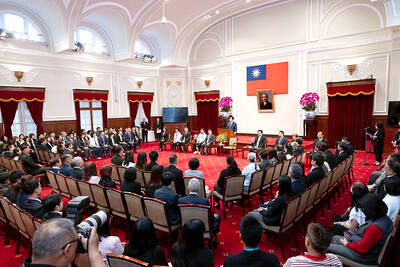
The next minimum wage hike is expected to exceed NT$30,000, President William Lai (賴清德) said yesterday during an award ceremony honoring “model workers,” including migrant workers, at the Presidential Office ahead of Workers’ Day today. Lai said he wished to thank the awardees on behalf of the nation and extend his most sincere respect for their hard work, on which Taiwan’s prosperity has been built. Lai specifically thanked 10 migrant workers selected for the award, saying that although they left their home countries to further their own goals, their efforts have benefited Taiwan as well. The nation’s industrial sector and small businesses lay
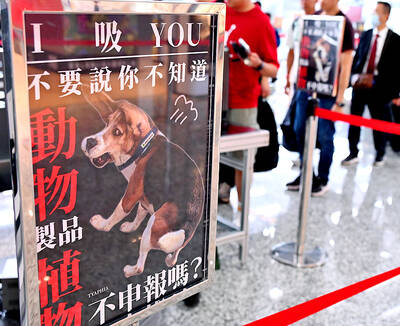
Quarantine awareness posters at Taiwan Taoyuan International Airport have gone viral for their use of wordplay. Issued by the airport branch of the Animal and Plant Health Inspection Agency, the posters feature sniffer dogs making a range of facial expressions, paired with advisory messages built around homophones. “We update the messages for holidays and campaign needs, periodically refreshing materials to attract people’s attention,” quarantine officials said. “The aim is to use the dogs’ appeal to draw focus to quarantine regulations.” A Japanese traveler visiting Taiwan has posted a photo on X of a poster showing a quarantine dog with a


 RSS
RSS