


The Intellectual Property and Commercial Court (IPCC) has ordered one former employee and two current employees of Taiwan Semiconductor Manufacturing Co (TSMC) be detained and held incommunicado for allegedly stealing sensitive trade secrets involving the company’s advanced 2-nanometer (nm) process.
The ruling was handed down after the three suspects — Chen Li-ming (陳力銘), a former TSMC engineer, Wu Ping-chun (吳秉駿) and Ko Yi-ping (戈一平), who currently worked as engineers for the chipmaker — were referred to the court yesterday morning.
A three-judge panel at the IPCC ruled that the three deleted their communications records after their conduct involving the alleged theft of TSMC’s advanced 2nm process was discovered, so there are reasonable fears they could continue to destroy evidence and collude with one another in making false statements.
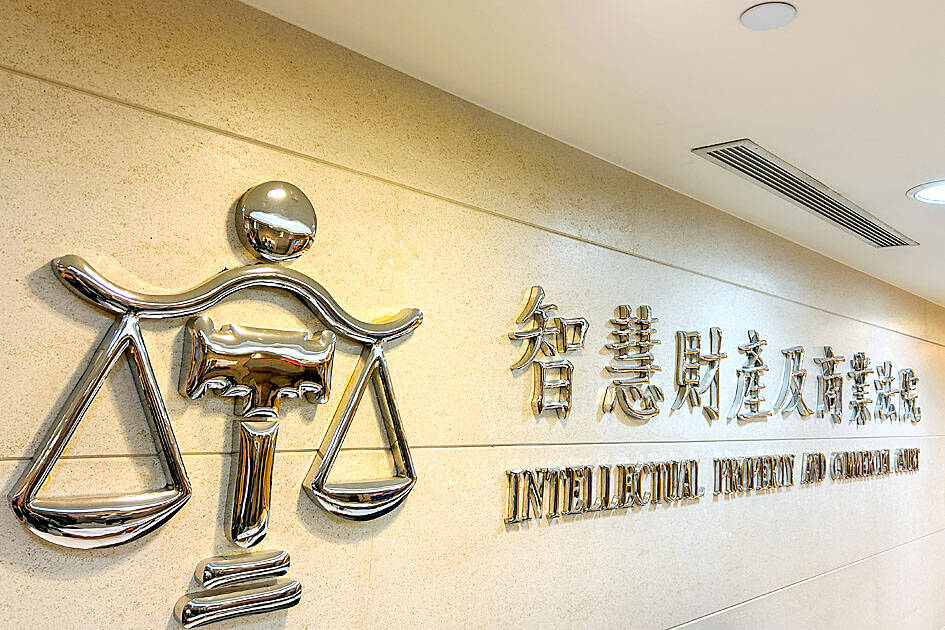
Photo: CNA
The judges said that as the three suspects’ conduct potentially harmed national security and affected market competition, they should be detained to make sure the future court hearings proceed smoothly.
On Wednesday last week, the High Prosecutors' Office Intellectual Property Branch indicted the three suspects for their roles in the alleged theft of trade secrets and breaches of the National Security Act (國家安全法) by obtaining national core technology secrets for use abroad.
Prosecutors are seeking prison terms of 14 years, nine years and seven years respectively for Chen, Wu and Ko.
Chen is a former TSMC engineer working at Tokyo Electron Ltd (TEL), a Japan-based supplier to TSMC.
During the second half of last year and the first half of this year, Chen asked Wu and Ko to provide trade secrets they had access to, under the guise of helping TEL secure more TSMC supplying contracts, prosecutors said.
TSMC detected the irregularity and filed a lawsuit against the three in early July.
Prosecutors launched searches and raids related to the case from July 25 to 28 and secured approval from the IPPC to detain them men the investigation.
The case was referred to the IPCC yesterday, and a hearing was needed to decide whether the three suspects could continue to be detained.
TEL said late last month that an internal investigation has so far found no evidence that confidential information about TSMC’s 2nm was leaked to a third party.
TSMC is developing the 2nm process, which is scheduled to start mass production in the second half of this year.
Currently, the 3nm process is the latest technology for TSMC to begin commercial production.

NATIONAL SECURITY: Authorities are working to confirm the identities of the military personnel involved and investigating possible illegal conduct and regulatory violations Authorities are probing possible national security implications after Kinmen police and immigration officers on Sunday found a Chinese woman allegedly posing as a tourist while engaging in prostitution involving more than 10 military personnel. The woman, surnamed Chen (陳), has since been deported, authorities said, adding that investigators are still working to confirm the identities of those implicated, as the records only listed code names and aliases. The case stemmed from a report received by the Kinmen District Prosecutors’ Office on Friday last week from the Jinhu Precinct of the Kinmen County Police Bureau. On Sunday, police, along with the National Immigration

GLOBALGIVING: ‘ Caving to external pressure is not acceptable for an organization that has cultivated justice reform and human rights for 30 years,’ one NGO said A slew of non-government organizations (NGOs) have withdrawn from the GlobalGiving fundraising platform after it announced it would use “Chinese Taipei” instead of “Taiwan” from next month. The Taiwan Good Rice Association wrote on Facebook on Friday that it was informed on April 28 via a teleconference call of the change, which was made because the platform wanted to operate in China. Taiwan Good Rice is to terminate all cooperative relationships with GlobalGiving in response to the platform’s “unilateral and non-negotiable” decision to remove references to Taiwan, the NGO said. “Taiwan is in the official name of Taiwan Good Rice Association and the

HEAVY WEATHER: Typhoon Jangmi is due to crash straight into the Ryukyus as airlines look to shift flights to larger aircraft or cancel flights to Okinawa entirely Taiwan’s international air carriers announced flight adjustments over the weekend as Typhoon Jangmi is forecast to hit the Ryukyu Islands today and tomorrow. The Central Weather Administration (CWA) upgraded Jangmi from a tropical storm to a typhoon at 8am yesterday, with the eye located 580km south of Naha city. It was moving north at 19kph. Today, China Airlines’ CI-120, CI-121, CI-122 and CI-123 flights between Taoyuan and Naha, Okinawa, have been canceled as well as CI-132 and CI-133 between Kaohsiung and Naha. EVA Air’s BR-112, BR-113, BR-186 and BR-185 flights between Taoyuan and Naha are also canceled. Low-cost carrier Tigerair Taiwan canceled IT-230,

Chinese Nationalist Party (KMT) Chairwoman Cheng Li-wun (鄭麗文) yesterday briefed her party’s Central Standing Committee regarding her scheduled visit to the US between Monday next week and June 16, saying that her purpose would be to persuade the US that the Republic of China (ROC) Constitution was a “one China” constitution that would foster stable and peaceful cross-strait relations. The ROC Constitution is the most important defense for all Taiwanese citizens, as it upholds our democracy and has contributed to our robust economy, which aligns with international and US interests, she said. “We would not be troublemakers and drag the US under,”


 RSS
RSS