


The Taiwan Alliance for the Self-Regulation of Online News (TASON) was launched yesterday, coinciding with Taiwan’s Journalists’ Day, with 23 media outlets signing on as founding members.
The alliance said at a news conference that it aims to safeguard online news freedom in Taiwan through the principles of truth, professionalism, self-regulation, transparent oversight and digital accountability.
It urged more outlets to join in fostering a truthful, professional and trustworthy digital news environment.

Photo: CNA
Amid intensifying competition in an algorithm-driven media landscape, TASON said it would build a governance platform that combines internal oversight with citizen participation.
The platform would feature systematic standards, transparent complaint and correction mechanisms, and collaboration among information stakeholders to improve the quality and credibility of reporting.
Lin Wen-chun (林妏純), convener of the alliance and editor-in-chief of ETtoday’s news department, said in a pre-recorded video that the alliance represents a reconstruction of media values, adding that journalism should not be measured solely by click-through rates.
Hakka Radio chief and alliance deputy coordinator Chuang Sheng-hung (莊勝鴻) said that Taiwan’s media face a trust crisis, as outlets often cross ethical boundaries in pursuit of higher click-through rates.
Taiwan’s media face a crisis of declining trust, as outlets frequently cross ethical boundaries in pursuit of higher click-through rates. The alliance expressed hope that its framework would help restore credibility and strengthen the role of Taiwanese journalism.
Andy Y.H. Liang (梁永煌), publisher of the Chinese-language Business Today, said that as the “fourth estate,” news media have a duty to regulate themselves.
“The subjects of news reports should be treated fairly, which is why the alliance has established a complaint channel to expand public participation and help journalists earn greater respect,” he said.
Minister of Digital Affairs Lin Yi-jing (林宜敬) said that as an engineer who worked in the high-tech sector, he only learned about online news through his friends active in student movements.
“Does false information on the Internet count as press freedom? This is what we need to discuss, and one that calls for self-regulation,” he said.

The military has spotted two Chinese warships operating in waters near Penghu County in the Taiwan Strait and sent its own naval and air forces to monitor the vessels, the Ministry of National Defense (MND) said. Beijing sends warships and warplanes into the waters and skies around Taiwan on an almost daily basis, drawing condemnation from Taipei. While the ministry offers daily updates on the locations of Chinese military aircraft, it only rarely gives details of where Chinese warships are operating, generally only when it detects aircraft carriers, as happened last week. A Chinese destroyer and a frigate entered waters to the southwest

The eastern extension of the Taipei MRT Red Line could begin operations as early as late June, the Taipei Department of Rapid Transit Systems said yesterday. Taipei Rapid Transit Corp said it is considering offering one month of free rides on the new section to mark its opening. Construction progress on the 1.4km extension, which is to run from the current terminal Xiangshan Station to a new eastern terminal, Guangci/Fengtian Temple Station, was 90.6 percent complete by the end of last month, the department said in a report to the Taipei City Council's Transportation Committee. While construction began in October 2016 with an
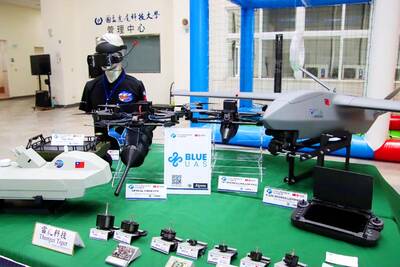
NON-RED SUPPLY: Boosting the nation’s drone industry is becoming increasingly urgent as China’s UAV dominance could become an issue in a crisis, an analyst said Taiwan’s drone exports to Europe grew 41.7-fold from 2024 to last year, with demand from Ukraine’s fight against Russian aggression the most likely driver of growth, a study showed. The Institute for Democracy, Society and Emerging Technology (DSET) in a statement on Wednesday said it found that many of Taiwan’s uncrewed aerial vehicle (UAV) sales were from Poland and the Czech Republic. These countries likely transferred the drones to Ukraine to aid it in its fight against the Russian invasion that started in 2022, it said. Despite the gains, Taiwan is not the dominant drone exporter to these markets, ranking second and fourth

Japanese Prime Minister Sanae Takaichi’s comment last year on Tokyo’s potential reaction to a Taiwan-China conflict has forced Beijing to rewrite its invasion plans, a retired Japanese general said. Takaichi told the Diet on Nov. 7 last year that a Chinese naval blockade or military attack on Taiwan could constitute a “survival-threatening situation” for Japan, potentially allowing Tokyo to exercise its right to collective self-defense. Former Japan Ground Self-Defense Force general Kiyofumi Ogawa said in a recent speech that the remark has been interpreted as meaning Japan could intervene in the early stages of a Taiwan Strait conflict, undermining China’s previous assumptions


 RSS
RSS