


The Ministry of Digital Affairs yesterday said it is partnering with global technology giants such as Qualcomm Technologies Inc, Microsoft Corp, IBM and Advanced Micro Devices Inc (AMD) to cultivate artificial intelligence (AI) talent in Taiwan.
Administration for Digital Industries Director-General Lin Jiunn-shiow (林俊秀) told a news conference that the ministry’s international partners would introduce the latest AI tools to Taiwan, helping local developers expand their skills and advance the nation’s AI capabilities.
“Taiwan stood on the shoulders of giants to develop its hardware industry,” Lin said, referring to the country’s collaboration with foreign firms. “Today, we are taking a similar approach to accelerate AI software and technology development in response to the boom of the AI era, as we recognize that talent is the cornerstone of AI infrastructure.”
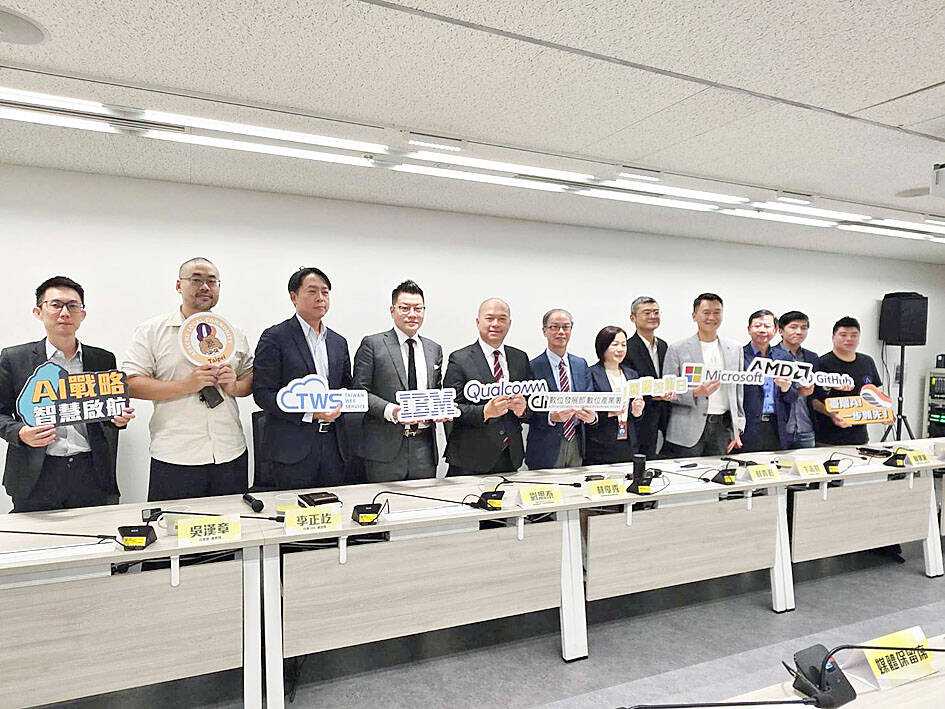
Photo: CNA
S.T. Liew (劉思泰), vice president of Qualcomm and president of Qualcomm Taiwan and South East Asia, Australia and New Zealand, said at the event that generative AI has brought sweeping change worldwide and driven rapid technological upgrades.
AI has not only intensified competition in innovation, but also created tremendous business opportunities, he said, adding that cultivating sufficient talent is essential for Taiwan to compete in the AI era.
Economies of scale in AI development are expected to drive success in the new era, with the public and private sectors playing central roles, Liew said.
“We hope Taiwan would not only be a semiconductor island, but also an AI island,” he said.
Microsoft Taiwan general manager Sean Pien (卞志祥) said that since 2020, the company has run a digital talent cultivation program in Taiwan, training about 200,000 professionals over three years.
However, as the digital era shifts into the AI era, demand from industry continues to outpace supply, he said, adding that talent cultivation is the first step to compete in the AI era.
IBM Taiwan general manager Nelson Lee (李正屹) said enterprises must not only nurture AI talent, but also become “AI ready” across areas such as corporate culture, governance and technology platforms to achieve higher returns.
AMD Taiwan senior vice general manager Lin Chien-cheng (林建誠) said the company has launched diverse and open AI development platforms to give industries the flexibility to build AI systems suited to their needs.
Local AI communities — including Apache Taipei, GitHub Star, WordPress and idealNCU — have also teamed up with the ministry in AI talent and technology development.
Apache Taipei is to establish a new branch next month to train open-source software engineers in Taiwan, and strengthen links between the nation’s open-source groups and their global counterparts, the ministry said.
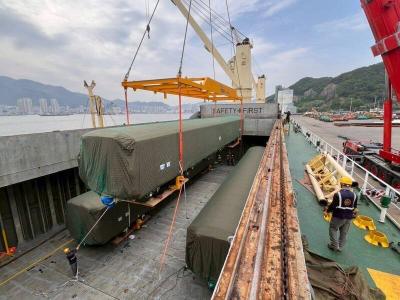
The first of 10 new high-capacity trains purchased from South Korea’s Hyundai Rotem arrived at the Port of Taipei yesterday to meet the demands of an expanding metro network, Taipei Rapid Transit Corp (TRTC) said yesterday. The train completed a three-day, 1,200km voyage from the Port of Masan in South Korea, the company said. Costing NT$590 million (US$18.79 million) each, the new six-carriage trains feature a redesigned interior based on "human-centric" transportation concepts, TRTC said. The design utilizes continuous longitudinal seating to widen the aisles and optimize passenger flow, while also upgrading passenger information displays and driving control systems for a more comfortable
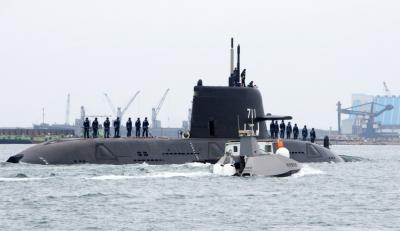
Taiwan's first indigenous defense submarine, the SS-711 Hai Kun (海鯤, or Narwhal), departed for its 13th sea trial at 7am today, marking its seventh submerged test, with delivery to the navy scheduled for July. The outing also marked its first sea deployment since President William Lai (賴清德) boarded the submarine for an inspection on March 19, drawing a crowd of military enthusiasts who gathered to show support. The submarine this morning departed port accompanied by CSBC Corp’s Endeavor Manta (奮進魔鬼魚號) uncrewed surface vessel and a navy M109 assault boat. Amid public interest in key milestones such as torpedo-launching operations and overnight submerged trials,
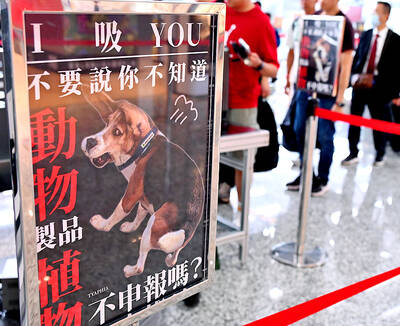
Quarantine awareness posters at Taiwan Taoyuan International Airport have gone viral for their use of wordplay. Issued by the airport branch of the Animal and Plant Health Inspection Agency, the posters feature sniffer dogs making a range of facial expressions, paired with advisory messages built around homophones. “We update the messages for holidays and campaign needs, periodically refreshing materials to attract people’s attention,” quarantine officials said. “The aim is to use the dogs’ appeal to draw focus to quarantine regulations.” A Japanese traveler visiting Taiwan has posted a photo on X of a poster showing a quarantine dog with a

Taiwan’s coffee community has launched a “one-person-one-e-mail” campaign, calling for people to send a protest-e-mail to the World Coffee Championships (WCC) urging it to redesignate Taiwanese competitors as from “Taiwan,” rather than “Chinese Taipei.” The call followed sudden action last week after the WCC changed all references to Taiwanese competitors from “Taiwan” to “Chinese Taipei,” including recent World Latte Art champion Bala (林紹興), who won the World Latte Art Championship in San Diego earlier this month. When Bala received the trophy, he was referred to as representing Taiwan, as well as in the announcement on the WCC’s Web site, until it


 RSS
RSS