


Health professionals yesterday warned not to eat wild mushrooms that have grown due to recent heavy rains, as they could cause nausea, vomiting, abdominal cramps, diarrhea and potentially kidney failure.
After continuous heavy rain in recent days, people in Kaohsiung’s Fongshan District (鳳山) discovered that wild mushrooms were growing on the central median along Fongnan Road.
Many people rushed to check out the phenomenon, disrupting traffic on the road.
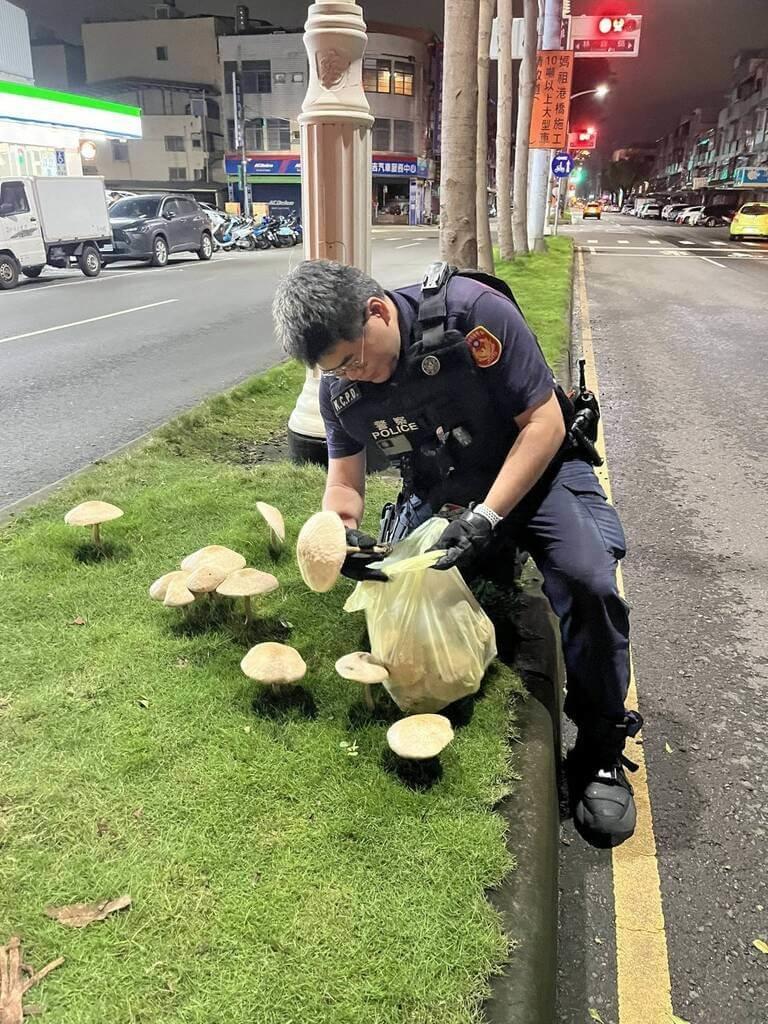
Photo courtesy of the Kaohsiung Police Department
Local police removed the mushrooms overnight yesterday to maintain traffic safety and ensure that people did not eat them.
According to the Food and Drug Administration (FDA), 33 people have been poisoned from eating wild mushrooms in the past five years.
Most of them mistook poisonous ones for edible mushrooms due to their similar appearance, the FDA said.
Taichung Veterans General Hospital Department of Toxicology director Mao Yen-chiao (毛彥喬) said yesterday that people should not eat wild mushrooms at random.
If symptoms appear within six hours of ingesting poisonous mushrooms, people are more likely to promptly seek medical attention, but if symptoms do not appear until after six hours, the situation is usually more serious, Mao said.
The most common type of poisonous mushroom is the green-spored parasol, which can cause nausea, vomiting, abdominal pain, bloody stool and dehydration within one to three hours after ingestion, Mao said.
It is most dangerous to eat multiple kinds of wild mushrooms at once, the doctor said.
He recounted a case in which a patient picked an entire bag of wild mushrooms and developed severe food poisoning about 10 hours after eating them.
The patient was brought to the hospital with renal failure and underwent dialysis for treatment, he said.
Mao said that wild mushroom poisoning is usually acute and there is no direct treatment.
In most cases, only the symptoms can be treated by replenishing electrolytes and prescribing medication to relieve diarrhea, abdominal pain and vomiting, he said.
The FDA said that Taiwan’s humid and rainy subtropical climate is ideal for many types of mushrooms to grow, especially in mountainous areas, farmland, grasslands and bamboo forests after it rains.
People should make sure not to pick or eat wild mushrooms, and not to give them as gifts, to avoid accidentally ingesting poisonous mushrooms, the FDA said.

SHIPS, TRAINS AND AUTOMOBILES: The ministry has announced changes to varied transportation industries taking effect soon, with a number of effects for passengers Beginning next month, the post office is canceling signature upon delivery and written inquiry services for international registered small packets in accordance with the new policy of the Universal Postal Union, the Ministry of Transportation and Communications said yesterday. The new policy does not apply to packets that are to be delivered to China, the ministry said. Senders of international registered small packets would receive a NT$10 rebate on postage if the packets are sent from Jan. 1 to March 31, it added. The ministry said that three other policies are also scheduled to take effect next month. International cruise ship operators

NUMBERS IMBALANCE: More than 4 million Taiwanese have visited China this year, while only about half a million Chinese have visited here Beijing has yet to respond to Taiwan’s requests for negotiation over matters related to the recovery of cross-strait tourism, the Tourism Administration said yesterday. Taiwan’s tourism authority issued the statement after Chinese-language daily the China Times reported yesterday that the government’s policy of banning group tours to China does not stop Taiwanese from visiting the country. As of October, more than 4.2 million had traveled to China this year, exceeding last year. Beijing estimated the number of Taiwanese tourists in China could reach 4.5 million this year. By contrast, only 500,000 Chinese tourists are expected in Taiwan, the report said. The report
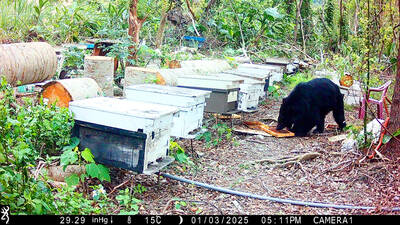
The Forestry and Nature Conservation Agency yesterday launched a gift box to market honey “certified by a Formosan black bear” in appreciation of a beekeeper’s amicable interaction with a honey-thieving bear. Beekeeper Chih Ming-chen (池明鎮) in January inspected his bee farm in Hualien County’s Jhuosi Township (卓溪) and found that more than 20 beehives had been destroyed and many hives were eaten, with bear droppings and paw prints near the destroyed hives, the agency said. Chih returned to the farm to move the remaining beehives away that evening when he encountered a Formosan black bear only 20m away, the agency said. The bear

Chinese embassy staffers attempted to interrupt an award ceremony of an international tea competition in France when the organizer introduced Taiwan and displayed the Republic of China flag, a Taiwanese tea farmer said in an interview published today. Hsieh Chung-lin (謝忠霖), chief executive of Juxin Tea Factory from Taichung's Lishan (梨山) area, on Dec. 2 attended the Teas of the World International Contest held at the Peruvian embassy in Paris. Hsieh was awarded a special prize for his Huagang Snow Source Tea by the nonprofit Agency for the Valorization of Agricultural Products (AVPA). During the ceremony, two Chinese embassy staffers in attendance


 RSS
RSS