


ENVIRONMENT
Ready for snake season
About 1,000 doses of antivenom are administered each year in Taiwan to treat snake bites, the Centers for Disease Control (CDC) said on Tuesday, before the country enters the peak month of snake bites next month. From 2017 to 2021, an average of 979 people per year received antivenom after being bitten by snakes, while nine died from such bites in that period — a fatality rate of 0.18 percent, CDC spokesman Philip Lo (羅一鈞) said, adding that most snake bites occurred between May and November, peaking in August with an average of 112 cases. Of the reported cases, 82.9 percent — or 811 people — were treated with antivenom after being bitten by a hundred-pacer or a Chinese green tree viper, followed by 110 involving the many-banded krait or Taiwan cobra. Lo said antivenom used in southern and eastern Taiwan was primarily for bites from hundred-pacers and Chinese green tree vipers, while cases involving many-banded kraits or cobras were more common in central Taiwan.
ENVIRONMENT
Illegal logging declines
Illegal logging in Taiwan’s national forests has dropped by 80 percent over the past decade, thanks in part to the rise of tribal forest-based economies, the Forestry and Nature Conservation Agency said on Tuesday. Illegal logging cases dropped from 290 in 2013 to 58 last year, a decline the agency attributed to support from indigenous communities in developing sustainable “understory industries” like beekeeping, mushroom farming and eco-tourism. “When tribal communities benefit legally from forest resources, they are far less likely to turn to or tolerate illegal logging,” agency Director Lin Hua-ching (林華慶) said. These efforts have not only improved local incomes and reduced poverty, but also encouraged young people to return home and take part in forest protection, Lin added. So far, 91 communities have joined forest patrol and protection programs, with some areas reporting nearly no illegal logging, agency data showed. National Taipei University associate professor Chen Shiang-fan (陳湘繁) said that poverty, poor education and gang recruitment were major drivers in illegal logging. Community elder Gen Chih-you (根誌優) said that when he returned to his village in 2018, many residents viewed forest resources as free for the taking. After partnering with the agency in 2019, they started raising bees and cultivating mushrooms to earn a living, and with more stable incomes, his fellow tribe members became increasingly willing to protect the forest, he said.
FISHERIES
New fish feed developed
The Fisheries Research Institute on Monday said it has developed a new technique to raise black soldier fly larvae using fish by-products, aiming to reduce reliance on imported fishmeal in aquaculture feed. The institute said that most fishmeal used in Taiwan’s aquaculture industry is imported and produced from large-scale marine fishing, and it began developing the larvae to address marine resource shortages. The larvae are fed on fish processing waste such as heads and bones, which helps them absorb nutrients that can then be converted into insect protein suitable for fish diets, it said adding that they take about two weeks to reach harvest maturity, after which they are dried, stripped of fat content and ground into powder. The resulting insect meal meets the highest-grade fishmeal protein specifications, it said, adding that insects are a natural part of fish diets in the wild, and that using them in feed supports both high-protein nutrition and ecological food cycles.
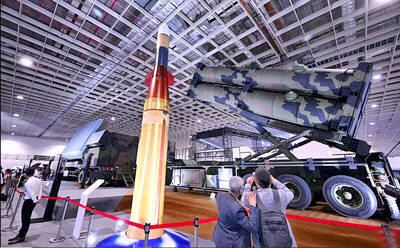
Taiwan is to commence mass production of the Tien Kung (天弓, “Sky Bow”) III, IV and V missiles by the second quarter of this year if the legislature approves the government’s NT$1.25 trillion (US$39.78 billion) special defense budget, an official said yesterday. Commenting on condition of anonymity, a defense official with knowledge of the matter said that the advanced systems are expected to provide crucial capabilities against ballistic and cruise missiles for the proposed “T-Dome,” an advanced, multi-layered air defense network. The Tien Kung III is an air defense missile with a maximum interception altitude of 35km. The Tien Kung IV and V
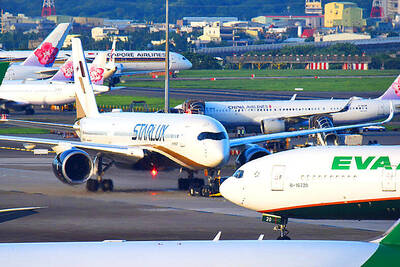
The disruption of 941 flights in and out of Taiwan due to China’s large-scale military exercises was no accident, but rather the result of a “quasi-blockade” used to simulate creating the air and sea routes needed for an amphibious landing, a military expert said. The disruptions occurred on Tuesday and lasted about 10 hours as China conducted live-fire drills in the Taiwan Strait. The Civil Aviation Administration (CAA) said the exercises affected 857 international flights and 84 domestic flights, affecting more than 100,000 travelers. Su Tzu-yun (蘇紫雲), a research fellow at the government-sponsored Institute for National Defense and Security Research, said the air
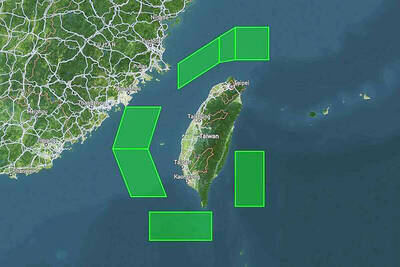
Trips for more than 100,000 international and domestic air travelers could be disrupted as China launches a military exercise around Taiwan today, Taiwan’s Civil Aviation Administration (CAA) said yesterday. The exercise could affect nearly 900 flights scheduled to enter the Taipei Flight Information Region (FIR) during the exercise window, it added. A notice issued by the Chinese Civil Aviation Administration showed there would be seven temporary zones around the Taiwan Strait which would be used for live-fire exercises, lasting from 8am to 6pm today. All aircraft are prohibited from entering during exercise, it says. Taipei FIR has 14 international air routes and
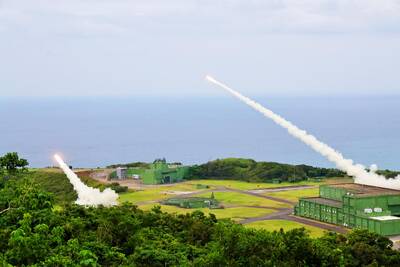
Taiwan lacks effective and cost-efficient armaments to intercept rockets, making the planned “T-Dome” interception system necessary, two experts said on Tuesday. The concerns were raised after China’s military fired two waves of rockets during live-fire drills around Taiwan on Tuesday, part of two-day exercises code-named “Justice Mission 2025.” The first wave involved 17 rockets launched at 9am from Pingtan in China’s Fujian Province, according to Lieutenant General Hsieh Jih-sheng (謝日升) of the Office of the Deputy Chief of the General Staff for Intelligence at the Ministry of National Defense. Those rockets landed 70 nautical miles (129.6km) northeast of Keelung without flying over Taiwan,


 RSS
RSS