


A joint initiative by Taiwan, France and Austria is to preserve and publish a collection of ancient songs recorded on Orchid Island (Lanyu, 蘭嶼) of the Tao people, an indigenous Taiwanese community, the Taiwan Music Institute (TMI) announced yesterday.
The project brings together TMI, France’s National Centre for Scientific Research (CNRS) and the Artistic Research Center (ARC) at the University of Music and Performing Arts Vienna, TMI said in a news release.
The collaboration is to result in the publication of a book next year and marks the first large-scale effort between the three countries to preserve indigenous cultural heritage, the institute said.
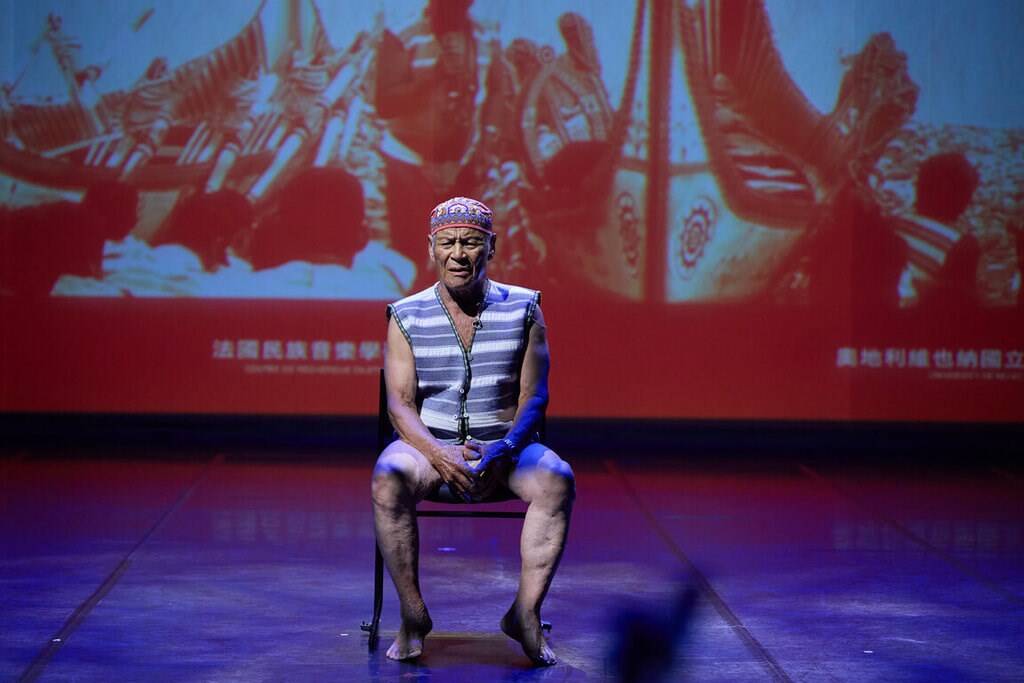
Photo courtesy of the Taiwan Music Institute
The effort centers on a 50-year archive compiled by French anthropologist Veronique Arnaud, who conducted long-term fieldwork among the Tao people on Orchid Island, located off Taiwan’s southeastern coast.
Arnaud, a leading Southeast Asia expert who lived for years in Langdao (Iraraley) Village, donated more than 500 hours of recordings to CNRS in 2013, TMI said.
TMI said that Arnaud passed away in 2022, and some of her recordings have not yet been translated or studied, which prompted this new collaboration.
Under authorization from CNRS, the audio files would be made available on TMI’s online platform, while ARC would be involved in the translation of the recordings, the institute said.
TMI added that the team is to incorporate handwritten song manuscripts collected by ethnomusicologist Chien Shan-hua (錢善華) and cultural worker Syaman Vengayen (郭健平).
At a news conference yesterday, Tao elder Syapen Meylamney sang a traditional song.
This was followed by other members of the indigenous community performing the traditional “Hair Dance,” which typically features Tao women gracefully swinging their long hair.
Speaking at the event, Syaman Vengayen described Arnaud as “a member of the tribe” and said Tao culture must never be overlooked or allowed to disappear.
Chen Yue-yi (陳悅宜), director of the National Center for Traditional Arts which oversees the institute, said the songs reflect the Tao people’s wisdom and collective memory.
Christian Helbig, head of the Austrian Office Taipei, said Austria places a high value on preserving musical culture and called the collaboration a valuable opportunity for international exchange and innovation.
Clea Le Cardeur, deputy director of the French Office in Taipei, said Arnaud’s lifelong commitment to Orchid Island was key to the project’s launch and thanked all participating parties.
Lin Wei-ya (林維亞), who is leading the project, said the research is to proceed in three phases.
The team would first build a song database and keyword system, then analyze the music and finally create a classification framework rooted in indigenous perspectives, along with publication and platform development to support knowledge sharing and cultural preservation.


UPGRADE: The Kang Ding-class frigate is replacing its Chaparall missiles with Tien Chien II and Hua Yang VLS, which would provide it with long-range, 360° air defense Taiwan plans to produce 1,200 to 1,376 Hai Chien II missiles (海劍二, Sea Sword II) — also known as TC-2N — to serve as the standard air defense system of the navy’s surface combatant fleet, a source said yesterday. Last week, the Hai Chien II, the naval version of the Tien Kung II missile (天劍二, Sky Sword II), completed a live-fire test in waters off the National Chungshan Institute of Science and Technology’s Jiupeng facility (九鵬) in Pingtung County’s Manjhou Township (滿州). The MIM72 Chaparral and other dated air defense missiles that currently arm Taiwanese ships have inadequate range to combat Chinese

REASONS FOR TRAVEL: An assistant professor said that proposed amendments to penalize drivers if they used drugs overseas would not deter people from traveling People who operate a motor vehicle under the influence of marijuana would have their driver’s license revoked, even if they used the substance while overseas, the Ministry of Transportation and Communications said yesterday, citing proposed amendments to the Road Traffic Management and Penalty Act (道路交通管理處罰條例). The amendments would also authorize the government to revoke the licenses of people determined to have used Category 1 or Category 2 narcotics, even if they were not operating a vehicle while under the influence of drugs, as well as ban them from taking the license test for three years, the ministry said. People aged 18 or

Johanne Liou (劉喬安), a Taiwanese woman who shot to unwanted fame during the Sunflower movement protests in 2014, returned to Taiwan last night after being deported from the US. She is to stand trial in Taiwan for charges involving embezzlement, fraud and drug crimes. The Criminal Investigation Bureau (CIB) said it took her into custody at Taiwan Taoyuan International Airport and would first question her before transferring her to the New Taipei District Prosecutors’ Office. She was arrested upon disembarking a flight from San Francisco that landed shortly before 7pm. Liou absconded to the US in 2019 after jumping bail

Shih Hsin University President Chen Ching-he (陳清河) yesterday issued a public apology for comments made in his commencement speech last week, stating that he has asked the school to suspend his duties and halt his wages for two months as a show of contrition. At the commencement ceremony on May 30, Chen said, “If you don’t manage your time well, or your own emotions, or your health, then I am telling every one of you — put a quick end to ‘you,’ because the world has no need for ‘you.’” The comments have sparked significant controversy online, and Chen through an open


 RSS
RSS