


People aged 80 or older would be allowed to hire foreign caregivers without undergoing a health evaluation, according to amendments to the Employment Service Act (就業服務法) to take effect on Friday.
The amendment to Article 46 of the act allows employers to hire live-in foreign caregivers for people aged 80 or older, or those aged 70 to 79 diagnosed with cancer at stage 2 or above, without requiring a health evaluation by a medical institution.
Some civic groups have expressed concern that the new policy might have a negative effect on the families of critically ill people or those with disabilities hiring foreign caregivers, as workers might prefer caring for elderly people.
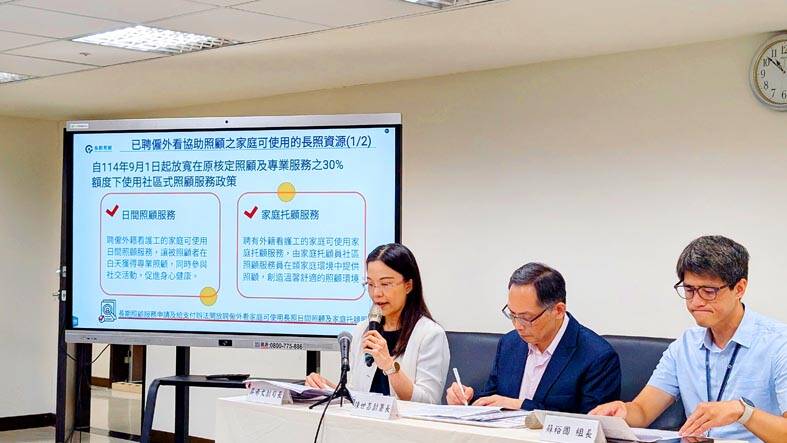
Photo: CNA
People with disabilities, rare diseases or dementia, as well as elderly people with severe impairments, might have to compete with more healthy or slightly frail elderly people to hire caregivers and be forced to pay higher wages, civil organizations and a lawmaker said on Monday.
The Ministry of Labor yesterday unveiled measures that officials said would help protect the welfare of 197,000 families that hire foreign workers to take care of critically ill family members.
There are 580,000 healthy or partly healthy elderly people in Taiwan, and 120,000 people aged 70 to 79 with stage 2 cancer, the ministry said, citing government data, adding that the law is expected to result in 100,000 new applicants for foreign caregivers.
It is heading a multi-ministerial workforce to establish a mechanism to separate applicants who are severely ill from those who are moderately sick to prioritize the former in authorizing foreign care workers to enter Taiwan, the ministry said.
Fewer people who are critically ill would have to undergo a Barthel index evaluation to hire a live-in foreign care worker, it said.
People with stage 4 cancer of any type, paralysis that prevents them from getting up without assistance and those who have been authorized to hire foreign carers may use a medical certificate issued the same year to renew their permit without an evaluation, it said.
The amendments would prioritize families with critically ill members to obtain permission to hire caregivers from abroad and allow them to employ foreigners who originally entered Taiwan for other types of work, it said.
A foreign worker can become a caregiver by completing 20 hours of mandatory training, it said.
The ministry would establish a service center to match families to available migrant workers, it said.
It would work with Indonesia, Vietnam, Thailand and the Philippines to increase the number of inbound migrant workers and the vocational training they received, the ministry said.
The labor ministry and the Ministry of Foreign Affairs are to prioritize the paperwork to certify foreign workers designated for families with critically ill members over other cases, it said.
The government would assign 188 additional civil servants to process foreign caregiver applications from such families, it said.
The ministry is to add NT$1.18 billion (US$39.72 million) to a fund to provide short-term care to alleviate the burden on the families of people who are critically ill until a permanent worker can be employed, it said.
It would publish a handbook of essential knowledge for employers of foreign carers and expand the information on its public Line account, it said.

Considering that most countries issue more than five denominations of banknotes, the central bank has decided to redesign all five denominations, the bank said as it prepares for the first major overhaul of the banknotes in more than 24 years. Central bank Governor Yang Chin-lung (楊金龍) is expected to report to the Legislative Yuan today on the bank’s operations and the redesign’s progress. The bank in a report sent to the legislature ahead of today’s meeting said it had commissioned a survey on the public’s preferences. Survey results showed that NT$100 and NT$1,000 banknotes are the most commonly used, while NT$200 and NT$2,000

The Centers for Disease Control (CDC) yesterday reported the first case of a new COVID-19 subvariant — BA.3.2 — in a 10-year-old Singaporean girl who had a fever upon arrival in Taiwan and tested positive for the disease. The girl left Taiwan on March 20 and the case did not have a direct impact on the local community, it said. The WHO added the BA.3.2 strain to its list of Variants Under Monitoring in December last year, but this was the first imported case of the COVID-19 variant in Taiwan, CDC Deputy Director-General Lin Ming-cheng (林明誠) said. The girl arrived in Taiwan on

ANNUAL EVENT: Two massive Pokemon balloons are to be set up in Daan Park, with an event zone operating from 10am to 6pm This year’s Taipei Floral Picnic is to be held at Daan Park today and tomorrow, featuring an exclusive Pokemon Go event, a themed food market, a coffee rave picnic area and stage performances, the Taipei Department of Information and Tourism said yesterday. Two massive Pokemon balloons are to be set up in the park as attractions, with an exclusive event zone operating from 10am to 6pm, it said. Participants who complete designated tasks on-site would have a chance to receive limited-edition souvenirs, it added. People could also try the newly launched game Pokemon Pokopia in the trial area, the department said. Three PokeStops are

South Korea is planning to revise its controversial electronic arrival card, a step Taiwanese officials said prompted them to hold off on planned retaliatory measures, a South Korean media report said yesterday. A Yonhap News Agency report said that the South Korean Ministry of Foreign Affairs is planning to remove the “previous departure place” and “next destination” fields from its e-arrival card system. The plan, reached after interagency consultations, is under review and aims to simplify entry procedures and align the electronic form with the paper version, a South Korean ministry official said. The fields — which appeared only on the electronic form


 RSS
RSS