


A new Taiwanese TV series that imagines the run-up to a Chinese invasion is getting rave reviews from viewers, who said that the program featuring the sensitive topic is a wake-up call for the public facing heightened Chinese military threat.
In the show Zero Day Attack (零日攻擊), a Chinese war plane goes missing near Taiwan. China then sends swarms of military boats and planes for a blockade, as Taiwan goes on a war footing. Panic ensues on the streets of Taipei.
At viewings in Taipei last week, attendees included American Institute in Taiwan Director Raymond Greene and United Micro Electronics Corp founder Robert Tsao (曹興誠), a strident critic of Beijing.
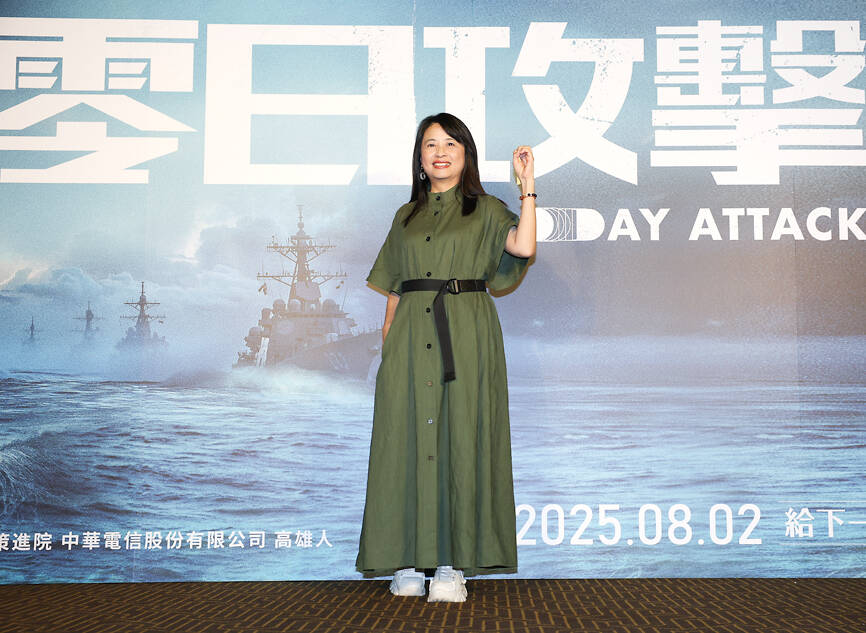
Photo: CNA
The series is set to premiere on Saturday in Taiwan, followed by its Japanese release on Amazon Prime Video.
“Presenting such a situation [of conflict] can lead to more discussion about what we should do if it really turns into reality one day,” said Blair Yeh, a 35-year-old engineer, after watching the first episode in the Taipei premier last week.
The premise of Zero Day Attack is a topic that has for years been considered too sensitive for many Taiwanese filmmakers and TV show creators, who fear losing access to the lucrative Chinese entertainment market.
More than half of the show’s crew asked to remain anonymous, and some people, including a director, pulled out of the production at the last minute, showrunner Cheng Hsin-mei (鄭心媚) said.
However, as China steps up military threats, including at least six rounds of major war games over the past five years and daily military activities close to Taiwan, the upcoming drama confronts the fear by setting the 10-episode series around a Chinese invasion of Taiwan.
The drama focuses on several scenarios Taiwan might face in the days leading up to a Chinese attack, including a global financial collapse, the activation of Chinese sleeper agents and panicked residents trying to flee the nation.
In the show’s trailer, the fictional Taiwanese president says in a televised speech that “without freedom, Taiwan is not Taiwan,” urging unity after declaring war on China. The live broadcast then gets abruptly cut off, replaced by a feed of a Chinese state television anchor calling for Taiwanese to surrender and to report “hidden pro-independence activists” to Chinese soldiers after they land on Taiwan.
“We have been comfortable for a long time now,” said Leon Yu, a 43-year-old semiconductor industry professional, adding that Taiwan’s freedom and democracy must be kept. “There is still a lot of people out there burying their head in the sand who do not want to face the dangers of the present.”

FUKUOKA SITUATION: Japanese media reported that the pathogen is expected to be identified by the summer, while the CDC downplayed the idea that it was hMPV A “mysterious cold-like illness” reported in Japan’s Fukuoka Prefecture does not seem to be a new disease, but Japanese authorities have been asked about the situation, the Centers for Disease Control (CDC) said yesterday. The Fukuoka Prefectural Medical Association on Wednesday told a news conference that a “mystery cold” that has become a hot topic on social media is “highly likely to be caused by some kind of viral infection,” Japan’s KBC News reported. “Many people are experiencing symptoms starting with a sore throat, followed by a runny nose, phlegm and a severe cough,” KBC News reported, citing association officials. Health authorities are

Nvidia Corp CEO Jensen Huang (黃仁勳) arrived in Taiwan yesterday ahead of upcoming AI and technology events, saying he plans to meet with clients and Taiwan Semiconductor Manufacturing Co Chairman C.C. Wei (魏哲家) during his visit. After landing at Taipei Songshan Airport, Huang posed for photos with fans and handed out Yakult drinks to reporters and supporters waiting at the scene, saying he has “a lot to do” during the trip. Asked about reports that Nvidia’s planned headquarters site in Taipei’s Beitou Shilin Technology Park could break ground on May 27, Huang said that if the company holds an event, he would

The Ministry of Finance this afternoon announced the winning numbers for the March-April uniform invoice lottery. The winning number for the NT$10 million (US$318,060) special prize is 19531471, and the winning number for the NT$2 million grand prize is 85941329. Three numbers were drawn for the NT$200,000 first prize: 07225810, 20231230 and 83518781. Those with receipts matching the last seven digits of any of the first-prize numbers will win the NT$40,000 second prize, while those matching the last six digits will win the NT$10,000 third prize. Those whose receipts match the last five digits of the first-prize numbers can claim the NT$4,000 fourth prize,

SIX SUBSIDIES: The monthly allowance for older farmers is to increase to NT$10,000, and NT$5,000 is to be given to homemakers under the national pension system, Lai said The government is to implement major welfare policies for disadvantaged groups, including raising the monthly allowance for older farmers to NT$10,000 and providing homemakers with NT$5,000 per month, President William Lai (賴清德) said yesterday. Lai made the remarks during a visit to Wangling Temple in Chiayi County, saying that the planned increases were being introduced amid economic growth and an increase in tax revenue. Touting a policy, in which the government plans to provide a monthly allowance of NT$5,000 for every child under the age of 18 in a bid to address Taiwan’s low birthrate, Lai said that if received for the


 RSS
RSS