


As of Wednesday, nearly 90 percent of Chinese spouses married to Taiwanese have complied with a requirement to provide evidence they have officially given up their household registration in China, while 10 chose to give up their Taiwanese household registration, the Mainland Affairs Council (MAC) said.
The 10 accounted for just 0.0008 percent of the 12,156 Chinese spouses tracked by the council, MAC Deputy Minister Liang Wen-chieh (梁文傑) said.
They gave up their household registration for various reasons, including death of their Taiwanese spouse, access to social welfare in China and inheritance rights, he said.
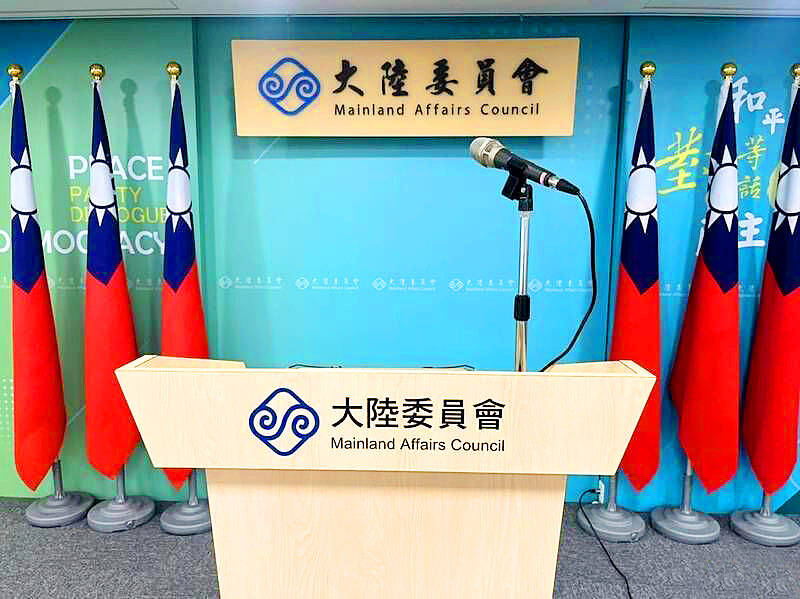
Photo: Taipei Times
The National Immigration Agency in early April sent notices to some Chinese spouses requesting that they submit proof of having renounced their household registration in China within three months of receiving the notice.
The Act Governing Relations Between the People of the Taiwan Area and the Mainland Area (臺灣地區與大陸地區人民關係條例) states that “the people of the Taiwan Area may not have household registrations in the Mainland Area.”
Those who contravene this provision “shall be deprived of its status as the people of the Taiwan area,” it says.
Those who lose their “Taiwan status,” meaning their household registration in Taiwan, will also lose their Taiwanese citizenship, Liang said in April.
The council said 6,569 Chinese spouses have submitted proof that they have renounced their Chinese household registration.
Another 4,287 who qualified for exemptions or deferrals — such as those with serious illnesses or injuries — have submitted affidavits instead, Liang said.
Meanwhile, 1,290 Chinese spouses identified by the council have either not yet been contacted or have not responded, he said, adding that the council would not revoke their household registration until they have been successfully reached.
All figures are expected to rise as the review process continues, Liang added.

SPACE VETERAN: Kjell N. Lindgren, who helps lead NASA’s human spaceflight missions, has been on two expeditions on the ISS and has spent 311 days in space Taiwan-born US astronaut Kjell N. Lindgren is to visit Taiwan to promote technological partnerships through one of the programs organized by the US for its 250th national anniversary. Lindgren would be in Taiwan from Tuesday to Saturday next week as part of the US Bureau of Educational and Cultural Affairs’ US Speaker Program, organized to celebrate the 250th anniversary of the signing of the Declaration of Independence, the American Institute in Taiwan (AIT) said in a statement yesterday. Lindgren plans to engage with key leaders across the nation “to advance cutting-edge technological partnerships and inspire the next generation of scientists and engineers,”

UNREASONABLE SURVEILLANCE: A camera targeted on an road by a neighbor captured a man’s habitual unsignaled turn into home, netting him dozens of tickets The Taichung High Administrative Court has canceled all 45 tickets given to a man for failing to use a turn signal while driving, as it considered long-term surveillance of his privacy more problematic than the traffic violations. The man, surnamed Tseng (曾), lives in Changhua County and was reported 45 times within a month for failing to signal while driving when he turned into the alley where his residence is. The reports were filed by his neighbor, who set up security cameras that constantly monitored not only the alley but also the door and yard of Tseng’s house. The surveillance occurred from July

A Japan Self-Defense Forces vessel entered the Taiwan Strait yesterday, Japanese media reported. After passing through the Taiwan Strait, the Ikazuchi was to proceed to the South China Sea to take part in a joint military exercise with the US and the Philippines, the reports said. Japan Self-Defense Force vessels were first reported to have passed through the strait in September, 2024, with two further transits taking place in February and June last year, the Asahi Shimbun reported. Yesterday’s transit also marked the first time since Japanese Prime Minister Sanae Takaichi took office that a Japanese warship has been sent through the Taiwan

‘SAME OLD TRICK’: Even if Beijing resumes individual travel to Taiwan, it would only benefit Chinese tourism companies, the Economic Democracy Union convener said China’s 10 new “incentives” are “sugar-coated poison,” an official said yesterday, adding that Taiwanese businesses see them clearly for what they are, but that Beijing would inevitably find some local collaborators to try to drums up support. The official, speaking on condition of anonymity, made the remark ahead of a news conference the General Chamber of Commerce is to hold today. The event, titled “Industry Perspectives on China’s Recent Pro-Taiwan Policies,” is expected to include representatives from industry associations — such as those in travel, hotels, food and agriculture — to request the government cooperate with China’s new measures, people familiar with


 RSS
RSS