


A large majority of Americans support the US militarily defending Taiwan should the latter face invasion or blockade from China, according to a recent survey by the Ronald Reagan Presidential Foundation and Institute (RRPFI).
The RRPFI said that the survey, released on June 22, showed that 75 percent of Americans believed a war between China and Taiwan would affect US security and prosperity.

Photo: Reuters
In addition, 70 percent of respondents supported the US taking military actions to defend Taiwan if China were to invade or blockade it, the RRPFI said.
Backing for military action is bipartisan, with 75 percent of Democrats and 70 percent of Republicans supporting such a response, according to the RRPFI survey.
Some of the top reasons for why survey respondents were more likely to support committing to defend Taiwan include: Taiwan is one of the world's largest producers of semiconductors (71 percent); and defending Taiwan is critical for the defense of other allies such as Japan, South Korea and the Philippines (70 percent).
Other reasons include that if Taiwan is not defended, it would send a message to China and other adversaries that the US is not willing to stand up for its friends (70 percent).
The RRPFI's latest survey also reveals Americans are showing increasing support for a stronger US role in global affairs and a commitment to the US' allies in the Middle East, Europe and Asia, the organization said in a news release.
The survey shows a sharp 24-point increase since 2022 in Americans who believe the US should be more engaged and take the lead in international events, including majorities of Republicans (69 percent) and self-identified MAGA Republicans (73 percent).
At the top of the list of geopolitical concerns is Iran, with a supermajority of Americans (84 percent) who want to prevent the Islamic Republic from obtaining nuclear weapons, and a plurality (45 percent) who support Israel conducting targeted airstrikes against Iran's nuclear facilities.
"These results demonstrate Americans continue to believe in President Reagan's vision of 'peace through strength,'" said Roger Zakheim, director of the Ronald Reagan Institute.
"Across party lines, Americans see US international leadership both as a strategic necessity and a moral obligation. They understand the US cannot remain secure or prosperous by retreating from the world," Zakheim was quoted as saying in the RRPFI news release.
The survey was conducted between May 27 and June 2 this year by a bipartisan research team at Beacon Research and Shaw & Company Research, according to the RRPFI.
It is based on a sample size of 1,257 respondents reflecting the demographics of the country, including 478 telephone interviews, split between cell phones and landlines, and 779 online surveys, it added.

The military has spotted two Chinese warships operating in waters near Penghu County in the Taiwan Strait and sent its own naval and air forces to monitor the vessels, the Ministry of National Defense (MND) said. Beijing sends warships and warplanes into the waters and skies around Taiwan on an almost daily basis, drawing condemnation from Taipei. While the ministry offers daily updates on the locations of Chinese military aircraft, it only rarely gives details of where Chinese warships are operating, generally only when it detects aircraft carriers, as happened last week. A Chinese destroyer and a frigate entered waters to the southwest
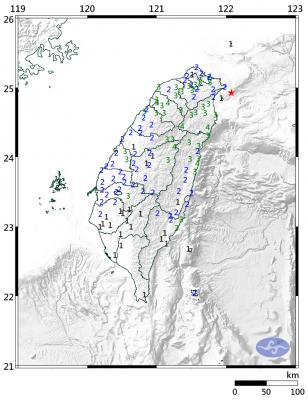
A magnitude 6.1 earthquake struck off the coast of Yilan County at 8:39pm tonight, the Central Weather Administration (CWA) said, with no immediate reports of damage or injuries. The epicenter was 38.7km east-northeast of Yilan County Hall at a focal depth of 98.3km, the CWA’s Seismological Center said. The quake’s maximum intensity, which gauges the actual physical effect of a seismic event, was a level 4 on Taiwan’s 7-tier intensity scale, the center said. That intensity level was recorded in Yilan County’s Nanao Township (南澳), Hsinchu County’s Guansi Township (關西), Nantou County’s Hehuanshan (合歡山) and Hualien County’s Yanliao (鹽寮). An intensity of 3 was

Japanese Prime Minister Sanae Takaichi’s comment last year on Tokyo’s potential reaction to a Taiwan-China conflict has forced Beijing to rewrite its invasion plans, a retired Japanese general said. Takaichi told the Diet on Nov. 7 last year that a Chinese naval blockade or military attack on Taiwan could constitute a “survival-threatening situation” for Japan, potentially allowing Tokyo to exercise its right to collective self-defense. Former Japan Ground Self-Defense Force general Kiyofumi Ogawa said in a recent speech that the remark has been interpreted as meaning Japan could intervene in the early stages of a Taiwan Strait conflict, undermining China’s previous assumptions
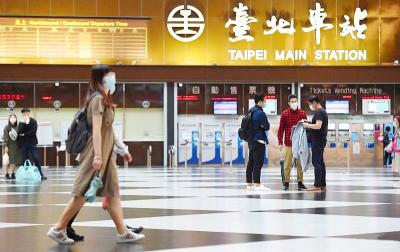
Taiwan Railways Corp (TRC) today announced that Shin Kong Mitsukoshi has been selected as the preferred bidder to operate the Taipei Railway Station shopping mall, replacing the current operator, Breeze Development Co Ltd. Among eight qualified firms that delivered presentations and were evaluated by a review committee, Shin Kong Mitsukoshi was ranked first, while Breeze was named the runner-up, the rail company said in a statement. Contract negotiations are to proceed in accordance with regulations, it said, adding that if negotiations with the top bidder fail, it could invite the second-ranked applicant to enter talks. Breeze in a statement today expressed doubts over


 RSS
RSS