


Up to 37 million tonnes of carbon emissions from animal food product consumption were not included in the National Greenhouse Gas Inventory last year, sustainability groups said yesterday, urging the government to establish a standardized carbon footprint labeling system to facilitate consumer choice.
Taiwan People’s Party Legislator Chen Gau-tzu (陳昭姿) convened a news conference along with sustainability group representatives, calling on the government to extend carbon labels to all food products sold in supermarkets and restaurants in line with global trends.
Changing dietary habits is indispensable to net zero transition, given that nearly one-quarter of global greenhouse gas emissions are generated from agriculture and animal husbandry, Chen said, citing data from the Food and Agriculture Organization.

Photo: Fang Pin-chao, Taipei Times
“We are seeking for carbon emissions to become visible [to consumers] so that everyone in society would be empowered to take carbon reduction actions,” she said.
Sustainable Healthy Diets Research Institute director-general Chang You-chuan (張祐銓) urged the Ministry of Environment (MOENV) and the Ministry of Agriculture (MOA) to integrate their variant carbon labels and emission factors for each category of food and agricultural products.
Current carbon labels are difficult for consumers to make comparisons, as they use various measurement units, such as per box, per piece, per gram or per tonne, to quantify carbon emissions regardless of product types, he said.
Meat Free Monday Taiwan secretary-general Chang Chia-pei (張家珮) said the agriculture sector’s actual carbon emissions were estimated to be much higher than the 2 percent listed in the inventory published last year, which only included emissions from domestic food production.
However, more than 80 percent of meat products and almost all animal feed were imported, but emissions from overseas feed production and meat product logistics, as well as local food processing and cold-chain logistics, were not taken into account, leading to a seriously underestimated amount of diet emissions, she said.
Calculated based on life-cycle assessments that consider emissions from production to waste, emissions from animal food product consumption by Taiwanese were 37 million tonnes last year, accounting for nearly 12 percent of total emissions in Taiwan, Chang Chia-pei said.
She also cited Carrefour France’s example of quantifying emissions as levels from A to E to help consumers choose environmentally friendly products, calling for establishment of a similar emissions labeling system by the government to align with international carbon disclosure standards.
Taiwan Water Resources Conservation Union chairwoman Chen Jiau-hua (陳椒華) called for interagency collaboration in developing a common methodology for quantifying carbon footprints and to put forward an initial plan within two months.
MOENV Climate Change Administration secretary-general Chang Wen-hsing (張文興) said that starting this year, the ministry has been promoting the grading mechanism for carbon footprint labeling to provide a more standardized labeling system for consumers, with business operators required to apply graded carbon labels to their products in compliance with climate regulations.
The MOA’s Department of Resources Sustainability said that the ministry has established emission factors for most agricultural, fishery and animal products according to the MOENV’s guidelines, and would cooperate with the environmental ministry in standardizing carbon labels.
It has also been developing a credible carbon footprint verification mechanism to support the labeling system, with the Agricultural Technology Research Institute as the verification service provider for last year, it said.
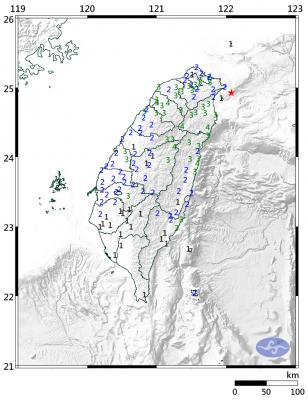
A magnitude 6.1 earthquake struck off the coast of Yilan County at 8:39pm tonight, the Central Weather Administration (CWA) said, with no immediate reports of damage or injuries. The epicenter was 38.7km east-northeast of Yilan County Hall at a focal depth of 98.3km, the CWA’s Seismological Center said. The quake’s maximum intensity, which gauges the actual physical effect of a seismic event, was a level 4 on Taiwan’s 7-tier intensity scale, the center said. That intensity level was recorded in Yilan County’s Nanao Township (南澳), Hsinchu County’s Guansi Township (關西), Nantou County’s Hehuanshan (合歡山) and Hualien County’s Yanliao (鹽寮). An intensity of 3 was

Instead of focusing solely on the threat of a full-scale military invasion, the US and its allies must prepare for a potential Chinese “quarantine” of Taiwan enforced through customs inspections, Stanford University Hoover fellow Eyck Freymann said in a Foreign Affairs article published on Wednesday. China could use various “gray zone” tactics in “reconfiguring the regional and ultimately the global economic order without a war,” said Freymann, who is also a nonresident research fellow at the US Naval War College. China might seize control of Taiwan’s links to the outside world by requiring all flights and ships entering or leaving Taiwan

The next minimum wage hike is expected to exceed NT$30,000, President William Lai (賴清德) said yesterday during an award ceremony honoring “model workers,” including migrant workers, at the Presidential Office ahead of Workers’ Day today. Lai said he wished to thank the awardees on behalf of the nation and extend his most sincere respect for their hard work, on which Taiwan’s prosperity has been built. Lai specifically thanked 10 migrant workers selected for the award, saying that although they left their home countries to further their own goals, their efforts have benefited Taiwan as well. The nation’s industrial sector and small businesses lay
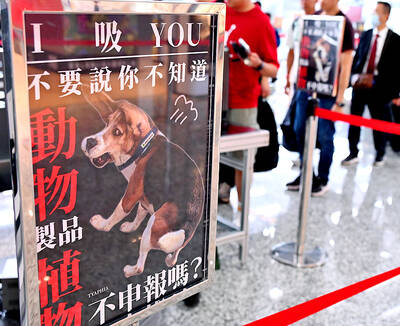
Quarantine awareness posters at Taiwan Taoyuan International Airport have gone viral for their use of wordplay. Issued by the airport branch of the Animal and Plant Health Inspection Agency, the posters feature sniffer dogs making a range of facial expressions, paired with advisory messages built around homophones. “We update the messages for holidays and campaign needs, periodically refreshing materials to attract people’s attention,” quarantine officials said. “The aim is to use the dogs’ appeal to draw focus to quarantine regulations.” A Japanese traveler visiting Taiwan has posted a photo on X of a poster showing a quarantine dog with a


 RSS
RSS