


Taipei police today said they have referred a woman for further investigation, after she was found allegedly livestreaming an elementary school on Chinese social media.
It is the first time an influencer is being investigated for criminal liability amid a spate of recent cases involving livestreaming of schoolchildren in Taiwan for Chinese social media.
Earlier this month, Democratic Progressive Party Taipei City Councilor Hsu Shu-hua (許淑華) posted on Facebook that she had received reports of a person allegedly filming children at a school in Taipei’s Minsheng community (民生社區).
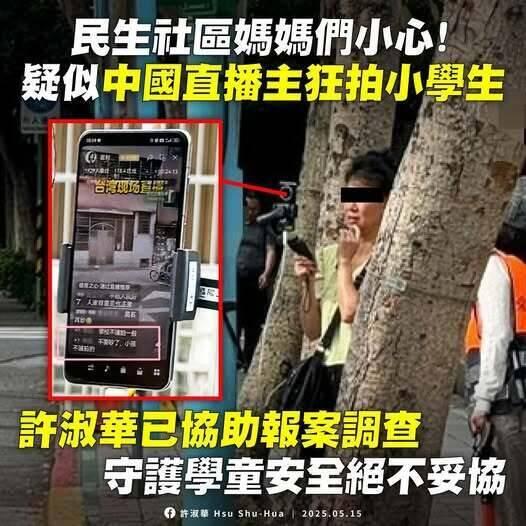
Photo from Hsu Shu-hua’s Facebook
The livestream on China’s Douyin (抖音) said it was footage of life in Taiwan and introduced the surrounding neighborhood, Hsu said.
Parents and volunteers at the school repeatedly asked the woman to stop filming, but she did not stop until they reported her to police, she added.
The Taipei Police Department's Songshan precinct said it received a report of the situation at about 8am on May 15, but the woman had already left by the time officers arrived.
Media reported that police after reviewing security footage found the woman to be a 52-year-old Chinese spouse surnamed Liu (劉) who lives near the school.
When she was summoned by police on May 16, Liu told them she just wanted to share a livestream of daily life in Taiwan.
Police today said they opened an investigation after Hsu filed a complaint, and have forwarded the case to the Taipei District Prosecutors’ Office and city government for further investigation and follow-up measures.
The woman is suspected of breaching privacy law as well as the Protection of Children and Youths Welfare and Rights Act (兒童及少年福利與權益保障法), police said.
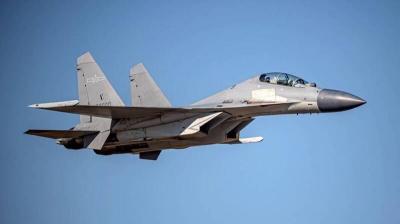
Eight Chinese naval vessels and 24 military aircraft were detected crossing the median line of the Taiwan Strait between 6am yesterday and 6am today, the Ministry of National Defense said this morning. The aircraft entered Taiwan’s northern, central, southwestern and eastern air defense identification zones, the ministry said. The armed forces responded with mission aircraft, naval vessels and shore-based missile systems to closely monitor the situation, it added. Eight naval vessels, one official ship and 36 aircraft sorties were spotted in total, the ministry said.
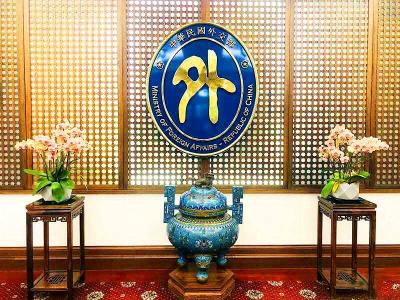
The Ministry of Foreign Affairs (MOFA) today said that if South Korea does not reply appropriately to its request to correct Taiwan’s name on its e-Arrival card system before March 31, it would take corresponding measures to alter how South Korea is labeled on the online Taiwan Arrival Card system. South Korea’s e-Arrival card system lists Taiwan as “China (Taiwan)” in the “point of departure” and “next destination” fields. The ministry said that it changed the nationality for South Koreans on Taiwan’s Alien Resident Certificates from “Korea” to “South Korea” on March 1, in a gesture of goodwill and based on the

Taiwanese officials were shown the first of 66 F-16V fighter jets purchased by Taiwan from the United States, the Ministry of National Defense said yesterday, adding the aircraft has completed an initial flight test and is expected to be delivered later this year. A delegation led by Deputy Minister of National Defense Hsu Szu-chien (徐斯儉) visited Lockheed Martin’s F-16 C/D Block 70 (also known as F-16V) assembly line in South Carolina on March 16 to view the aircraft. The jet will undergo a final acceptance flight in the US before being delivered to Taiwan, the
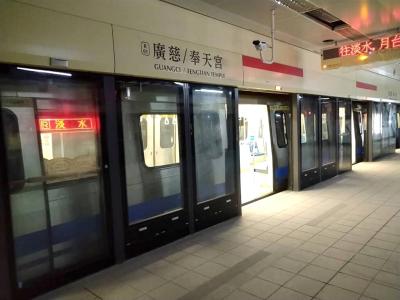
The New Taipei Metro's Sanyin Line and the eastern extension of the Taipei Metro's Tamsui-Xinyi Line (Red Line) are scheduled to begin operations in June, the National Development Council said today. The Red Line, which terminates at Xiangshan Station, would be connected by the 1.4km extension to a new eastern terminal, Guangci/Fengtian Temple Station, while the Sanyin Line would link New Taipei City's Tucheng and Yingge stations via Sanxia District (三峽). The council gave the updates at a council meeting reviewing progress on public construction projects for this year. Taiwan's annual public infrastructure budget would remain at NT$800 billion (US$25.08 billion), with NT$97.3


 RSS
RSS