


Taiwanese indie band Sunset Rollercoaster and South Korean outfit Hyukoh collectively received the most nominations at this year’s Golden Melody Awards, earning a total of seven nods from the jury on Wednesday.
The bands collaborated on their 2024 album AAA, which received nominations for best band, best album producer, best album design and best vocal album recording.
“Young Man,” a single from the album, earned nominations for song of the year and best music video, while another track, “Antenna,” also received a best music video nomination.

Photo grab from facebook.com/sunsetrollercoaster
Late Hong Kong-American singer Khalil Fong (方大同) was named the jury award winner for his 2024 album The Dreamer (夢想家), which has also received a nomination for best Mandarin album.
He was also nominated for song of the year, best composer, and best lyricist for the track “Twenty Three” (才 二十三).
On March 1, Fong’s talent agency announced that the singer had died on Feb. 21 after years of poor health.

Photo: CNA
The nominees in the Mandarin male singer category are PoLin (柏霖), Ricky Hsiao (蕭煌奇), Terence Lam (林家謙), Trout Fresh (real name Lu Shih-hsuan 呂士軒) and Li Ronghao (李榮浩).
Tanya Chua (蔡健雅), Penny Tai (戴佩妮), Vicky Chen (陳忻玥), Karencici (林愷倫) and Waa Wei (魏如萱) are nominated for best Mandarin female singer.
Meanwhile, 23 albums across the Mandarin, Hakka, Taiwanese and Indigenous-language categories have been shortlisted for the coveted album of the year award.

Photo:Taipei Times
The jury also named Taiwanese composer-producer Weng Xiao-liang (翁孝良) and the late Taiwanese singer Ma Chao-chun (馬兆駿) as winners of the special contribution award.
Weng made his debut on Taiwan’s music scene in the 1960s, quickly establishing himself as one of the country’s finest guitar players. He wrote several well-known classics, including “My Future is Not a Dream” (我的未來不是夢), “Dreamland” (夢田) and “Devotion” (奉獻).
He is also credited with discovering young talent who would later become household names in Taiwan, including Tom Chang (張雨生), Yuki Hsu (徐懷鈺) and Matilda Tao (陶晶瑩).
Ma was a mainstay of Taiwan’s “campus folk songs” movement from the 1970s to the early 1980s, during which he notably composed folk classics such as “Kapok Road” (木棉道) and “July, At the Liang Mountain” (七月涼山) with songwriting partner Hung Kuang-ta (洪光達).
Ma also produced albums for several superstars, including Liu Wen-zheng (劉文正), Fong Fei-fei (鳳飛飛), and Tracy Huang (黃鶯鶯). His legacy continued into the 21st century, when he frequently served as a judge at singing contests to discover up-and-coming musical talent. He died in 2007.
Organizers announced this year’s nominees at a press event in Taipei on Wednesday. Vice Culture Minister Hsu Yi-chun (徐宜君) said the jury had a tough job reviewing 846 submissions across 27 categories.
Ting Hsiao-wen (丁曉雯), who heads the jury, said the submissions are marked by their diversity and ingenuity, representing a clear departure from traditional notions of songs.
Ting noted that many of the submissions are from overseas, highlighting Taiwan’s diverse pop music scene.
Ting added that the jury took into account the works’ artistic achievement, potential impact on the music industry and public reception when compiling a “balanced” list of nominees.
Now in its 36th year, the Golden Melody Awards, hosted by Taiwan’s Ministry of Culture, remain the most prestigious music awards in the Mandarin-speaking world. In 2014, Billboard described the awards as the “Grammys of the Mandarin pop world.”

NATIONAL SECURITY: Authorities are working to confirm the identities of the military personnel involved and investigating possible illegal conduct and regulatory violations Authorities are probing possible national security implications after Kinmen police and immigration officers on Sunday found a Chinese woman allegedly posing as a tourist while engaging in prostitution involving more than 10 military personnel. The woman, surnamed Chen (陳), has since been deported, authorities said, adding that investigators are still working to confirm the identities of those implicated, as the records only listed code names and aliases. The case stemmed from a report received by the Kinmen District Prosecutors’ Office on Friday last week from the Jinhu Precinct of the Kinmen County Police Bureau. On Sunday, police, along with the National Immigration

GLOBALGIVING: ‘ Caving to external pressure is not acceptable for an organization that has cultivated justice reform and human rights for 30 years,’ one NGO said A slew of non-government organizations (NGOs) have withdrawn from the GlobalGiving fundraising platform after it announced it would use “Chinese Taipei” instead of “Taiwan” from next month. The Taiwan Good Rice Association wrote on Facebook on Friday that it was informed on April 28 via a teleconference call of the change, which was made because the platform wanted to operate in China. Taiwan Good Rice is to terminate all cooperative relationships with GlobalGiving in response to the platform’s “unilateral and non-negotiable” decision to remove references to Taiwan, the NGO said. “Taiwan is in the official name of Taiwan Good Rice Association and the

HEAVY WEATHER: Typhoon Jangmi is due to crash straight into the Ryukyus as airlines look to shift flights to larger aircraft or cancel flights to Okinawa entirely Taiwan’s international air carriers announced flight adjustments over the weekend as Typhoon Jangmi is forecast to hit the Ryukyu Islands today and tomorrow. The Central Weather Administration (CWA) upgraded Jangmi from a tropical storm to a typhoon at 8am yesterday, with the eye located 580km south of Naha city. It was moving north at 19kph. Today, China Airlines’ CI-120, CI-121, CI-122 and CI-123 flights between Taoyuan and Naha, Okinawa, have been canceled as well as CI-132 and CI-133 between Kaohsiung and Naha. EVA Air’s BR-112, BR-113, BR-186 and BR-185 flights between Taoyuan and Naha are also canceled. Low-cost carrier Tigerair Taiwan canceled IT-230,
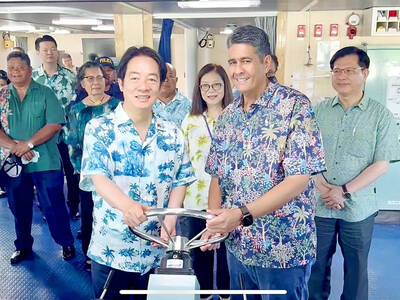
MULTIPRONGED APPROACH: China has sought to pressure Palau across a number of fronts, but the island nation has staunchly resisted overtures to ditch Taiwan Palau has been firm in backing Taiwan despite Chinese pressure that uses tourism economics, cyberattacks and criminal infiltration as tools to threaten the Pacific ally into renouncing its recognition of Taiwan as a sovereign state. The Presidential Office yesterday announced that Vice President Hsiao Bi-khim (蕭美琴) would visit Palau from Saturday to Wednesday next week at the invitation of Palauan President Surangel Whipps Jr. Whipps in April said in an interview that China had outspokenly asked Palau to “denounce Taiwan.” “And we have said: ‘We have no enemies, but nobody tells us who our friends are,’” he said. Whipps has told reporters multiple times


 RSS
RSS