


Former Dingyue Development Corp (鼎越開發) president Chu Yea-hu (朱亞虎) admitted yesterday to bribing former Taiwan People's Party (TPP) leader Ko Wen-je (柯文哲) in connection with a real estate development project during Ko's tenure as Taipei mayor 2014-2022.
Testifying as a witness before the Taipei District Court, Chu said he was responsible for delivering bribes to help the real estate company he worked for illegally boost the floor area ratio (FAR) of its Core Pacific City redevelopment project in Taipei’s Songshan District, in an effort to raise the property's value.
"I admit to bribery. I admit guilt," Chu told the court.
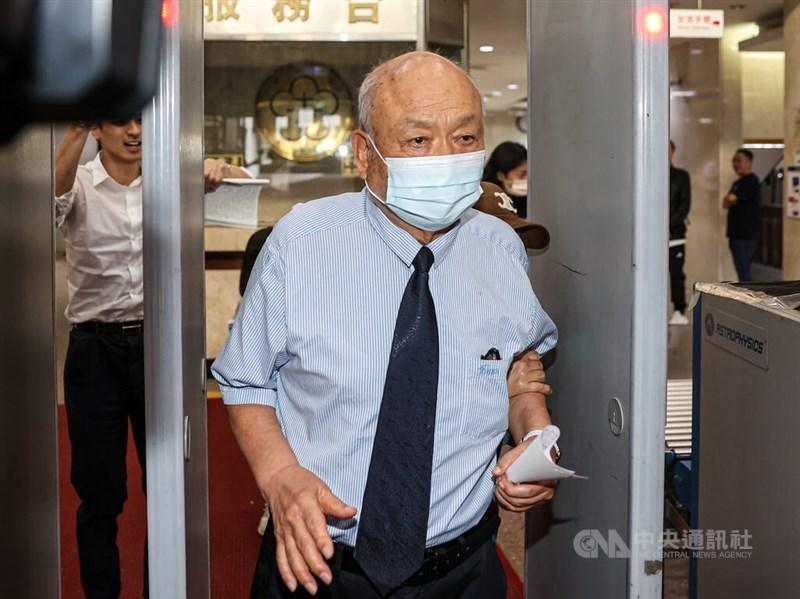
Photo: CNA
According to Chu, the scheme began about 18 months after he joined the Core Pacific Group, when chairman Sheen Ching-jing (沈慶京) instructed him to liaise with Ko, officials at the Taipei City Government Department of Urban Development and Taipei City councilors about the redevelopment project.
Chu said his first meeting with Ko was in May 2016, arranged through Tsai Pi-ru (蔡壁如), then director of the mayor's office, during which the development project was briefly discussed.
In February 2020, Chu said he arranged a meeting between Sheen and Ko through Tung Chin-yeh (董晉曄), then the mayor's confidential secretary.
Chu said he was not in the room during Sheen and Ko’s conversation which lasted for about an hour, but told the court: "If they didn't talk about the Core Pacific City case, what else could they have talked about?"
Chu testified that Sheen also directed him to direct NT$2.1 million (US$69,513.49) in political donations to the TPP under the names of Core Pacific Group employees. Although Sheen did not state the purpose of the donations, Chu believed they were related to the company's efforts to increase the project's FAR.
Chu received a deferred prosecution in exchange for his testimony and was ordered to pay NT$3.3 million to the public treasury within three months.
The Taipei District Prosecutors Office indicted Ko, Sheen and nine others in December on charges including bribery, embezzlement and breach of trust under the Anti-Corruption Act.
The other defendants in the case include Pong Cheng-sheng (彭振聲), former Taipei deputy mayor; Huang Ching-mao (黃景茂), former head of the Taipei City Government Department of Urban Development; and Shao Hsiu-pei (邵琇珮), executive secretary at the city government's Urban Planning Commission.
Also indicted were Kuomintang (KMT) Taipei City Councilor Ying Hsiao-wei (應曉薇), Ying's assistant Wu Shun-min (吳順民), Core Pacific supervisor Chang Chih-cheng (張志澄), Lee Wen-tsung (李文宗), then head of the mayor's office; Lee Wen-chuan (李文娟) chairperson of MuKo Public Relations, and accountant Tuanmu Cheng (端木正).
At the hearing yesterday, the court also summoned Ko, Sheen, Lee and Ying for cross-examination.
Among the observers in the courtroom were Ko's wife Chen Pei-chi (陳佩琪), TPP leader Huang Kuo-chang (黃國昌) and TPP lawmaker Huang Shan-shan (黃珊珊).
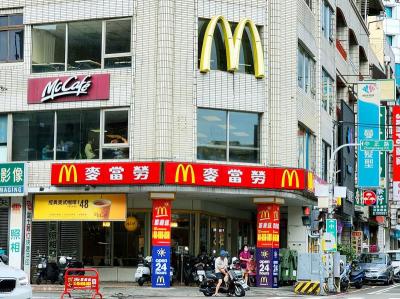
Fast food chain McDonald's is to raise prices by up to NT$5 on some products at its restaurants across Taiwan, starting on Wednesday next week, the company announced today. The prices of all extra value meals and sharing boxes are to increase by NT$5, while breakfast combos and creamy corn soup would go up by NT$3, the company said in a statement. The price of the main items of those meals, if ordered individually, would remain the same. Meanwhile, the price of a medium-sized lemon iced tea and hot cappuccino would rise by NT$3, extra dipping sauces for chicken nuggets would go up
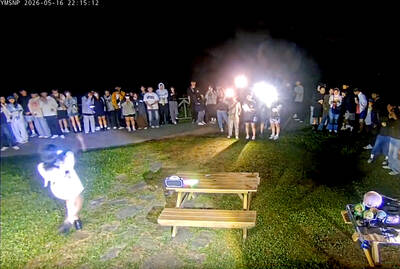
Yangmingshan National Park’s Qingtiangang (擎天崗) nature area has gone viral after a park livestream camera observed a couple in the throes of intimate congress, which was broadcast live on YouTube, drawing large late-night crowds and sparking a backlash over noise, bright lights and disruption to wildlife habitat. The area’s livestream footage appeared to show a couple engaging in sexual activity on a picnic table in the park on Friday last week, with the uncensored footage streamed publicly online. The footage quickly spread across social media, prompting a tide of visitors to travel to the site to “check in” and recreate the

Minister of Digital Affairs Lin Yi-ching (林宜敬) yesterday cited regulatory issues and national security concerns as an expert said that Taiwan is among the few Asian regions without Starlink. Lin made the remarks on Facebook after funP Innovation Group chief executive officer Nathan Chiu (邱繼弘) on Friday said Taiwan and four other countries in Asia — China, North Korea, Afghanistan and Syria — have no access to Starlink. Starlink has become available in 166 countries worldwide, including Ukraine, Malaysia, the Philippines and Vietnam, in the six years since it became commercial, he said. While China and North Korea block Starlink, Syria is not
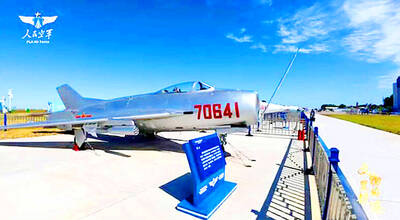
GROUNDED: A KMT lawmaker proposed eliminating drone development programs and freezing funding for counterdrone systems, despite China’s adoption of the technology China has deployed attack drones at air bases near the Taiwan Strait in a strategy aimed at overwhelming Taiwan’s air defense systems through saturation attacks, the Mainland Affairs Council (MAC) said. The council’s latest quarterly report on China said that satellite imagery and open-source intelligence indicate that the Chinese People’s Liberation Army (PLA) had converted retired J-6 fighter jets into J-6W drones, which the PLA has stationed at six air bases near Taiwan, five in China’s Fujian Province and one in Guangdong Province. The report cited J. Michael Dahm, a senior fellow at the US-based Mitchell Institute, as saying that China has


 RSS
RSS