


The nation is likely to have a hotter plum rain season after having experienced a colder and more humid spring, the Central Weather Administration (CWA) said yesterday.
The state-run meteorology agency issued its forecast for the plum rain season, which generally lasts from May to June.
It also concluded its weather observations for spring, which ends today.
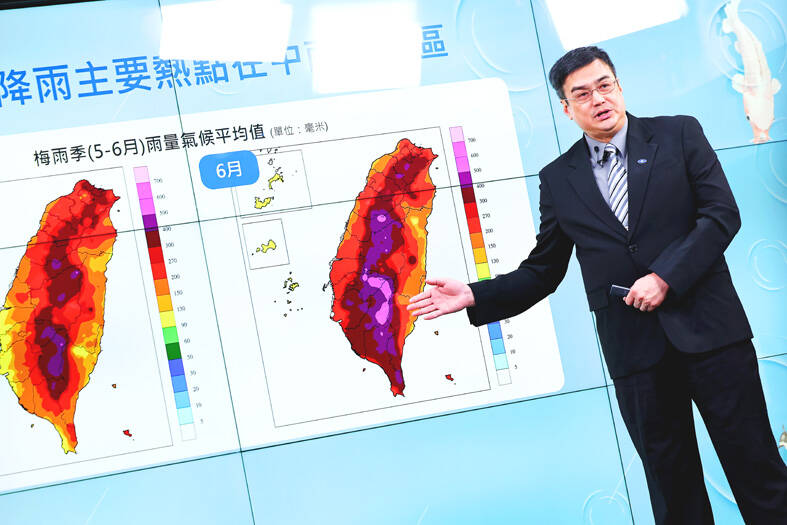
Photo: CNA
The average temperature this spring was 20.4°C, slightly below the climatic average of 20.8°C, Weather Forecast Center Director Chen Yi-liang (陳怡良) told a news conference in Taipei.
Nearly all automatic weather stations reported lower average temperatures in spring due to the arrival of two cold waves, six waves of continental cold air masses and a few bouts of the northeast monsoon, Chen said.
Further analyses of weather data showed that 11 monitoring stations reported the third-coldest average spring temperature since 2011, he said.
The average temperature in February was lower than the climatic average, while average temperatures recorded last month and this month fell within the normal range, he said.
CWA data also showed that the number of days this spring in which temperatures dropped to 14°C or below reached 30, the third-highest in the past two decades, he said.
The average spring rainfall was higher than the climatic average due to the influences of rain fronts, he said.
The agency recorded average spring rainfall of 321.3mm, higher than the climatic average of 282.8mm from 1991 to 2022, he said.
Precipitation in February and last month was slightly above average, while the rainfall this month was slightly below average, he said.
“We think that this year’s spring was colder, because of persistent northeast winds, and overall temperatures along the coastal areas of East Asia were lower as well. There has been more spring rain this year, because of the interactions between convective cloud systems from the South China Sea and east of the Philippines, and the northeast monsoon,” Chen said.
Temperatures during the upcoming plum rain season are likely to be “between normal and slightly higher,” while rainfall would be “between normal and slightly lower,” he said.
When the plum rain season starts depends on region, with the amount of accumulated rainfall varying every year without any fixed patterns, Chen said.
Plum rain in northern Taiwan would probably begin during the first half of next month, while residents in southern Taiwan would probably have to wait until the second half of next month or even later, Chen said.
Rainfall in central and southern Taiwan would likely be lower than normal next month, he said.

PRAISE: Japanese visitor Takashi Kubota said the Taiwanese temple architecture images showcased in the AI Art Gallery were the most impressive displays he saw Taiwan does not have an official pavilion at the World Expo in Osaka, Japan, because of its diplomatic predicament, but the government-backed Tech World pavilion is drawing interest with its unique recreations of works by Taiwanese artists. The pavilion features an artificial intelligence (AI)-based art gallery showcasing works of famous Taiwanese artists from the Japanese colonial period using innovative technologies. Among its main simulated displays are Eastern gouache paintings by Chen Chin (陳進), Lin Yu-shan (林玉山) and Kuo Hsueh-hu (郭雪湖), who were the three young Taiwanese painters selected for the East Asian Painting exhibition in 1927. Gouache is a water-based
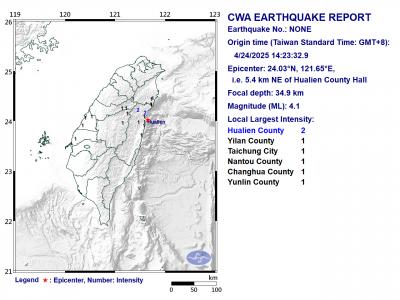
A magnitude 4.1 earthquake struck eastern Taiwan's Hualien County at 2:23pm today, according to the Central Weather Administration (CWA). The epicenter of the temblor was 5.4 kilometers northeast of Hualien County Hall, at a depth of 34.9 km, according to the CWA. The earthquake's intensity, which gauges the actual effect of a temblor, was the highest in Hualien County, where it measured 2 on Taiwan's 7-tier intensity scale. The quake also measured an intensity of 1 in Yilan county, Taichung, Nantou County, Changhua County and Yunlin County, the CWA said. There were no immediate reports of damage or injuries.

OFF-TARGET: More than 30,000 participants were expected to take part in the Games next month, but only 6,550 foreign and 19,400 Taiwanese athletes have registered Taipei city councilors yesterday blasted the organizers of next month’s World Masters Games over sudden timetable and venue changes, which they said have caused thousands of participants to back out of the international sporting event, among other organizational issues. They also cited visa delays and political interference by China as reasons many foreign athletes are requesting refunds for the event, to be held from May 17 to 30. Jointly organized by the Taipei and New Taipei City governments, the games have been rocked by numerous controversies since preparations began in 2020. Taipei City Councilor Lin Yen-feng (林延鳳) said yesterday that new measures by
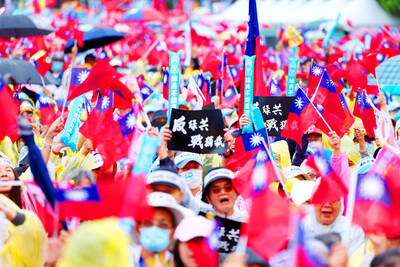
‘WORSE THAN COMMUNISTS’: President William Lai has cracked down on his political enemies and has attempted to exterminate all opposition forces, the chairman said The legislature would motion for a presidential recall after May 20, Chinese Nationalist Party (KMT) Chairman Eric Chu (朱立倫) said yesterday at a protest themed “against green communists and dictatorship” in Taipei. Taiwan is supposed to be a peaceful homeland where people are united, but President William Lai (賴清德) has been polarizing and tearing apart society since his inauguration, Chu said. Lai must show his commitment to his job, otherwise a referendum could be initiated to recall him, he said. Democracy means the rule of the people, not the rule of the Democratic Progressive Party (DPP), but Lai has failed to fulfill his


 RSS
RSS