


The US Department of State on Monday reaffirmed that US policy on Taiwan remains unchanged, following US President Donald Trump’s use of the term “unification” while commenting on recent trade talks with China.
Speaking at a wide-ranging press conference, Trump described what he viewed as progress in trade negotiations with China held in Geneva, Switzerland, over the weekend.
“They’ve agreed to open China — fully open China, and I think it’s going to be fantastic for China. I think it’s going to be fantastic for us,” Trump said. “I think it’s going to be great for unification and peace.”
Photo: AFP
Trump’s use of the word “unification,” almost always used in the context of China unifying or annexing Taiwan, raised eyebrows in Taiwan.
However, the state department said that Trump was not thinking of Taiwan.
“It’s clear President Trump was speaking in the context of the US-China trade relationship,” a state department spokesperson told Central News Agency on Monday.
Just prior to using the term “unification,” Trump reflected on a trade deal with China that fell through during his first term, saying it “would have brought unity, better unity, between China and the United States” — a comment that suggests that he might have misused the term “unification.”
The state department said that “US policy on Taiwan remains the same.”
“We continue to have an abiding interest in peace and stability across the Taiwan Strait,” it said, adding that the US “opposes any unilateral changes to the status quo by either side.”
The American Institute in Taiwan also clarified that Trump’s remarks were focused on trade.
“US policy on Taiwan remains the same, and the US approach to Taiwan has remained consistent across decades and administrations,” it said.
The Ministry of Foreign Affairs echoed this interpretation, agreeing that the comment was made in a trade context.
“According to our understanding, the Taiwan issue was not touched on during the latest round of US-China trade negotiations,” ministry spokesperson Hsiao Kuang-wei (蕭光偉) said during a weekly briefing yesterday.
“The US’ commitment to Taiwan remains strong and unchanged,” Presidential Office spokesperson Karen Kuo (郭雅慧) said.
Trump’s comments followed two days of talks in Switzerland between the world’s two largest economies, during which the two sides agreed to ease their tit-for-tat battle over tariffs.
Under the preliminary agreement, the US is to lower tariffs on Chinese imports from 145 to 30 percent, while China is to reduce levies on US goods from 125 to 10 percent.
Additional reporting by Reuters
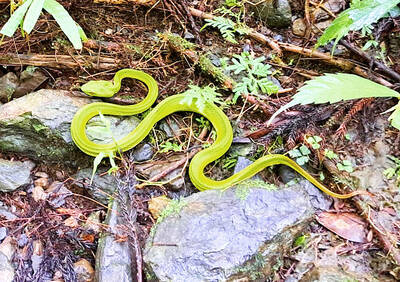
More than half of the bamboo vipers captured in Tainan in the past few years were found in the city’s Sinhua District (新化), while other districts had smaller catches or none at all. Every year, Tainan captures about 6,000 snakes which have made their way into people’s homes. Of the six major venomous snakes in Taiwan, the cobra, the many-banded krait, the brown-spotted pit viper and the bamboo viper are the most frequently captured. The high concentration of bamboo vipers captured in Sinhua District is puzzling. Tainan Agriculture Bureau Forestry and Nature Conservation Division head Chu Chien-ming (朱健明) earlier this week said that the
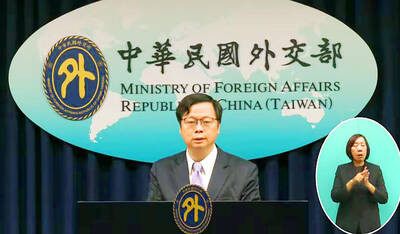
NAMING SPAT: The foreign ministry called on Denmark to propose an acceptable solution to the erroneous nationality used for Taiwanese on residence permits Taiwan has revoked some privileges for Danish diplomatic staff over a Danish permit that lists “Taiwan” as “China,” Eric Huang (黃鈞耀), head of the Ministry of Foreign Affairs’ Department of European Affairs, told a news conference in Taipei yesterday. Reporters asked Huang whether the Danish government had responded to the ministry’s request that it correct the nationality on Danish residence permits of Taiwanese, which has been listed as “China” since 2024. Taiwan’s representative office in Denmark continues to communicate with the Danish government, and the ministry has revoked some privileges previously granted to Danish representatives in Taiwan and would continue to review
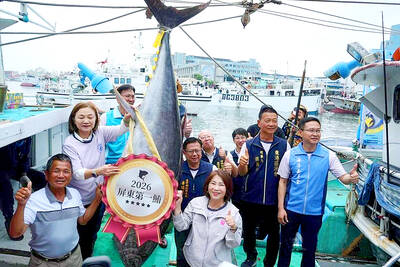
The first bluefin tuna of the season, brought to shore in Pingtung County and weighing 190kg, was yesterday auctioned for NT$10,600 (US$333.5) per kilogram, setting a record high for the local market. The auction was held at the fish market in Donggang Fishing Harbor, where the Siaoliouciou Island-registered fishing vessel Fu Yu Ching No. 2 delivered the “Pingtung First Tuna” it had caught for bidding. Bidding was intense, and the tuna was ultimately jointly purchased by a local restaurant and a local company for NT$10,600 per kilogram — NT$300 ,more than last year — for a total of NT$2.014 million. The 67-year-old skipper
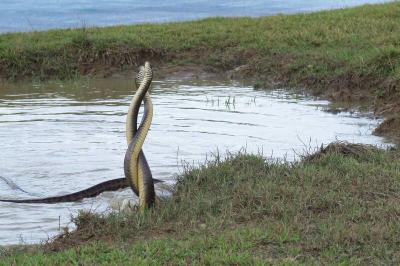
Kenting National Park service technician Yang Jien-fon (楊政峰) won a silver award in World Grand Prix Photography Awards Spring Season for his photograph of two male rat snakes intertwined in combat. Yang’s colleagues at Kenting National Park said he is a master of nature photography who has been held back by his job in civil service. The awards accept entries in all four seasons across six categories: architectural and urban photography, black-and-white and fine art photography, commercial and fashion photography, documentary and people photography, nature and experimental photography, and mobile photography. Awards are ranked according to scores and divided into platinum, gold and


 RSS
RSS