


The Polish Office in Taipei and the National Fire Agency on Tuesday hosted an event for members of foreign representative offices and international groups to improve their disaster response and first aid skills.
Thirty-five representatives from 20 EU member states, the US, Canada, the UK and Australia, as well as the branch offices of international organizations, attended the event in New Taipei City, which featured lectures and hands-on training.
Lecturers focused on disasters and risks facing Taiwan, the nation’s disaster management system and operations, and how to achieve disaster preparedness at home.
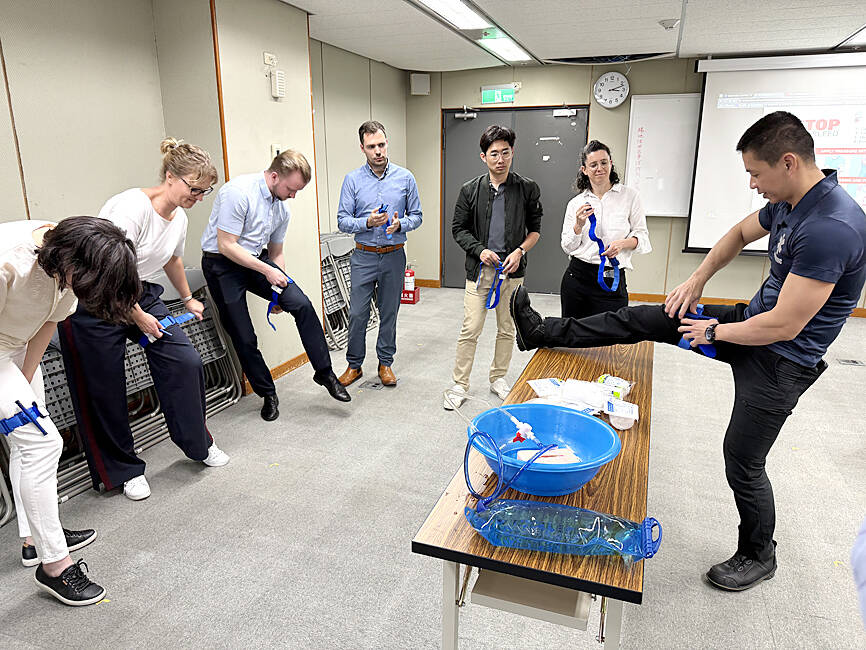
Photo courtesy of the National Fire Agency
Chen Chao-wen (陳昭文), a physician at Kaohsiung Medical University Chung-Ho Memorial Hospital, led training on cardiopulmonary resuscitation, automated external defibrillators, controlling bleeding and transporting people with injuries.
Deputy Minister of the Interior Dong Jian-hong (董建宏) told the event that Taiwan is in a region prone to earthquakes and typhoons, making disaster preparedness a major priority.
Dong conveyed Minister of the Interior Liu Shyh-fang’s (劉世芳) hope that a more resilient and safe environment would be fostered through the participants learning essential disaster response and first aid skills.
Poland, which holds the presidency of the EU Council, has demonstrated a strong commitment to global disaster preparedness and humanitarian relief, Dong said.
The event underscored the close collaboration between Taiwan and its international partners in disaster management, and bolstered exchanges between Taiwan and the EU in disaster preparedness, he added.
Hsiao Huan-chang (蕭煥章), director-general of the National Fire Agency, reaffirmed his agency’s commitment to expanding international cooperation, building a global disaster prevention network and enhancing emergency response capabilities to better protect the safety of people around the world.
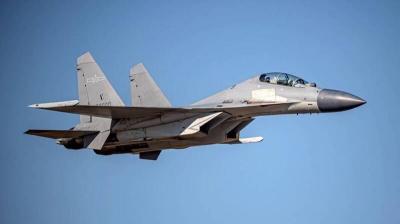
Eight Chinese naval vessels and 24 military aircraft were detected crossing the median line of the Taiwan Strait between 6am yesterday and 6am today, the Ministry of National Defense said this morning. The aircraft entered Taiwan’s northern, central, southwestern and eastern air defense identification zones, the ministry said. The armed forces responded with mission aircraft, naval vessels and shore-based missile systems to closely monitor the situation, it added. Eight naval vessels, one official ship and 36 aircraft sorties were spotted in total, the ministry said.
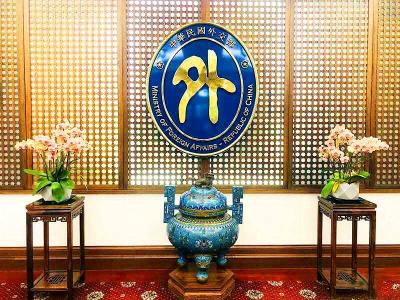
The Ministry of Foreign Affairs (MOFA) today said that if South Korea does not reply appropriately to its request to correct Taiwan’s name on its e-Arrival card system before March 31, it would take corresponding measures to alter how South Korea is labeled on the online Taiwan Arrival Card system. South Korea’s e-Arrival card system lists Taiwan as “China (Taiwan)” in the “point of departure” and “next destination” fields. The ministry said that it changed the nationality for South Koreans on Taiwan’s Alien Resident Certificates from “Korea” to “South Korea” on March 1, in a gesture of goodwill and based on the
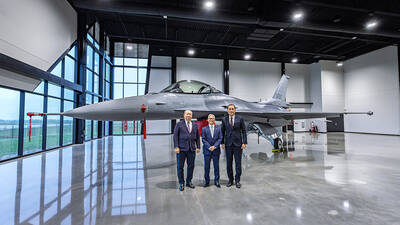
Taiwanese officials were shown the first of 66 F-16V fighter jets purchased by Taiwan from the United States, the Ministry of National Defense said yesterday, adding the aircraft has completed an initial flight test and is expected to be delivered later this year. A delegation led by Deputy Minister of National Defense Hsu Szu-chien (徐斯儉) visited Lockheed Martin’s F-16 C/D Block 70 (also known as F-16V) assembly line in South Carolina on March 16 to view the aircraft. The jet will undergo a final acceptance flight in the US before being delivered to Taiwan, the
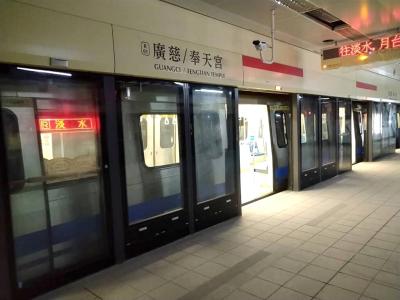
The New Taipei Metro's Sanyin Line and the eastern extension of the Taipei Metro's Tamsui-Xinyi Line (Red Line) are scheduled to begin operations in June, the National Development Council said today. The Red Line, which terminates at Xiangshan Station, would be connected by the 1.4km extension to a new eastern terminal, Guangci/Fengtian Temple Station, while the Sanyin Line would link New Taipei City's Tucheng and Yingge stations via Sanxia District (三峽). The council gave the updates at a council meeting reviewing progress on public construction projects for this year. Taiwan's annual public infrastructure budget would remain at NT$800 billion (US$25.08 billion), with NT$97.3


 RSS
RSS