


The Taipei District Court ruled yesterday that the detention of former Taipei mayor Ko Wen-je (柯文哲) be extended for two months from Wednesday next week.
There is still a risk that Ko could flee and collude with others to destroy evidence, hence the decision to extend his detention, the court said.
It also ordered that three other suspects — Core Pacific Group founder Sheen Ching-jing (沈慶京), Ko’s former mayoral office head Lee Wen-tsung (李文宗) and Taipei City Councilor Ying Hsiao-wei (應曉薇) — remain detained and held incommunicado for another two months, citing the same reasons.
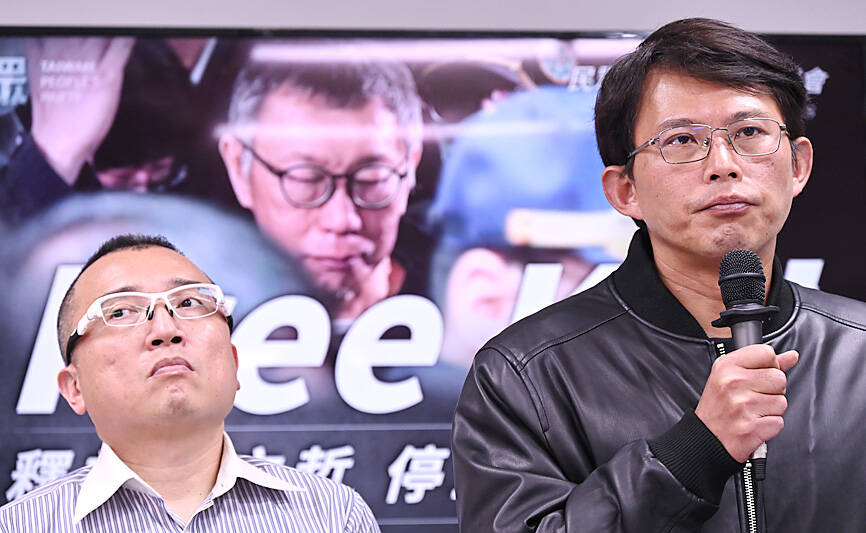
Photo: Liu Hsin-de, Taipei Times
Ko has been indicted over alleged bribery, embezzlement and breach of public trust dating to his second term as mayor from 2018 to 2022 and during his campaign for last year’s presidential election as the Taiwan People’s Party (TPP) candidate.
Ko last week told the court during the first trial that he was wrongfully accused, with prosecutors alleging that he accepted bribes from Sheen to give Core Pacific Group an unusually high floor area ratio for the Core Pacific City redevelopment project in Taipei’s Songshan District (松山).
Ko is also being accused of having used more than NT$60 million (US$1.81 million) in political donations from Muko Public Relations Marketing Co for personal gain.
Ko said he had never closely examined the company’s financial records, believing that the donations were solely from supporters.
He had no intention of embezzling money, he said.
The court also heard opinions on whether Ko’s continued detention was necessary.
TPP Chairman Huang Kuo-chang (黃國昌) said that the court’s decision was “unacceptable.”
Taipei prosecutors did not provide any evidence to suggest that Ko might flee or collude with witnesses, but the court still extended his detention, Huang said, adding that the decision further tarnished the credibility of Taiwan’s judicial system.
Ko’s lawyers would file an appeal to seek justice, he said.

A magnitude 6.1 earthquake struck off the coast of Yilan County at 8:39pm tonight, the Central Weather Administration (CWA) said, with no immediate reports of damage or injuries. The epicenter was 38.7km east-northeast of Yilan County Hall at a focal depth of 98.3km, the CWA’s Seismological Center said. The quake’s maximum intensity, which gauges the actual physical effect of a seismic event, was a level 4 on Taiwan’s 7-tier intensity scale, the center said. That intensity level was recorded in Yilan County’s Nanao Township (南澳), Hsinchu County’s Guansi Township (關西), Nantou County’s Hehuanshan (合歡山) and Hualien County’s Yanliao (鹽寮). An intensity of 3 was

Instead of focusing solely on the threat of a full-scale military invasion, the US and its allies must prepare for a potential Chinese “quarantine” of Taiwan enforced through customs inspections, Stanford University Hoover fellow Eyck Freymann said in a Foreign Affairs article published on Wednesday. China could use various “gray zone” tactics in “reconfiguring the regional and ultimately the global economic order without a war,” said Freymann, who is also a nonresident research fellow at the US Naval War College. China might seize control of Taiwan’s links to the outside world by requiring all flights and ships entering or leaving Taiwan
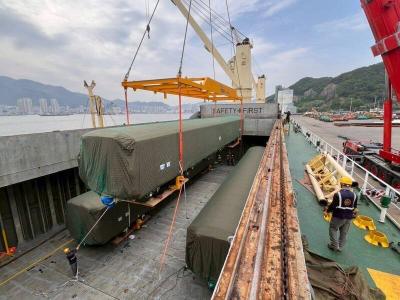
The first of 10 new high-capacity trains purchased from South Korea’s Hyundai Rotem arrived at the Port of Taipei yesterday to meet the demands of an expanding metro network, Taipei Rapid Transit Corp (TRTC) said yesterday. The train completed a three-day, 1,200km voyage from the Port of Masan in South Korea, the company said. Costing NT$590 million (US$18.79 million) each, the new six-carriage trains feature a redesigned interior based on "human-centric" transportation concepts, TRTC said. The design utilizes continuous longitudinal seating to widen the aisles and optimize passenger flow, while also upgrading passenger information displays and driving control systems for a more comfortable
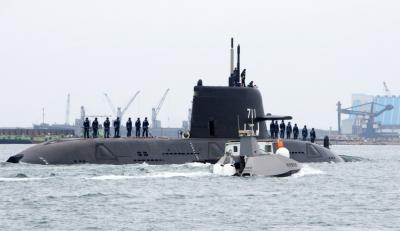
Taiwan's first indigenous defense submarine, the SS-711 Hai Kun (海鯤, or Narwhal), departed for its 13th sea trial at 7am today, marking its seventh submerged test, with delivery to the navy scheduled for July. The outing also marked its first sea deployment since President William Lai (賴清德) boarded the submarine for an inspection on March 19, drawing a crowd of military enthusiasts who gathered to show support. The submarine this morning departed port accompanied by CSBC Corp’s Endeavor Manta (奮進魔鬼魚號) uncrewed surface vessel and a navy M109 assault boat. Amid public interest in key milestones such as torpedo-launching operations and overnight submerged trials,


 RSS
RSS