


A newborn who died last week was the second death from serious enterovirus infection this year, the Centers for Disease Control (CDC) said yesterday, as it also warned that the number of people seeking treatment for diarrhea remained high.
Hospitals reported 3,878 visits for enterovirus infection last week, which was relatively low and below the epidemic threshold, CDC Epidemic Intelligence Center Director Guo Hung-wei (郭宏偉) said.
Surveillance data from contracted labs showed that the most common enterovirus detected in the past four weeks was coxsackievirus A16, followed by coxsackievirus A6 and echovirus 11, he said.
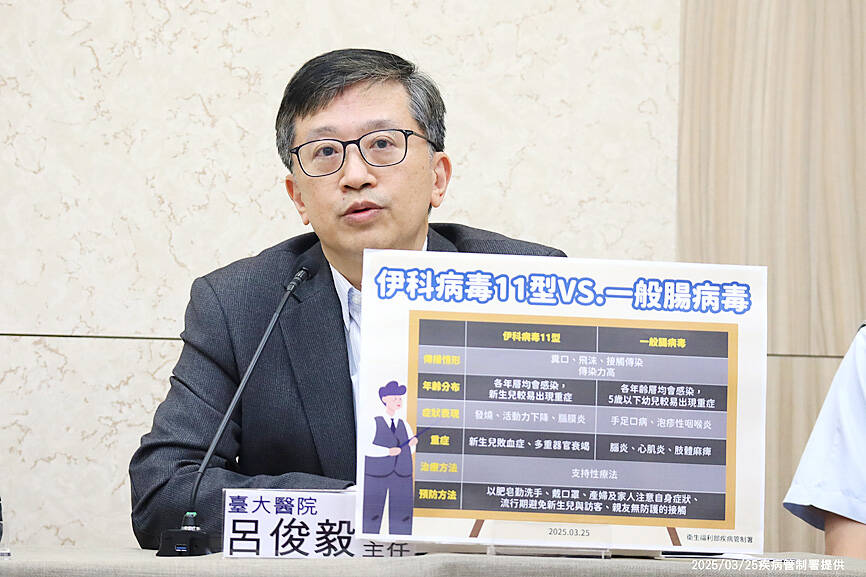
Photo courtesy of the Centers for Disease Control
The less-than-a-month-old baby in northern Taiwan who last week died from severe enterovirus infection with complications had contracted echovirus 11, he said.
CDC physician Lin Yung-ching (林詠青) said the baby was born prematurely and was last month hospitalized for respiratory distress.
His condition worsened earlier this month, with low blood pressure, a slow heartbeat, hepatitis and low platelet count, and tested positive for enterovirus, Lin said.
The boy died of septic shock and multiple organ failure about a week after the onset of symptoms, he said.
Contact tracing found that none of his family members, patients or healthcare workers or other patients and healthcare workers where he was hospitalized was infected with echovirus 11, so the infection source is unknown.
There have been three cases of serious enterovirus infection this year, including two people who died, both of whom were infected with echovirus 11, Guo said.
The enterovirus epidemic in Taiwan typically starts in late April and peaks in June, but few cases of severe infection have been reported, with newborns more susceptible to severe echovirus 11 infection, National Taiwan University Hospital’s Pediatric Infection Disease Division director Lu Chun-yi (呂俊毅) said.
People infected with echovirus 11 do not exhibit common symptoms such as hand-foot-and-mouth disease or herpangina (blister-like sores or ulcers in the mouth), and infected children might only develop mild symptoms such as a fever or rashes, he said.
However, newborns up to three months old infected with echovirus 11 might become severely ill due to acute hepatitis, encephalitis or sepsis, Lu said.
Echovirus 11 is primarily transmitted through the fecal-oral and respiratory routes, so close contact with infected family members, such as older siblings, is a source of infection; another potential source of infection is vertical transmission from mother to child during birth, he said.
Pregnant women and newborns should avoid contact with infected people, Lu said, adding that pregnant women should pay special attention to their health before and after giving birth, while caregivers should practice good respiratory and hand hygiene, Lu said.
Meanwhile, hospitals reported 186,708 visits for diarrhea last week, down 12.7 percent from the previous week, but still the highest for the same week in five years, Guo said.
CDC Deputy Director-General Tseng Shu-hui (曾淑慧) said that weekly visits had declined for four consecutive weeks, and are expected to drop to a low level early next month, but people should continue to practice hand hygiene and food safety.
As for a hot pot restaurant in Yilan County where a cluster of diarrhea cases was reported last week, Tseng said five customers and five food handlers tested positive for norovirus.
The hot pot restaurant chain in Luodong Township (羅東) held a soft opening on March 15, but as of Saturday, 63 customers had reported feeling ill after eating there.

REASONS FOR TRAVEL: An assistant professor said that proposed amendments to penalize drivers if they used drugs overseas would not deter people from traveling People who operate a motor vehicle under the influence of marijuana would have their driver’s license revoked, even if they used the substance while overseas, the Ministry of Transportation and Communications said yesterday, citing proposed amendments to the Road Traffic Management and Penalty Act (道路交通管理處罰條例). The amendments would also authorize the government to revoke the licenses of people determined to have used Category 1 or Category 2 narcotics, even if they were not operating a vehicle while under the influence of drugs, as well as ban them from taking the license test for three years, the ministry said. People aged 18 or

GLOBALGIVING: ‘ Caving to external pressure is not acceptable for an organization that has cultivated justice reform and human rights for 30 years,’ one NGO said A slew of non-government organizations (NGOs) have withdrawn from the GlobalGiving fundraising platform after it announced it would use “Chinese Taipei” instead of “Taiwan” from next month. The Taiwan Good Rice Association wrote on Facebook on Friday that it was informed on April 28 via a teleconference call of the change, which was made because the platform wanted to operate in China. Taiwan Good Rice is to terminate all cooperative relationships with GlobalGiving in response to the platform’s “unilateral and non-negotiable” decision to remove references to Taiwan, the NGO said. “Taiwan is in the official name of Taiwan Good Rice Association and the

HEAVY WEATHER: Typhoon Jangmi is due to crash straight into the Ryukyus as airlines look to shift flights to larger aircraft or cancel flights to Okinawa entirely Taiwan’s international air carriers announced flight adjustments over the weekend as Typhoon Jangmi is forecast to hit the Ryukyu Islands today and tomorrow. The Central Weather Administration (CWA) upgraded Jangmi from a tropical storm to a typhoon at 8am yesterday, with the eye located 580km south of Naha city. It was moving north at 19kph. Today, China Airlines’ CI-120, CI-121, CI-122 and CI-123 flights between Taoyuan and Naha, Okinawa, have been canceled as well as CI-132 and CI-133 between Kaohsiung and Naha. EVA Air’s BR-112, BR-113, BR-186 and BR-185 flights between Taoyuan and Naha are also canceled. Low-cost carrier Tigerair Taiwan canceled IT-230,

MULTIPRONGED APPROACH: China has sought to pressure Palau across a number of fronts, but the island nation has staunchly resisted overtures to ditch Taiwan Palau has been firm in backing Taiwan despite Chinese pressure that uses tourism economics, cyberattacks and criminal infiltration as tools to threaten the Pacific ally into renouncing its recognition of Taiwan as a sovereign state. The Presidential Office yesterday announced that Vice President Hsiao Bi-khim (蕭美琴) would visit Palau from Saturday to Wednesday next week at the invitation of Palauan President Surangel Whipps Jr. Whipps in April said in an interview that China had outspokenly asked Palau to “denounce Taiwan.” “And we have said: ‘We have no enemies, but nobody tells us who our friends are,’” he said. Whipps has told reporters multiple times


 RSS
RSS