


Research conducted by Veterans General Hospital’s Taichung branch shows that a particular genetic variation, specific to Taiwanese, leads to a higher risk of stroke and dementia, and warned that families with a history of strokes or hyperlipidemia should be on the alert.
Department of Neurology doctor Tung Hsin (董欣) said the R544C variant in the Notch-3 gene is a common variant for Taiwanese and is considered a cause of cerebral autosomal dominant arteriopathy with subcortical infarcts and leukoencephalopathy.
If either parent carries the gene variation, their offspring would have a 50/50 chance of inheriting the gene variation, Tung said.
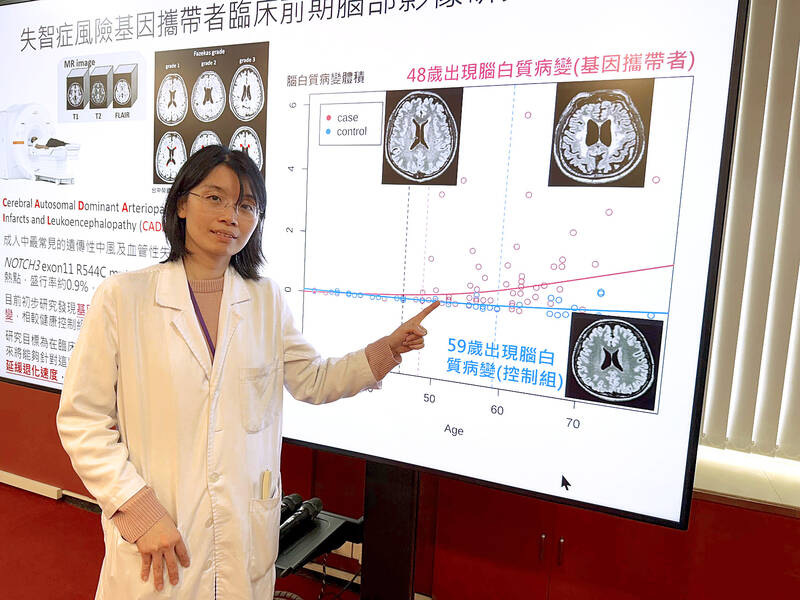
Photo: Tsai Shu-yuan, Taipei Times
The genetic variation causes congenital fragility of blood vessel walls, and people who have it should control their lipedema levels.
Tung said past research showed that patients were usually diagnosed with the symptoms at the age of 54 to 56.
People with the gene variation could experience general leukoencephalopathy, cerebral infarction and a minute brain hemorrhage from the progressive buildup of cerebral white matter as they age, resulting in a decrease in cognitive and memory functions.
Head of the hospital’s center for dementia Kee Wei-ju (李威儒) said the center’s research team combed through the hospital’s archives, established during the hospital’s participation in the nation’s Precision Medicine Initiative, and found that there were 554 patients with the R544C variation, or a prevalence rate of 0.96 percent.
About 28 percent of patients with the gene variation have been diagnosed with dementia or have suffered a stroke, while the remaining 72 percent, while visibly healthy, have also demonstrated higher rates of leukoencephalopathy compared with patients without the gene variation, Kee said.
The team conducted neuroimaging for 63 patients with the gene variation without visible symptoms, and 37 people without the gene variation, showing that those with the gene variation experienced increased rates of leukoencephalopathy — comprising 0.336 percent of the cerebral mass — after the age of 48, higher than the 0.059 percent of those without the gene variation.
Lee said the research suggests that those with the gene variation experience increased rates of leukoencephalopathy 10 years before those without the gene variation and six to seven years before noticeable symptoms develop.
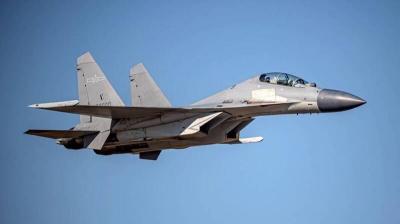
Eight Chinese naval vessels and 24 military aircraft were detected crossing the median line of the Taiwan Strait between 6am yesterday and 6am today, the Ministry of National Defense said this morning. The aircraft entered Taiwan’s northern, central, southwestern and eastern air defense identification zones, the ministry said. The armed forces responded with mission aircraft, naval vessels and shore-based missile systems to closely monitor the situation, it added. Eight naval vessels, one official ship and 36 aircraft sorties were spotted in total, the ministry said.
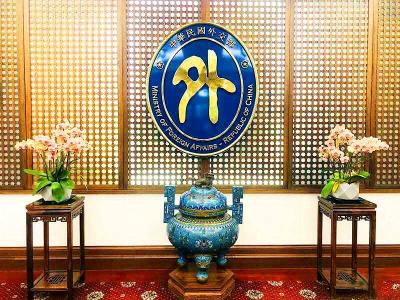
The Ministry of Foreign Affairs (MOFA) today said that if South Korea does not reply appropriately to its request to correct Taiwan’s name on its e-Arrival card system before March 31, it would take corresponding measures to alter how South Korea is labeled on the online Taiwan Arrival Card system. South Korea’s e-Arrival card system lists Taiwan as “China (Taiwan)” in the “point of departure” and “next destination” fields. The ministry said that it changed the nationality for South Koreans on Taiwan’s Alien Resident Certificates from “Korea” to “South Korea” on March 1, in a gesture of goodwill and based on the

Taiwanese officials were shown the first of 66 F-16V fighter jets purchased by Taiwan from the United States, the Ministry of National Defense said yesterday, adding the aircraft has completed an initial flight test and is expected to be delivered later this year. A delegation led by Deputy Minister of National Defense Hsu Szu-chien (徐斯儉) visited Lockheed Martin’s F-16 C/D Block 70 (also known as F-16V) assembly line in South Carolina on March 16 to view the aircraft. The jet will undergo a final acceptance flight in the US before being delivered to Taiwan, the
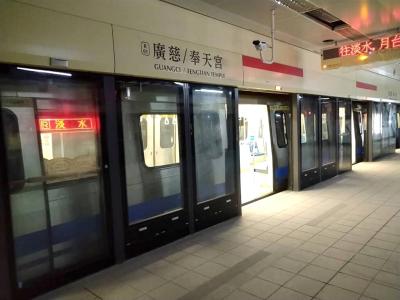
The New Taipei Metro's Sanyin Line and the eastern extension of the Taipei Metro's Tamsui-Xinyi Line (Red Line) are scheduled to begin operations in June, the National Development Council said today. The Red Line, which terminates at Xiangshan Station, would be connected by the 1.4km extension to a new eastern terminal, Guangci/Fengtian Temple Station, while the Sanyin Line would link New Taipei City's Tucheng and Yingge stations via Sanxia District (三峽). The council gave the updates at a council meeting reviewing progress on public construction projects for this year. Taiwan's annual public infrastructure budget would remain at NT$800 billion (US$25.08 billion), with NT$97.3


 RSS
RSS