


The College of Veterinary Medicine at National Chung Hsing University yesterday held a ceremony to launch the use of bionic animals in clinical training.
Living animals and animal remains are indispensable in traditional veterinary medical internships, but concerns have been raised over limited resources and animal welfare, college dean Chen Peng-wen (陳德勛) said.
Using bionic animals as teaching materials is an efficient and standardized learning method that would reduce the dependence on laboratory animals, as well as enable students to practice surgical skills in a stress-free environment until they master core techniques of clinical diagnosis and treatment for small animals, he said.
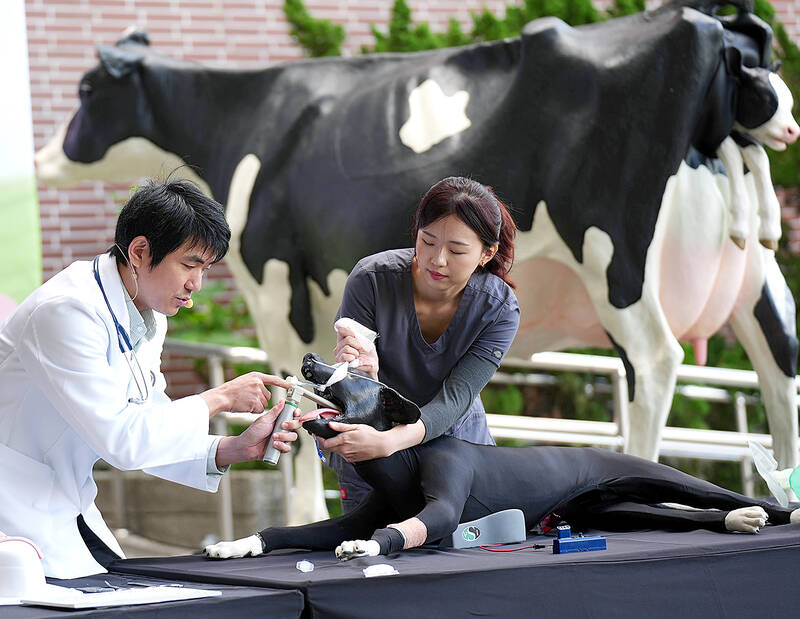
Photo: Tsai Shu-yuan, Taipei Times
Bionic teaching materials can be used for practicing small animal clinical operations such as blood draws from the leg, palpation of internal organs, cardiopulmonary resuscitation, tracheal intubation, nasogastric intubation, dental surgery, spaying, bandaging and stitching. These tools are expected to help students cultivate professional capabilities in simulated environments, Chen said.
The college also introduced life-sized bionic dairy cattle from Canada under the Ministry of Education’s Higher Education Sprout Project in 2020, becoming the first institute to use bionic animals as teaching materials in Taiwan, he said.
Last year, it used funding from the Ministry of Agriculture to introduce life-sized bionic dogs for training on small animal clinical operations, Chen said, adding that five dog models were procured for each type of operation.
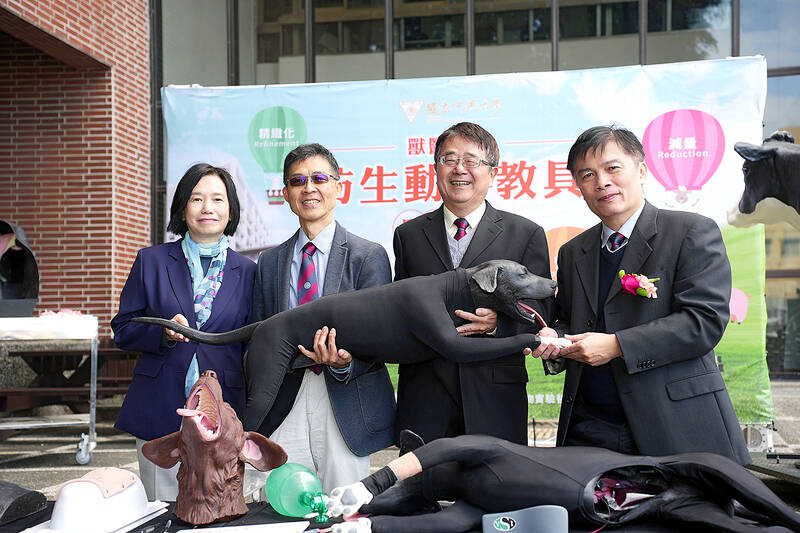
Photo: Tsai Shu-yuan, Taipei Times
Hsieh Chia-yu (謝嘉裕), associate professor of the college, also developed a bionic fish model for blood-draw training, he added.
Deputy Minister of Agriculture Tu Wen-jane (杜文珍) said that bionic animals could not substitute for real animals, but they could boost students’ confidence and skills.
Combined with artificial intelligence and virtual intelligence, bionic teaching materials would increase teaching quality by providing enhanced simulated context and sensory feedback in the future, she said.
University president Chan Fu-chih (詹富智) said the investment in bionic teaching materials has made the university a model for veterinary medical education nationwide, bringing multiple benefits for students, animals and the whole of society.
The college bases its teaching and training on case studies, encouraging students to practice techniques and solve problems in simulated clinical contexts, Chen said.
Such a practice-oriented teaching method allows students to learn better by deepening their understanding of diagnosis and treatment processes, ensuring that each graduate from the college is equipped with professional competencies that can be transferred immediately to the workplace, he said.

Fast food chain McDonald's is to raise prices by up to NT$5 on some products at its restaurants across Taiwan, starting on Wednesday next week, the company announced today. The prices of all extra value meals and sharing boxes are to increase by NT$5, while breakfast combos and creamy corn soup would go up by NT$3, the company said in a statement. The price of the main items of those meals, if ordered individually, would remain the same. Meanwhile, the price of a medium-sized lemon iced tea and hot cappuccino would rise by NT$3, extra dipping sauces for chicken nuggets would go up

FUKUOKA SITUATION: Japanese media reported that the pathogen is expected to be identified by the summer, while the CDC downplayed the idea that it was hMPV A “mysterious cold-like illness” reported in Japan’s Fukuoka Prefecture does not seem to be a new disease, but Japanese authorities have been asked about the situation, the Centers for Disease Control (CDC) said yesterday. The Fukuoka Prefectural Medical Association on Wednesday told a news conference that a “mystery cold” that has become a hot topic on social media is “highly likely to be caused by some kind of viral infection,” Japan’s KBC News reported. “Many people are experiencing symptoms starting with a sore throat, followed by a runny nose, phlegm and a severe cough,” KBC News reported, citing association officials. Health authorities are

Nvidia Corp CEO Jensen Huang (黃仁勳) arrived in Taiwan yesterday ahead of upcoming AI and technology events, saying he plans to meet with clients and Taiwan Semiconductor Manufacturing Co Chairman C.C. Wei (魏哲家) during his visit. After landing at Taipei Songshan Airport, Huang posed for photos with fans and handed out Yakult drinks to reporters and supporters waiting at the scene, saying he has “a lot to do” during the trip. Asked about reports that Nvidia’s planned headquarters site in Taipei’s Beitou Shilin Technology Park could break ground on May 27, Huang said that if the company holds an event, he would

Carrefour Taiwan is to begin using a new name from the start of July, but it cannot divulge the name until then, the chairman of the supermarket chain's parent company said today. President Chain Store Co chairman Lo Chih-hsien (羅智先) was asked by reporters after a shareholders' meeting to confirm whether the company has settled on a new name for the supermarket brand. In March, the government-registered name of two Carrefour Taiwan branches was quietly changed to "Le Chia Kang" (樂家康) in Chinese, raising speculation that has been selected as the name. Lo said that because of local regulations and contractual obligations, the


 RSS
RSS