


Taiwan Tobacco and Liquor Co prices for cooking rice wine and other related products would remain frozen this year and next year, the state-run liquor company said yesterday, adding that it is seeking an anti-dumping investigation into Chinese beer through the Taiwan Brewers’ Association, of which it is a member.
“To comply with government policy to control inflation, prices of cooking rice wine and other related products, which are used by people daily, would not rise this year or next year,” Taiwan Tobacco and Liquor chairman Tang Chi-an (湯期安) told a meeting of the legislature’s Finance Committee.
Freezing retail prices of red-label cooking rice wine alone costs the company about NT$500 million (US$15.21 million) per year, Tang said.
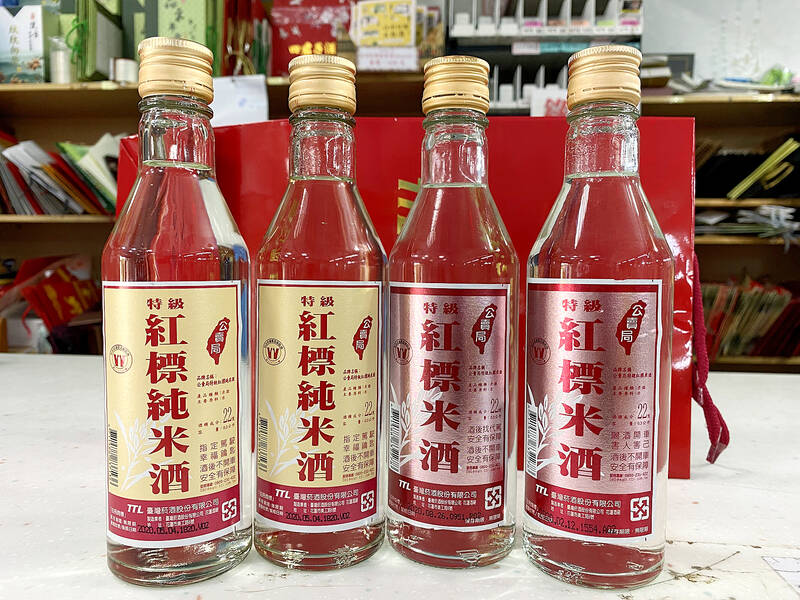
Photo: CNA
“We will continue to find ways to cover the losses, but we also hope this could be listed as a financial burden that the company must carry in compliance with government policy,” he said.
Chinese Nationalist Party (KMT) Legislator Lai Shyh-bao (賴士葆) said that the company’s revenue has dropped to NT$55 billion from NT$61.9 billion in 2020, with profits declining to NT$5.8 billion from NT$7.4 billion.
Lai attributed the decrease to Japan Tobacco Inc opening a factory in Tainan and Heineken NV opening its Northeast Asia supply center in Pingtung County in April last year.
Meanwhile, Taiwan Beer has been banned from entering the Chinese market for two years, Lai said, adding that Taiwan Tobacco and Liquor’s finances this year are expected to be worse than last year.
Tang said he is confident about the company’s performance this year, adding that the year-end bonus for employees would exceed 2.5 months of salary.
“We are receiving new orders from overseas buyers and would expand marketing efforts by working with baseball tournaments,” he said.
Tang in November last year said that the company would only consider slightly raising the price of Kaoliang liquor due to a large increase in wheat prices.
The price of Taiwan Beer is likely to remain the same, he said.
“Instead of a pricing scheme, we would focus more on targeting young consumers using innovative marketing strategies, such as sponsoring qualifiers for the World Baseball Classic next month,” Tang said.
The Taipei Dome from Feb. 21 to 25 is to host qualifiers for the global event in 2026. Taiwan are to vie against Nicaragua, South Africa and Spain for two berths.
Minister of Finance Chuang Tsui-yun (莊翠雲) said that the firm is considering asking the government to launch an anti-dumping investigation into Chinese beer through the association, adding that the ministry would work with the Ministry of Economic Affairs to determine whether an anti-dumping tax should be imposed on Chinese beer.
Lawmakers have accused Chinese brewers of engaging in unfair trade practices by receiving subsidies from the Chinese government.
A review and investigation of an anti-dumping case could take eight months to a year to complete, Customs Administration Director-General Peng Ying-wei (彭英偉) said.
The association was established last year by Taiwan Tobacco and Liquor, Heineken Taiwan, Le Ble D’or, Taihu Brewing, Zhangmen Craft Brewing and Kavalan Distillery.

The military has spotted two Chinese warships operating in waters near Penghu County in the Taiwan Strait and sent its own naval and air forces to monitor the vessels, the Ministry of National Defense (MND) said. Beijing sends warships and warplanes into the waters and skies around Taiwan on an almost daily basis, drawing condemnation from Taipei. While the ministry offers daily updates on the locations of Chinese military aircraft, it only rarely gives details of where Chinese warships are operating, generally only when it detects aircraft carriers, as happened last week. A Chinese destroyer and a frigate entered waters to the southwest
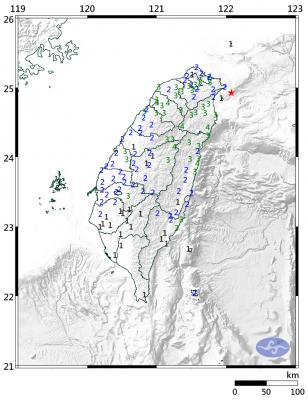
A magnitude 6.1 earthquake struck off the coast of Yilan County at 8:39pm tonight, the Central Weather Administration (CWA) said, with no immediate reports of damage or injuries. The epicenter was 38.7km east-northeast of Yilan County Hall at a focal depth of 98.3km, the CWA’s Seismological Center said. The quake’s maximum intensity, which gauges the actual physical effect of a seismic event, was a level 4 on Taiwan’s 7-tier intensity scale, the center said. That intensity level was recorded in Yilan County’s Nanao Township (南澳), Hsinchu County’s Guansi Township (關西), Nantou County’s Hehuanshan (合歡山) and Hualien County’s Yanliao (鹽寮). An intensity of 3 was

Japanese Prime Minister Sanae Takaichi’s comment last year on Tokyo’s potential reaction to a Taiwan-China conflict has forced Beijing to rewrite its invasion plans, a retired Japanese general said. Takaichi told the Diet on Nov. 7 last year that a Chinese naval blockade or military attack on Taiwan could constitute a “survival-threatening situation” for Japan, potentially allowing Tokyo to exercise its right to collective self-defense. Former Japan Ground Self-Defense Force general Kiyofumi Ogawa said in a recent speech that the remark has been interpreted as meaning Japan could intervene in the early stages of a Taiwan Strait conflict, undermining China’s previous assumptions
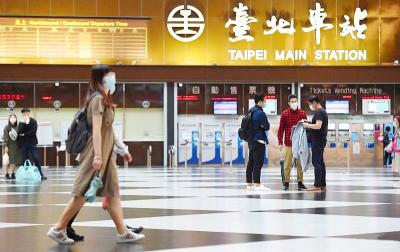
Taiwan Railways Corp (TRC) today announced that Shin Kong Mitsukoshi has been selected as the preferred bidder to operate the Taipei Railway Station shopping mall, replacing the current operator, Breeze Development Co Ltd. Among eight qualified firms that delivered presentations and were evaluated by a review committee, Shin Kong Mitsukoshi was ranked first, while Breeze was named the runner-up, the rail company said in a statement. Contract negotiations are to proceed in accordance with regulations, it said, adding that if negotiations with the top bidder fail, it could invite the second-ranked applicant to enter talks. Breeze in a statement today expressed doubts over


 RSS
RSS