


Six men were yesterday sentenced to between 1.5 years and 12 years in prison for tricking or blackmailing girls into filming sexually explicit pictures and videos, and then selling them online.
According to the indictment by Taichung prosecutors, a 35-year-old man surnamed Pan (潘) began soliciting sexually explicit photos from girls on Instagram in 2021 using fraud and threats.
Pan then uploaded the images to a Telegram channel he created, and sold or traded them with other users, in a manner apparently modeled on South Korea’s “Nth room” case, prosecutors said.

Photo: Chang Jui-chen, Taipei Times
Later, Pan enlisted five other men to help him: a 37-year-old beef noodle soup store owner surnamed Chen (陳), and others surnamed Chang (張), Liu (劉), Su (蘇) and Lee (李).
The group victimized 86 girls aged nine to 17 from across Taiwan, earning about NT$8 million (US$244,888) in illicit profits, according to the indictment.
Chen, in particular, was found to have recruited girls by promising them money or iPhones in return. After obtaining their images, Chen blackmailed the girls into sending more by threatening to publish images if they refused, prosecutors said.
The crime ring was ultimately busted based on information provided by the operator of another child pornography chat group on Telegram, who was arrested in late 2022.
Following an investigation, the Taichung District Prosecutors’ Office indicted Pan and the five other suspects in December last year for violations of the Organized Crime Prevention Act (組織犯罪防制條例), and the Child and Youth Sexual Exploitation Prevention Act (兒童及少年性剝削防制條例).
The Taichung District Court on Thursday last week found all six men guilty, sentencing Pan to six years in prison, Chen to 12 years, Liu to 10 years, Chang to three years, Lee to 8.5 years. Su was sentenced to to 1.5 years in prison, suspended for four years.
The sentences are subject to appeal.

FUKUOKA SITUATION: Japanese media reported that the pathogen is expected to be identified by the summer, while the CDC downplayed the idea that it was hMPV A “mysterious cold-like illness” reported in Japan’s Fukuoka Prefecture does not seem to be a new disease, but Japanese authorities have been asked about the situation, the Centers for Disease Control (CDC) said yesterday. The Fukuoka Prefectural Medical Association on Wednesday told a news conference that a “mystery cold” that has become a hot topic on social media is “highly likely to be caused by some kind of viral infection,” Japan’s KBC News reported. “Many people are experiencing symptoms starting with a sore throat, followed by a runny nose, phlegm and a severe cough,” KBC News reported, citing association officials. Health authorities are

Nvidia Corp CEO Jensen Huang (黃仁勳) arrived in Taiwan yesterday ahead of upcoming AI and technology events, saying he plans to meet with clients and Taiwan Semiconductor Manufacturing Co Chairman C.C. Wei (魏哲家) during his visit. After landing at Taipei Songshan Airport, Huang posed for photos with fans and handed out Yakult drinks to reporters and supporters waiting at the scene, saying he has “a lot to do” during the trip. Asked about reports that Nvidia’s planned headquarters site in Taipei’s Beitou Shilin Technology Park could break ground on May 27, Huang said that if the company holds an event, he would

The Ministry of Finance this afternoon announced the winning numbers for the March-April uniform invoice lottery. The winning number for the NT$10 million (US$318,060) special prize is 19531471, and the winning number for the NT$2 million grand prize is 85941329. Three numbers were drawn for the NT$200,000 first prize: 07225810, 20231230 and 83518781. Those with receipts matching the last seven digits of any of the first-prize numbers will win the NT$40,000 second prize, while those matching the last six digits will win the NT$10,000 third prize. Those whose receipts match the last five digits of the first-prize numbers can claim the NT$4,000 fourth prize,
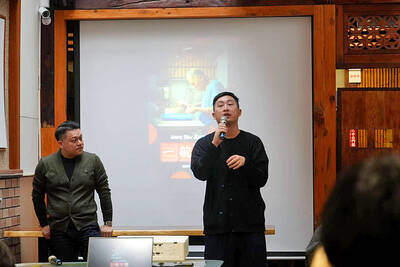
Taiwan Travelogue (臺灣漫遊錄), which earlier this week became the first Taiwanese novel to win the International Booker Prize, is to be adapted into a television series through a Taiwan-Japan coproduction, producer Chang Chen-yu (張辰漁) said yesterday. Chang, a producer at World Softest Production Film Co, wrote on Facebook that the company had been searching for projects with international appeal that retain a strong Taiwanese identity after colleagues and Japanese partners strongly recommended the novel. After reading the book, Chang said he immediately decided to pursue the screen rights. “A great story has the power to transcend time and borders, and connect countless people,”


 RSS
RSS