

A former US national security advisor on Thursday said he expects Taiwan to make large arms procurements during US president-elect Donald Trump’s second presidency to balance the latter’s trade deficit.
Robert O’Brien, who served under Trump from 2019 to 2021, made the remarks during an event hosted by the Washington-based think tank Global Taiwan Institute (GTI).
O’Brien praised Taiwan’s democracy for debunking China’s narrative that “Chinese people can’t govern themselves,” which he said has frustrated and angered Beijing.
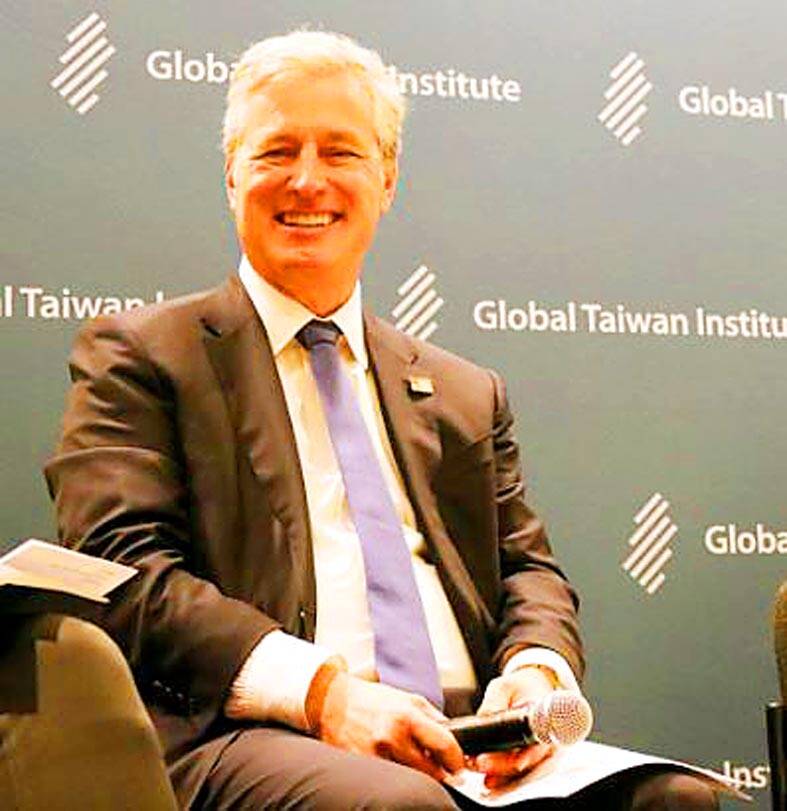
Photo: CNA
Speaking about Trump’s approach to Taiwan in his term, O’Brien described the former president as a “dealmaker” who does not just see Taiwan through a security lens.
“[Trump] also looks Taiwan and sees rich people, and he sees Taiwan as a very rich country,” he said, referring to Taiwan Semiconductor Manufacturing Co’s (TSMC) factories in Arizona as one example.
“I don’t think [Trump] will be willing to underwrite Taiwan’s defense anymore,” O’Brien said. “So, I can see the Taiwanese coming in ... with big purchases of US weapon systems, to balance the trade deficit.”
Last month, Taiwan was named for the sixth consecutive time on the US Department of the Treasury’s twice-yearly currency monitoring list, which also included China, Japan, South Korea, Singapore, Vietnam and Germany.
Together, the seven countries accounted for about 78 percent of the US’ foreign trade in goods and services over the four quarters ending in June this year, the US Treasury said.
Data from the Office of Trade Negotiations showed that the US recorded a trade deficit of US$61.87 billion with Taiwan in the first 10 months of this year.
“The Chinese are gonna make deals with Donald Trump, and the Taiwanese will [have to] prepare to make deals,” O’Brien said.
O’Brien also highlighted Trump’s nomination of several pro-Taiwan officials in his incoming administration, including China hawks Marco Rubio as secretary of state, Mike Waltz as national security advisor and Alex Wong (黃之瀚), who has family connections with Taiwan, as deputy national security advisor.
Jamieson Greer, a member of the Global Taiwan Institute’s US-Taiwan relationship team, has also been designated as US trade representative, he said, adding that “personnel is policy.”
O’Brien confirmed delivering President William Lai’s (賴清德) congratulatory letter to Trump’s Mar-a-Lago residence as reported by CNN last month, and that the US president-elect was reportedly “very pleased.”
O’Brien said Lai’s letter marked one of the first instances of communication following Trump’s election victory.
“I think it was a great start,” he said, despite no direct phone call having taken place.
O’Brien was referring to when former president Tsai Ing-wen (蔡英文) personally called Trump in December 2016 to congratulate him on his first presidential victory.
The 10-minute call marked the first direct communication between a Taiwanese leader and a US president-elect since the diplomatic ties between Taipei and Washington were cut off in 1979.
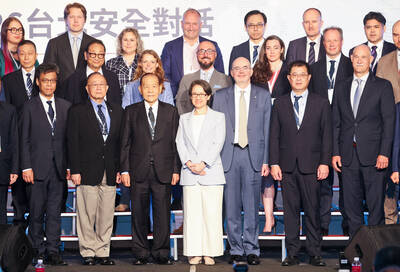
Taiwan’s growing defense preparations might be sending a stronger signal to the US than to Beijing, highlighting the need for Taipei to tailor its deterrence efforts to different audiences, a US security academic said yesterday. Stanford University Freeman Spogli Institute for International Studies fellow Oriana Skylar Mastro made the comment during a Taipei Security Dialogue panel examining lessons Taiwan could draw from the wars in Ukraine and the Middle East. Mastro said she was impressed by Taiwan’s increased defense spending, emphasis on asymmetric capabilities and efforts to prepare society for conflict, but questioned whom those initiatives were influencing. She said when she asked
A total of 400 foreign “high- level” professionals have been naturalized as Republic of China (Taiwan) citizens over the past decade as the government has eased nationality rules to attract talent from a wider range of fields, the Ministry of the Interior said yesterday. The 400th high-level professional, who works in the electronics industry, was approved for ROC citizenship on Aug. 26, the MOI said. The MOI quoted the newly naturalized citizen as saying that Taiwan is a leader in fields such as semiconductors, electronics manufacturing, artificial intelligence development and energy technology. He also said
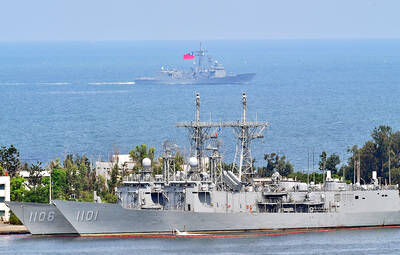
SIZE MATTERS: Large ships are politically attractive as visible symbols of national defense, but small surface combatants are more likely to survive an initial strike Taiwan needs to restructure its naval fleet from focusing on large warships, which are “sitting ducks” for China’s advanced tracking technology, to smaller, stealthy corvettes that are harder to detect but retain sufficient firepower to deter a Chinese invasion, a Taiwanese academic and a former US military commander said in an article published on Friday in the journal Foreign Affairs. Taiwan does not need a fleet capable of competing with the Chinese navy for traditional control of the Taiwan Strait, but rather “sea denial” capabilities that would prevent China from freely using the waterway, Taiwanese aerospace and security expert Holmes Liao
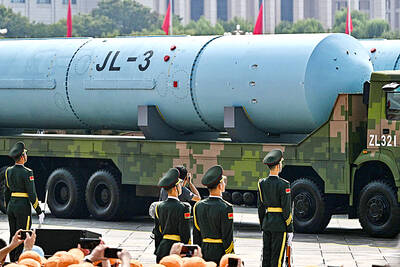
SUB-LAUNCHED SUBOPTIMAL: The JL-3, an upgraded version of the missile test-fired earlier in the summer, would have the range to strike at much of the country Refits to Chinese nuclear submarines to carry JL-3 intercontinental ballistic missiles would put much of the US in striking distance, Taiwanese defense analysts said in a report commissioned by the Mainland Affairs Council. Researchers from National Defense University’s Graduate Institute of China Military Affairs Studies said that the Chinese People’s Liberation Army Navy (PLAN) in July test-fired a missile with a training warhead. Chinese state media reported without elaborating that a PLAN nuclear-powered ballistic missile submarine (SSBN) launched a missile with a training warhead, which accurately hit the designated target area in the Pacific, the report said. The launch was a rare display


 RSS
RSS