


The National Health Insurance Administration (NHIA) yesterday said it does not rule out working with the Ministry of Labor on easing restrictions on hiring foreign workers to help with a nursing shortage.
NHIA Director-General Shih Chung-liang (石崇良) made the comment during a presentation at a forum organized by the Taiwan Union of Nurses Association and Taipei Veterans General Hospital.
Shih highlighted Taiwan’s increasing demographic challenges, including a shrinking workforce and aging population in need of care.
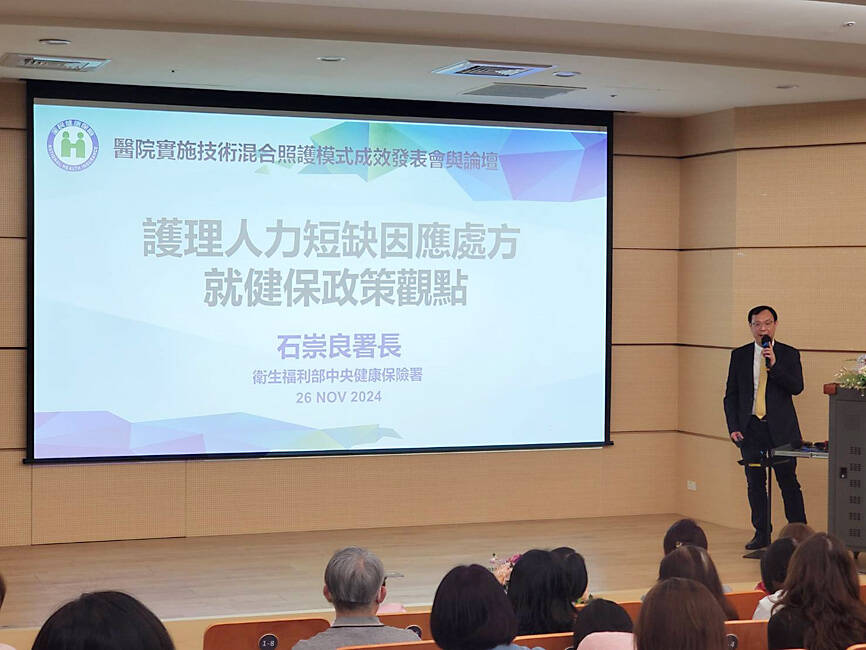
Photo: Lin Hui-chin, Taipei Times
Since 2015, the NHIA has reallocated resources to improve inpatient nursing care, including moving NT$20 billion (US$615.2 million) from hospital budgets to general services and increasing nursing fees, he said.
However, the number of nurses has only grown by 4,000, showing the need to continue improving salaries, he said.
Taiwan has expanded its inpatient care program to meet the needs of an aging population, a low fertility rate and the inability of working-age family members to care for older relatives, he said.
In the inpatient care program, hospitals arrange for nursing assistants to provide care for acute patients, allowing for continuous supervision, he said.
For the service, the NHIA pays hospitals 750 points (1 point equals NT$1) per day per nursing assistant, and the patient pays up to NT$1,050 in fees, he said.
When it was first launched in 2022, the program had a NT$300 million budget with 40 hospitals and 2,847 beds, Shih said.
The program expanded to NT$560 million, 111 hospitals and 5,376 beds last year, along with an increase in usage rate from 14.1 percent to 37.2 percent, he said.
From January to July, the program served 36,380 patients, almost matching last year’s total, he added.
Although patient satisfaction is high with the program, its expansion has been limited by a shortage of nursing staff, Shih said.
If the public supports it, the Ministry of Labor could amend regulations to include foreign workers in these wards, he said.
Taiwan Union of Nurses Association president Chi Shu-ching (紀淑靜) expressed support for including trained foreign care workers and nursing graduates to assist with daily patient care, allowing licensed nurses to concentrate on administering medicine and more urgent tasks.
Pilot programs have shown promising results and there is an opportunity for more government funding to expand them, Chi said.

NATIONAL SECURITY: Authorities are working to confirm the identities of the military personnel involved and investigating possible illegal conduct and regulatory violations Authorities are probing possible national security implications after Kinmen police and immigration officers on Sunday found a Chinese woman allegedly posing as a tourist while engaging in prostitution involving more than 10 military personnel. The woman, surnamed Chen (陳), has since been deported, authorities said, adding that investigators are still working to confirm the identities of those implicated, as the records only listed code names and aliases. The case stemmed from a report received by the Kinmen District Prosecutors’ Office on Friday last week from the Jinhu Precinct of the Kinmen County Police Bureau. On Sunday, police, along with the National Immigration
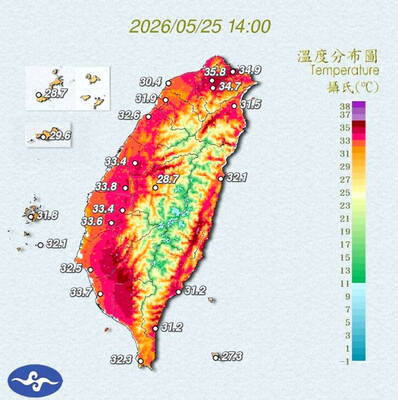
STAY COOL: The HPA recommended that people stay hydrated, use air-conditioning or fans while indoors, wear loose-fitting clothes and walk in the shade while outdoors Employers must implement measures such as installing cooling equipment, and providing drinking water and rest breaks for outdoor workers starting from Monday next week, the Taipei Department of Labor said on Sunday. Employers who fail to comply could face fines of NT$30,000 to NT$300,000 under the Occupational Safety and Health Act (職業安全衛生法), the department said. Businesses in Taipei employing fewer than 100 workers, as well as registered self-employed workers with labor insurance coverage, could receive on-site assessments and guidance from occupational safety consultants to help them apply for central government subsidies to implement or improve heat-protection measures, it said. Under the Ministry of

GLOBALGIVING: ‘ Caving to external pressure is not acceptable for an organization that has cultivated justice reform and human rights for 30 years,’ one NGO said A slew of non-government organizations (NGOs) have withdrawn from the GlobalGiving fundraising platform after it announced it would use “Chinese Taipei” instead of “Taiwan” from next month. The Taiwan Good Rice Association wrote on Facebook on Friday that it was informed on April 28 via a teleconference call of the change, which was made because the platform wanted to operate in China. Taiwan Good Rice is to terminate all cooperative relationships with GlobalGiving in response to the platform’s “unilateral and non-negotiable” decision to remove references to Taiwan, the NGO said. “Taiwan is in the official name of Taiwan Good Rice Association and the

Chinese Nationalist Party (KMT) Chairwoman Cheng Li-wun (鄭麗文) yesterday briefed her party’s Central Standing Committee regarding her scheduled visit to the US between Monday next week and June 16, saying that her purpose would be to persuade the US that the Republic of China (ROC) Constitution was a “one China” constitution that would foster stable and peaceful cross-strait relations. The ROC Constitution is the most important defense for all Taiwanese citizens, as it upholds our democracy and has contributed to our robust economy, which aligns with international and US interests, she said. “We would not be troublemakers and drag the US under,”


 RSS
RSS