


Chung Hua University (CHU), amid declining enrollment, has agreed to merge with National Tsing Hua University (NTHU) and would cease enrolling students as early as next year.
Officials from the universities, both located in Hsinchu City, have reached a preliminary consensus on the merger, but have yet to go through the administrative procedures, CHU president Victor Liu (劉維琪) said on Friday.
Founded in 1990, privately run CHU had a total of 3,898 students enrolled during the 2023 academic year. Its student enrollment numbers have been declining steadily since the 2017 academic year, when it had 6,722 students enrolled.
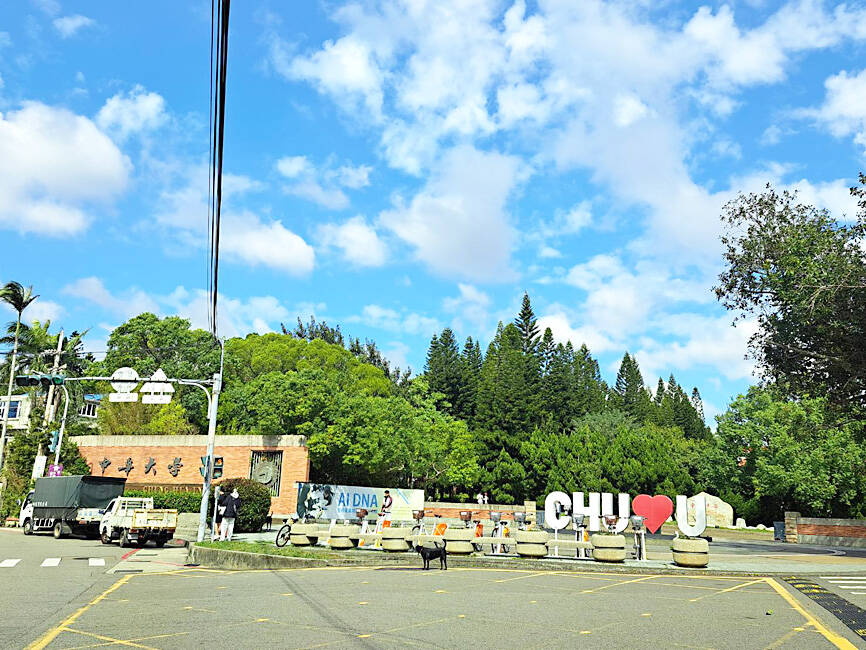
Photo: Hung Mei-hsiu, Taipei Times
The merger and subsequent closure of the university follows a string of private university closures during the past decade, the most recent being TransWorld University, Tatung Institute of Technology and Mingdao University in July.
Liu said that CHU would prioritize the rights of its students and faculty in carrying out the merger.
Current students would be able to take courses that NTHU opens on the CHU campus, Liu said.
Regarding faculty, the school would look to the example set by the National Taiwan University of Science and Technology (NTUST) and Hwa Hsia University of Technology when they merged last year, which allowed the faculty to continue working at the school for six years.
CHU’s financial operations were sound, and the board would continue carrying out the mission of the university, which is to cultivate technological talent for the country, Liu said.
The university agreed to donate its campus and assets to NTHU, Liu added.
The merger would be similar to the NTUST and Hwa Hsia University of Technology merger last year, the first between a public and a private university in Taiwan, NTHU president John Kao (高為元) said
Under that model, CHU would stop enrolling new students as early as the next academic year, with its existing students studying as usual until graduating and receiving diplomas. After the CHU students graduate, NTHU would take over CHU’s campus and equipment, Kao said.
However, NTHU has yet to internally discuss the issue, he added.
NTHU’s College of Semiconductor Research has expressed an interest in setting up courses and equipment on the CHU campus and establish a “Tsing Hua Square Technology Park.” Other departments of the university have also expressed similar interests, which need to be thoroughly discussed, Kao said.
NTHU said in a statement on Thursday that CHU is near the Hsinchu Science Park (新竹科學園區), which provides a geological advantage for cultivating semiconductor talent and developing the industry.
The Ministry of Education on Friday said that it had not received merger plans from the two schools.
It said that after the plan is submitted, it would ensure the rights of existing students and faculty and provide assistance.

Considering that most countries issue more than five denominations of banknotes, the central bank has decided to redesign all five denominations, the bank said as it prepares for the first major overhaul of the banknotes in more than 24 years. Central bank Governor Yang Chin-lung (楊金龍) is expected to report to the Legislative Yuan today on the bank’s operations and the redesign’s progress. The bank in a report sent to the legislature ahead of today’s meeting said it had commissioned a survey on the public’s preferences. Survey results showed that NT$100 and NT$1,000 banknotes are the most commonly used, while NT$200 and NT$2,000

The Centers for Disease Control (CDC) yesterday reported the first case of a new COVID-19 subvariant — BA.3.2 — in a 10-year-old Singaporean girl who had a fever upon arrival in Taiwan and tested positive for the disease. The girl left Taiwan on March 20 and the case did not have a direct impact on the local community, it said. The WHO added the BA.3.2 strain to its list of Variants Under Monitoring in December last year, but this was the first imported case of the COVID-19 variant in Taiwan, CDC Deputy Director-General Lin Ming-cheng (林明誠) said. The girl arrived in Taiwan on

South Korea is planning to revise its controversial electronic arrival card, a step Taiwanese officials said prompted them to hold off on planned retaliatory measures, a South Korean media report said yesterday. A Yonhap News Agency report said that the South Korean Ministry of Foreign Affairs is planning to remove the “previous departure place” and “next destination” fields from its e-arrival card system. The plan, reached after interagency consultations, is under review and aims to simplify entry procedures and align the electronic form with the paper version, a South Korean ministry official said. The fields — which appeared only on the electronic form

The Ministry of Foreign Affairs (MOFA) is suspending retaliation measures against South Korea that were set to take effect tomorrow, after Seoul said it is updating its e-arrival system, MOFA said today. The measures were to be a new round of retaliation after Taiwan on March 1 changed South Korea's designation on government-issued alien resident certificates held by South Korean nationals to "South Korea” from the "Republic of Korea," the country’s official name. The move came after months of protests to Seoul over its listing of Taiwan as "China (Taiwan)" in dropdown menus on its new online immigration entry system. MOFA last week


 RSS
RSS