


A proposed amendment would ban drivers who operate a vehicle without a license from taking the license test for life if their driving kills or injures someone, the Ministry of Transportation and Communications said yesterday.
The ministry yesterday briefed lawmakers in a meeting of the legislature’s Transportation Committee about its plan to tackle forged licensed plates and curb a rise of unlicensed drivers.
The police have reported about 300,000 incidents of unlicensed drivers annually in the past three years, which includes about 39,000 involving minors, the ministry said.
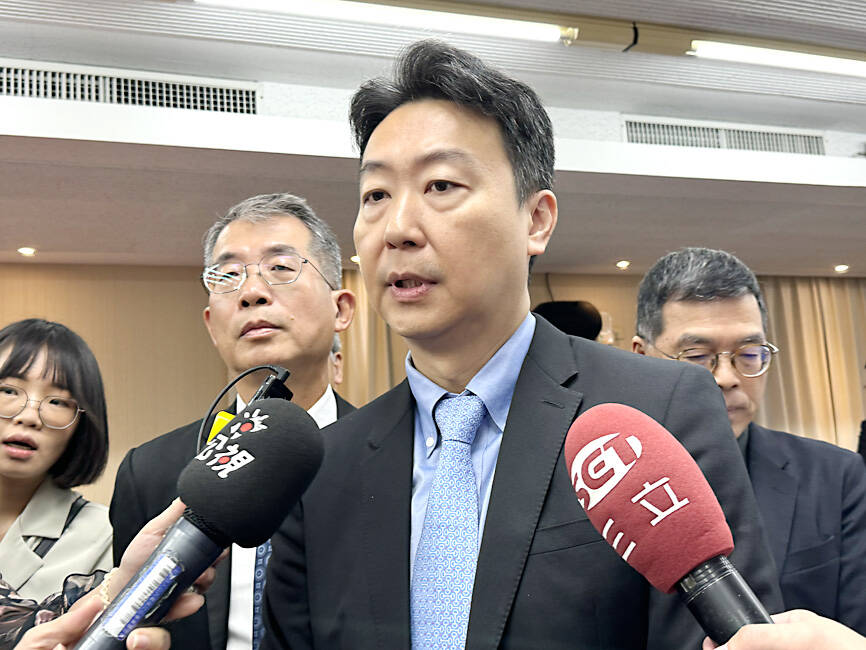
Photo: Tsai Yun-jung, Taipei Times
If a minor is found to have contravened traffic regulations, their legal guardians would be notified immediately, and both of them would be asked to attend defensive driving courses, it said.
The proposed amendment to the Road Traffic Management and Penalty Act (道路交通管理處罰條例) stipulates a maximum fine for unlicensed drivers of NT$36,000, up from NT$24,000, and their vehicles would be confiscated on the spot. The minimum fine for those who were caught driving without a license two or more times within five years would be NT$36,000.
The suspension period of vehicle license plates would also be extended for unlicensed motorcyclists and those driving vehicles, commercial trucks or buses without a license, the proposal says.
License plates of first-time offenders would be suspended for three months, which would be extended to six months if they were caught driving without a license twice within five years.
Those found to have contravened the regulations three or more times would have their license plates suspended for one year, and their vehicle and license would be removed from them immediately.
Unlicensed drivers or those driving with a suspended, revoked or invalid license would not be able to take a driver’s license test for four years. They would be banned from taking the tests for life if they cause accidents leading to deaths or severe personnel injuries.
Fines for unlicensed minors and their legal guardians would be increased, and the suspension period of their license plates would be extended as well.
Meanwhile, Minister of Transportation and Communications Chen Shih-kai (陳世凱) pledged to improve the lighting at pedestrian crossings at night to reduce casualties.
Legislators questioned Chen on pedestrian safety issues after a woman in Taipei was dragged under a bus and killed while crossing a street on Sunday. Although the bus had stopped for the woman and her husband to cross the street, it was pushed forward after it was rear-ended by another bus.
The incident occurred after the government had allocated funding and resources in an attempt to counter Taiwan’s reputation as a “living hell for pedestrians.”
Democratic Progressive Party Legislator Lin Chun-hsien (林俊憲) said the number of pedestrian deaths from 6pm to 6am are almost double those recorded during the daytime, citing data from the transportation ministry.
As of September, there were 19 A1-category accidents from 6am to 6pm, in which victims died within 24 hours, but that number rose to 30 during the period from 6pm to 6am, he said.
Many drivers claim they did not see pedestrians in the darkness, he said.
In addition to improving lightning at pedestrian crossings, many countries have installed devices to force drivers to slow down, Lin said.

SPACE VETERAN: Kjell N. Lindgren, who helps lead NASA’s human spaceflight missions, has been on two expeditions on the ISS and has spent 311 days in space Taiwan-born US astronaut Kjell N. Lindgren is to visit Taiwan to promote technological partnerships through one of the programs organized by the US for its 250th national anniversary. Lindgren would be in Taiwan from Tuesday to Saturday next week as part of the US Bureau of Educational and Cultural Affairs’ US Speaker Program, organized to celebrate the 250th anniversary of the signing of the Declaration of Independence, the American Institute in Taiwan (AIT) said in a statement yesterday. Lindgren plans to engage with key leaders across the nation “to advance cutting-edge technological partnerships and inspire the next generation of scientists and engineers,”

The Chinese Nationalist Party (KMT) caucus yesterday said it opposes the introduction of migrant workers from India until a mechanism is in place to prevent workers from absconding. Minister of Labor Hung Sun-han (洪申翰) on Thursday told the Legislative Yuan that the first group of migrant workers from India could be introduced as early as this year, as part of a government program. The caucus’ opposition to the policy is based on the assessment that “the risk is too high,” KMT caucus secretary-general Lin Pei-hsiang (林沛祥) said. Taiwan has a serious and long-standing problem of migrant workers absconding from their contracts, indicating that

UNREASONABLE SURVEILLANCE: A camera targeted on an road by a neighbor captured a man’s habitual unsignaled turn into home, netting him dozens of tickets The Taichung High Administrative Court has canceled all 45 tickets given to a man for failing to use a turn signal while driving, as it considered long-term surveillance of his privacy more problematic than the traffic violations. The man, surnamed Tseng (曾), lives in Changhua County and was reported 45 times within a month for failing to signal while driving when he turned into the alley where his residence is. The reports were filed by his neighbor, who set up security cameras that constantly monitored not only the alley but also the door and yard of Tseng’s house. The surveillance occurred from July

TRADE-OFF: Beijing seeks to trade a bowl of tempura for a Chinese delicacy, an official said, while another said its promises were attempts to interfere in the polls The government must carefully consider the national security implications of building a bridge connecting Kinmen County and Xiamen, China, the Public Construction Commission (PCC) said yesterday. PCC Commissioner Derek Chen (陳金德), who is also a minister without portfolio, made the remarks in a meeting of the legislature’s Transportation Committee, after Democratic Progressive Party Legislator Hsu Fu-kuei (徐富癸) asked about China’s proposal of new infrastructure projects to further connect Kinmen and Lienchiang (Matsu) counties with Xiamen. China unveiled the bridge plan, along with nine other policies for Taiwan, on Sunday, the last day of Chinese Nationalist Party (KMT) Chairwoman Cheng Li-wun’s (鄭麗文) visit


 RSS
RSS