


Taiwanese officials have contacted the incoming US administration about procuring up to US$15 billion in military hardware, including the Aegis destroyer, the Financial Times reported yesterday.
The paper quoted several sources likely to be in the administration of US president-elect Donald Trump regarding Taiwan’s intentions to demonstrate that the nation is “serious” about its defense.
A former Trump administration official was quoted as saying that when the US national security advisor is formally announced, Taiwan is to “present a very aggressive package of American hardware.”
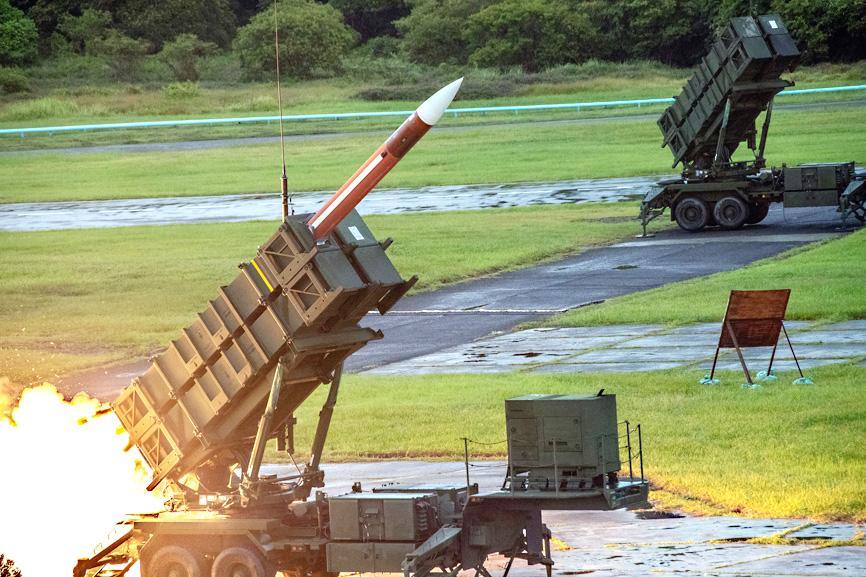
Photo courtesy of Ministry of National Defense via CNA
The piece quotes a high-ranking Taiwanese official confirming there have been informal discussions with the Trump team on the kind of arms deal that would signal Taiwan’s commitment to its own defense.
“There are quite a few big platforms and other items that our armed forces have had their eyes on for a long time, but have not been able to acquire, so there’s a lot to choose from,” the paper quoted the official as saying.
This would include the Aegis destroyer, another official said, although other officials and experts said that some more expensive and necessary items would “leave a bigger impression.”
“If you are talking about a wish list, this is the time to ask for F-35s,” Institute for National Defense and Security Research fellow Su Tzu-yun (蘇紫雲) was quoted as saying.
Taiwan may also wish to request retired ships like the Ticonderoga-class cruisers and Perry-class frigates, he added.
This current package could be worth US$15 billion, Su said, citing reporting that Taiwan might request 60 F-35s, four Advanced Hawkeyes, 10 retired vessels and 400 Patriot missiles.
Elbridge Colby, who served as US deputy assistant secretary of defense for strategy and force development during the first Trump administration and may be named to a senior position in the new administration, has repeatedly urged Taiwan to spend more on its military.
“Those who care about Taiwan should be super clear they need to dramatically step up. Their fate hangs in the balance,” Colby said recently on X.
The piece also quotes Trump’s former deputy assistant secretary of defense for East Asia, Heino Klinck, who said that while the F-35 suggestion is not necessary, Taiwan’s approach is the right one.
Klinck added that critical capabilities such as air and missile defense systems, and enacting defense reforms, should outweigh F-35s, which “would not make much sense operationally or fiscally.”
The anonymous Taiwanese officials expressed confidence that concerns regarding Trump and Taiwan are exaggerated, as support for the nation has bipartisan consensus.
In his first term, Trump approved 11 packages to Taiwan worth US$21 billion, including F-16 jets and tanks, with the administration under US President Joe Biden also approving US$7 billion in deals.
The Financial Times quoted US-Taiwan Business Council president Rupert Hammond-Chambers as saying that a large arms deal “could look like a down payment that would attempt to get off on the right foot with the new administration.”
Presidential Office spokesperson Karen Kuo (郭雅慧) has not confirmed or denied the talks, while the Trump team has also not responded to related questions.

FUKUOKA SITUATION: Japanese media reported that the pathogen is expected to be identified by the summer, while the CDC downplayed the idea that it was hMPV A “mysterious cold-like illness” reported in Japan’s Fukuoka Prefecture does not seem to be a new disease, but Japanese authorities have been asked about the situation, the Centers for Disease Control (CDC) said yesterday. The Fukuoka Prefectural Medical Association on Wednesday told a news conference that a “mystery cold” that has become a hot topic on social media is “highly likely to be caused by some kind of viral infection,” Japan’s KBC News reported. “Many people are experiencing symptoms starting with a sore throat, followed by a runny nose, phlegm and a severe cough,” KBC News reported, citing association officials. Health authorities are

Nvidia Corp CEO Jensen Huang (黃仁勳) arrived in Taiwan yesterday ahead of upcoming AI and technology events, saying he plans to meet with clients and Taiwan Semiconductor Manufacturing Co Chairman C.C. Wei (魏哲家) during his visit. After landing at Taipei Songshan Airport, Huang posed for photos with fans and handed out Yakult drinks to reporters and supporters waiting at the scene, saying he has “a lot to do” during the trip. Asked about reports that Nvidia’s planned headquarters site in Taipei’s Beitou Shilin Technology Park could break ground on May 27, Huang said that if the company holds an event, he would

The Ministry of Finance this afternoon announced the winning numbers for the March-April uniform invoice lottery. The winning number for the NT$10 million (US$318,060) special prize is 19531471, and the winning number for the NT$2 million grand prize is 85941329. Three numbers were drawn for the NT$200,000 first prize: 07225810, 20231230 and 83518781. Those with receipts matching the last seven digits of any of the first-prize numbers will win the NT$40,000 second prize, while those matching the last six digits will win the NT$10,000 third prize. Those whose receipts match the last five digits of the first-prize numbers can claim the NT$4,000 fourth prize,
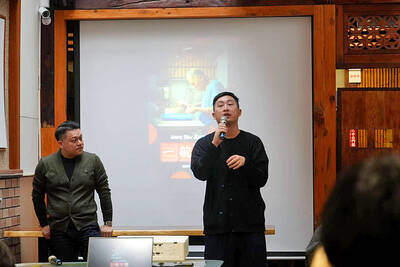
Taiwan Travelogue (臺灣漫遊錄), which earlier this week became the first Taiwanese novel to win the International Booker Prize, is to be adapted into a television series through a Taiwan-Japan coproduction, producer Chang Chen-yu (張辰漁) said yesterday. Chang, a producer at World Softest Production Film Co, wrote on Facebook that the company had been searching for projects with international appeal that retain a strong Taiwanese identity after colleagues and Japanese partners strongly recommended the novel. After reading the book, Chang said he immediately decided to pursue the screen rights. “A great story has the power to transcend time and borders, and connect countless people,”


 RSS
RSS