


Every winter in Kinmen, thousands of cormorants can be seen at dawn and dusk, forming V-shaped or straight lines in the sky as they return to their roosts. This spectacular “black-clad army” descending upon Kinmen is one of the park’s most iconic ecological sights. These visitors from southern Siberia have become a top bird-watching attraction for birdwatchers. What is not widely known is that over the past two years, the Kinmen National Park Headquarters (KMNP) has been dedicated to a series of long-term habitat restoration efforts to prevent the disappearance of the ecological spectacle of the “black army” of cormorants in Kinmen.
Located on the edge of the Eurasian continent, Kinmen serves as a key stopover for migratory birds in East Asia. Each year, from autumn to late spring, large flocks of migratory birds fly south to Kinmen to feed and pass through, with an impressive variety and abundance of species. While Taiwan’s main island has recorded 674 bird species across 87 families, Kinmen, with an area half the size of Taipei City, is home to over 430 species, 74% of which are migratory.
Despite the rich bird diversity, over 20 years of monitoring by the KMNP has revealed a decline in cormorant numbers visiting Kinmen in the past five years. The population have dropped from 11,330 in 2020, to 9,583 in 2021, 8,553 in 2022, 7,721 in December 2023, and 7,517 by mid-January 2024, marking four consecutive years below 10,000.

Photo credit: Kinmen National Park Headquarters, Photographer: Liao Dong-kun
KMNP commissioned Professor TING Tsung-Su from the Department of Forestry and Resource Conservation at National Taiwan University to conduct a three-year study (2020–2022) on cormorant migration and ecology in Kinmen. The report highlighted the severe impact of Typhoon Meranti in September 2016, which significantly damaged Kinmen’s casuarina trees, a crucial roosting species for cormorants. The storm reduced forested areas, and invasive species and habitat fragmentation further dispersed the cormorants’ roosting sites. Some even shifted to nearby Xiamen for nighttime roosting.
Cormorants prefer tall forests near water for roosting. Professor Ting recommended that degraded public lands in key roosting areas within Kinmen National Park be restored by removing invasive species like Leucaena and Morning Glory, and replanting hardy, fast-growing Casuarina seedlings.
For privately-owned lands, such as those near fishponds, he suggested developing ecosystem service payment plans and ecological compensation mechanisms to encourage landowner participation in habitat restoration. Monitoring methods should also be dynamically adjusted to provide timely ecological data and implement adaptive management strategies.
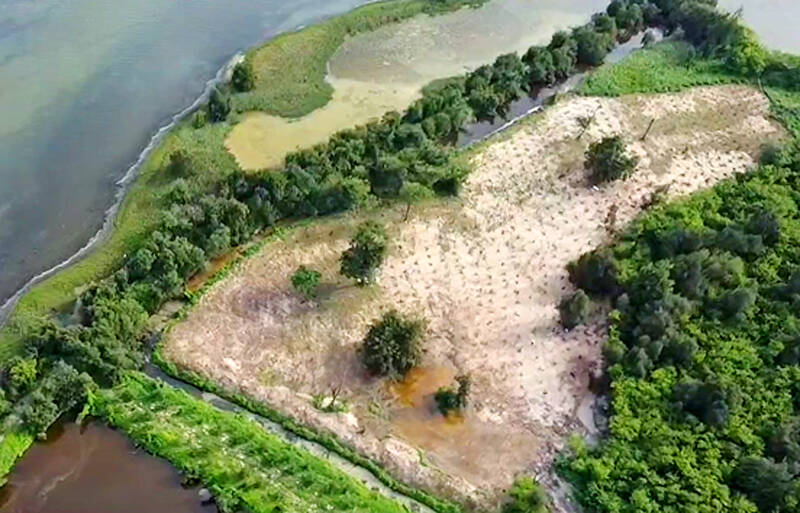
Photo credit: Kinmen National Park Headquarters
KMNP places great emphasis on the conservation of cormorants, continuously monitoring their numbers and behavior while prioritizing habitat restoration at Ci Lake since 2023. Efforts include removing invasive species like Morning Glory and Leucaena from degraded habitats, alongside planting over 2,600 trees, such as Casuarina and Melaleuca, to create a more suitable roosting environment. These actions aim to ensure cormorants return year after year.
Birds are vital indicators of environmental health, with their abundance reflecting the diversity of the ecosystem, and they are an essential resource for sustainable tourism in Kinmen. As habitats shrink, food webs become simpler, and the ecosystem’s natural regulatory functions diminish, highlighting the importance of habitat restoration, especially in the face of extreme weather events that pose significant challenges to maintaining island ecosystems.

FUKUOKA SITUATION: Japanese media reported that the pathogen is expected to be identified by the summer, while the CDC downplayed the idea that it was hMPV A “mysterious cold-like illness” reported in Japan’s Fukuoka Prefecture does not seem to be a new disease, but Japanese authorities have been asked about the situation, the Centers for Disease Control (CDC) said yesterday. The Fukuoka Prefectural Medical Association on Wednesday told a news conference that a “mystery cold” that has become a hot topic on social media is “highly likely to be caused by some kind of viral infection,” Japan’s KBC News reported. “Many people are experiencing symptoms starting with a sore throat, followed by a runny nose, phlegm and a severe cough,” KBC News reported, citing association officials. Health authorities are

Nvidia Corp CEO Jensen Huang (黃仁勳) arrived in Taiwan yesterday ahead of upcoming AI and technology events, saying he plans to meet with clients and Taiwan Semiconductor Manufacturing Co Chairman C.C. Wei (魏哲家) during his visit. After landing at Taipei Songshan Airport, Huang posed for photos with fans and handed out Yakult drinks to reporters and supporters waiting at the scene, saying he has “a lot to do” during the trip. Asked about reports that Nvidia’s planned headquarters site in Taipei’s Beitou Shilin Technology Park could break ground on May 27, Huang said that if the company holds an event, he would

The Ministry of Finance this afternoon announced the winning numbers for the March-April uniform invoice lottery. The winning number for the NT$10 million (US$318,060) special prize is 19531471, and the winning number for the NT$2 million grand prize is 85941329. Three numbers were drawn for the NT$200,000 first prize: 07225810, 20231230 and 83518781. Those with receipts matching the last seven digits of any of the first-prize numbers will win the NT$40,000 second prize, while those matching the last six digits will win the NT$10,000 third prize. Those whose receipts match the last five digits of the first-prize numbers can claim the NT$4,000 fourth prize,

Taiwan Travelogue (臺灣漫遊錄), which earlier this week became the first Taiwanese novel to win the International Booker Prize, is to be adapted into a television series through a Taiwan-Japan coproduction, producer Chang Chen-yu (張辰漁) said yesterday. Chang, a producer at World Softest Production Film Co, wrote on Facebook that the company had been searching for projects with international appeal that retain a strong Taiwanese identity after colleagues and Japanese partners strongly recommended the novel. After reading the book, Chang said he immediately decided to pursue the screen rights. “A great story has the power to transcend time and borders, and connect countless people,”


 RSS
RSS