


China’s hostility toward Taiwan would only have “the opposite effect” of what it hopes to achieve and further alienate Taiwanese, similar to how Russia has changed the perception of many Ukrainians, visiting members of the European Parliament (MEPs) said on Wednesday.
Asked how he viewed China’s attempts to bring Taiwanese into its orbit, German MEP Michael Gahler compared it to the situation in Ukraine.
“There were many Russian speakers in Ukraine who, for a while, asked themselves: ‘Who am I living in this country?’” said Gahler, chair of the European Taiwan Friendship Group, who is leading a delegation of MEPs in Taiwan.
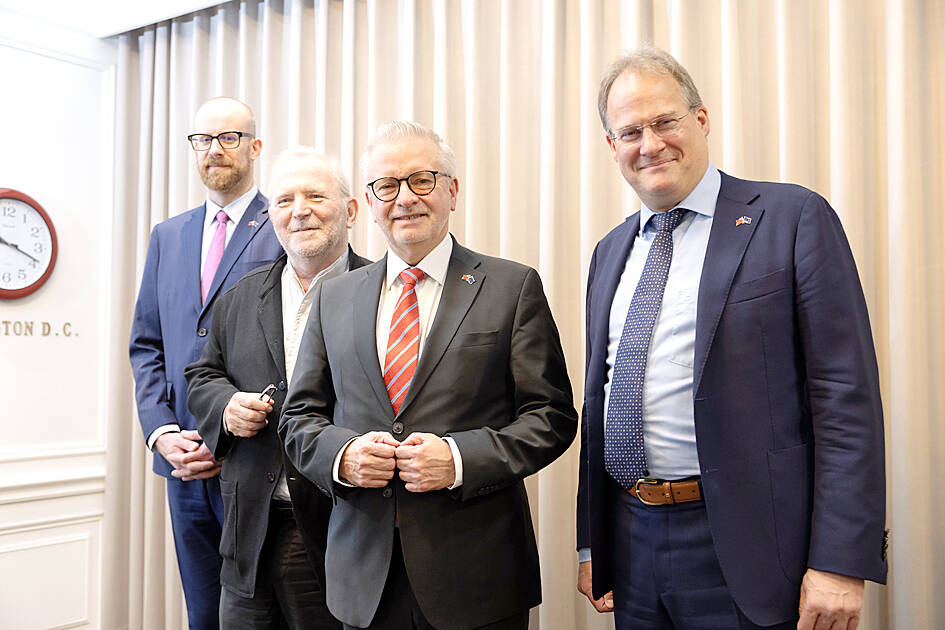
Photo: CNA
After Russia’s occupation of Crimea in 2014 and its full-scale invasion of Ukraine in February 2022, those people made it very clear that “I am Ukrainian. I do not want to be treated as the Russians,” Gahler said.
“Yes, I speak Russian, but I do not want to be treated in such a way. And that is not the future that I see,” he said, describing their change in attitude.
This, along with Russia’s pretext for war — that Russian speakers in Ukraine were discriminated against — has had the “opposite effect” of what Russia hoped to achieve, and the same can be said of China’s approach with Taiwan, Gahler said.
“The more pressure there is, the more you say, ‘no, we belong together and we stand together, and we do not want to be part of something that is so unfriendly to us,” he said.
French MEP Bernard Guetta, a member of the delegation, agreed.
“The Beijing authorities should understand that, because of their hostility toward Taiwan, you are more and more a nation in the making — not only a country, but a nation in the making,” Guetta said.
Asked what he found most impressive about Taiwan, Gahler said it was Taiwan being a “daily provocation” to China.
“You prove every day that one can organize a Chinese-speaking society in a democratic way and in a more successful way than the communist mainland,” he said.
The European Parliament rejecting China’s “misinterpretation” of UN Resolution 2758 was a “sign of unity and broad understanding that we do not want political circumstances to be unilaterally misinterpreted in a certain way,” Gahler said.
The vote against China’s bid to sideline Taiwan in the international community with its interpretation of the resolution was carried on Thursday last week with a strong majority vote of 432 to 60 and 71 abstentions.
While the UN resolution was clear about the People’s Republic of China (PRC) replacing the Republic of China on the UN Security Council and that the PRC is the only representative of China in the UN, there was no language in it indicating that statehood should be the prerequisite for international relations, Gahler said, adding that Taiwan should make use of opportunities to participate in international fora as an observer or participating entity.
“There is no point for China to interpret something against Taiwan that is not in this resolution, and that is their attempt,” he said.
Asked what the delegation discussed with Vice President Hsiao Bi-khim (蕭美琴) during a meeting on Tuesday, Gahler said they were exploring possibilities to broaden economic cooperation between the EU and Taiwan.
The two sides exchanged opinions on how they could arrive at economic agreements in certain sectors, he added.
The European Parliament had earlier proposed entering into a bilateral investment agreement with Taiwan, but many economic insiders said making the move now would be “too ambitious.”
It is the parliament’s job to identify areas of mutual benefit where both sides can strengthen cooperation, Gahler said, citing the signing of memorandums of understanding as an example.
Taiwan is a “world champion” in semiconductors, but the parliament hopes to expand cooperation in artificial intelligence, which is being developed at a rapid pace and is an area where the EU needs to “catch up” by collaborating with Taiwan, he said.
In many cases, the EU has provided the technology used by Taiwan to make new products, he added.
That “mutual dependence” must be further developed so it can better benefit both sides, Gahler said.

FUKUOKA SITUATION: Japanese media reported that the pathogen is expected to be identified by the summer, while the CDC downplayed the idea that it was hMPV A “mysterious cold-like illness” reported in Japan’s Fukuoka Prefecture does not seem to be a new disease, but Japanese authorities have been asked about the situation, the Centers for Disease Control (CDC) said yesterday. The Fukuoka Prefectural Medical Association on Wednesday told a news conference that a “mystery cold” that has become a hot topic on social media is “highly likely to be caused by some kind of viral infection,” Japan’s KBC News reported. “Many people are experiencing symptoms starting with a sore throat, followed by a runny nose, phlegm and a severe cough,” KBC News reported, citing association officials. Health authorities are

Nvidia Corp CEO Jensen Huang (黃仁勳) arrived in Taiwan yesterday ahead of upcoming AI and technology events, saying he plans to meet with clients and Taiwan Semiconductor Manufacturing Co Chairman C.C. Wei (魏哲家) during his visit. After landing at Taipei Songshan Airport, Huang posed for photos with fans and handed out Yakult drinks to reporters and supporters waiting at the scene, saying he has “a lot to do” during the trip. Asked about reports that Nvidia’s planned headquarters site in Taipei’s Beitou Shilin Technology Park could break ground on May 27, Huang said that if the company holds an event, he would

The Ministry of Finance this afternoon announced the winning numbers for the March-April uniform invoice lottery. The winning number for the NT$10 million (US$318,060) special prize is 19531471, and the winning number for the NT$2 million grand prize is 85941329. Three numbers were drawn for the NT$200,000 first prize: 07225810, 20231230 and 83518781. Those with receipts matching the last seven digits of any of the first-prize numbers will win the NT$40,000 second prize, while those matching the last six digits will win the NT$10,000 third prize. Those whose receipts match the last five digits of the first-prize numbers can claim the NT$4,000 fourth prize,

Taiwan Travelogue (臺灣漫遊錄), which earlier this week became the first Taiwanese novel to win the International Booker Prize, is to be adapted into a television series through a Taiwan-Japan coproduction, producer Chang Chen-yu (張辰漁) said yesterday. Chang, a producer at World Softest Production Film Co, wrote on Facebook that the company had been searching for projects with international appeal that retain a strong Taiwanese identity after colleagues and Japanese partners strongly recommended the novel. After reading the book, Chang said he immediately decided to pursue the screen rights. “A great story has the power to transcend time and borders, and connect countless people,”


 RSS
RSS