


Reported usage of so-called “zombie vapes” has grown 58-fold this year, the Taiwan High Prosecutors’ Office said on Wednesday last week.
“Zombie vapes” use etomidate, a type of central nervous system depressant that can induce anesthesia.
The office cited data from the Food and Drug Administration as showing that the number of etomidate-positive non-urine samples has surged by 58.2 times from 22 last year to 1,281 as of last month.
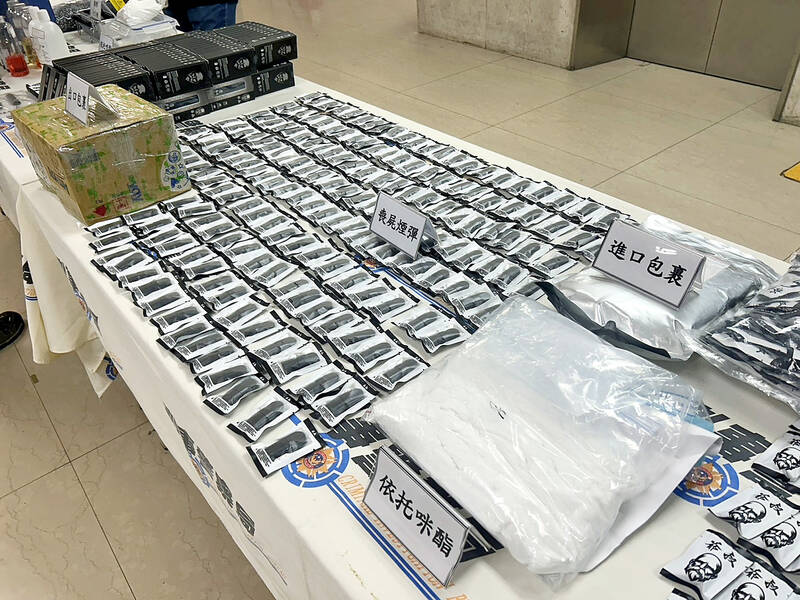
Photo: Chiu Chun-fu, Taipei Times
The authorities also seized 2.3 tonnes of cannabis last year, up 9.7 times from 240.5kg in 2021, and 15,360 cannabis plants from January to August, an increase of 1.6 times from 6,692 plants last year, it said.
That indicates that cannabis has become one of the most popular narcotics in Taiwan, it added.
Abusing etomidate could lead to irritability, disorganized behavior, tremors, twitching or even death, Kaohsiung Medical University Chung-Ho Memorial Hospital pediatrician Lin Yi-ching (林宜靜) said.
Taiwan High Prosecutors’ Office prosecutor Chao Yen-li (趙燕利) said the office would clamp down on drug abuse, as cannabis and etomidate-related narcotics are increasingly used among young people and the number of reported seizures has been increasing over the past few years.
The office would monitor the sources and destinations of narcotic ingredients, and sites for drug cultivation, manufacturing and distribution, while working with international law enforcement, he said.
Criminal Investigation Bureau official Liu Chen-ju (劉貞汝) said the number of hit-and-run incidents that occur while driving under the influence of etomidate-related narcotics is increasing.
Two police officers died in the line of duty and five others have been injured this year, Liu said.
From July to this month, authorities seized 14,128 “zombie vape” cartridges, along with e-liquid and powders that could be made into more than 1.83 million cartridges worth about NT$4.6 billion (US$143,432 million), she said.
While etomidate is listed as a Category 3 narcotic, a narcotics review committee meeting would be convened early next month to discuss whether to upgrade the drug to Category 2, Ministry of Justice Department of Prosecutorial Affairs Director-General Kuo Yung-fa (郭永發) said.
Meanwhile, Taiwan High Prosecutors’ Office prosecutor Huang Kuan-yun (黃冠運) said the office continues to promote a policy offering deferred prosecution and addiction treatment for drug users.
The recidivism rate for people who received deferred prosecution and addiction treatment was only 22.5 percent, much lower than those who were sentenced to observation, rehabilitation, compulsory abstention or rehabilitation in prison, he said.
The office would request district prosecutors to use deferred prosecution and addiction treatment to encourage defendants in drug abuse cases to abstain from narcotics, Huang said.

FUKUOKA SITUATION: Japanese media reported that the pathogen is expected to be identified by the summer, while the CDC downplayed the idea that it was hMPV A “mysterious cold-like illness” reported in Japan’s Fukuoka Prefecture does not seem to be a new disease, but Japanese authorities have been asked about the situation, the Centers for Disease Control (CDC) said yesterday. The Fukuoka Prefectural Medical Association on Wednesday told a news conference that a “mystery cold” that has become a hot topic on social media is “highly likely to be caused by some kind of viral infection,” Japan’s KBC News reported. “Many people are experiencing symptoms starting with a sore throat, followed by a runny nose, phlegm and a severe cough,” KBC News reported, citing association officials. Health authorities are

Nvidia Corp CEO Jensen Huang (黃仁勳) arrived in Taiwan yesterday ahead of upcoming AI and technology events, saying he plans to meet with clients and Taiwan Semiconductor Manufacturing Co Chairman C.C. Wei (魏哲家) during his visit. After landing at Taipei Songshan Airport, Huang posed for photos with fans and handed out Yakult drinks to reporters and supporters waiting at the scene, saying he has “a lot to do” during the trip. Asked about reports that Nvidia’s planned headquarters site in Taipei’s Beitou Shilin Technology Park could break ground on May 27, Huang said that if the company holds an event, he would

The Ministry of Finance this afternoon announced the winning numbers for the March-April uniform invoice lottery. The winning number for the NT$10 million (US$318,060) special prize is 19531471, and the winning number for the NT$2 million grand prize is 85941329. Three numbers were drawn for the NT$200,000 first prize: 07225810, 20231230 and 83518781. Those with receipts matching the last seven digits of any of the first-prize numbers will win the NT$40,000 second prize, while those matching the last six digits will win the NT$10,000 third prize. Those whose receipts match the last five digits of the first-prize numbers can claim the NT$4,000 fourth prize,

Former president Ma Ying-jeou (馬英九) yesterday expressed “shock and regret” over a statement issued by his wife without his consent, and rejected her assertion that his eldest sister, Ma Yi-nan (馬以南), would manage his medical care or act as his spokesperson amid an ongoing embezzlement probe into his foundation. Ma Ying-jeou in a statement said he was shocked by a statement by his wife, Chou Mei-ching (周美青), regarding his affairs. Ma Yi-nan “must not” be in charge of his healthcare and other personal affairs, nor can she be allowed to represent the Ma family, the former president said. He said he was also


 RSS
RSS