

China’s attempts at expanding into waters around Taiwan are facing international pushback, the National Security Bureau (NSB) said.
Beijing’s expansion into the Taiwan Strait, and East China and South China seas has triggered international countermeasures, the NSB said in a report to the Legislative Yuan.
The US and China have not changed their strategic rivalry, it said. The US is closely monitoring China’s coercive “gray zone” tactics in the Indo-Pacific region and expressed support for maintaining the “status quo” in the Taiwan Strait. Meanwhile, China maintains its position on Taiwan, emphasizing its right to enforce its laws in the South China Sea, and has attempted to exclude the US in the ongoing issue according to the Declaration on the Conduct of Parties in the South China Sea agreement.

Photo: AFP
As a way to counter the US’ containment strategy, China has also suspended arms control and arms proliferation consultations with the US, the NSB added.
Chinese President Xi Jinping (習近平) has tried to prepare his party and armed forces for military conflict at sea, and promote the construction of “modern” sea and air border defenses, the report said.
China has also expanded its jurisdiction in the region through laws such as China Coast Guard Regulation No. 3, which allows the coast guard to board and hold vessels in disputed waters it claims, as well as augmenting its patrols and surveillance at sea, the NSB said.
In the area around the Taiwan Strait, the Chinese People’s Liberation Army (PLA) has renovated coastal airports and used military exercises to demonstrate the integration of its maritime policing and military capabilities and put pressure on Taiwan, it said.
The PLA has frequently crossed into the restricted waters around Taiwan’s outlying islands with military, non-military and dual-use vessels, and has even sent small speedboats to Linkou (林口) and Tamsui (淡水), expanding the potential area of “gray zone” tactics and further harassing Taiwan, the report said.
In the East China Sea, the PLA recently sent four armed vessels to the Diaoyutai Islands (釣魚台) — also known as the Senkakus in Japan — in addition to its patrols around Japan’s Ryukyu Islands and sending an intelligence-gathering plane in Japan’s airspace for the first time in August, it said.
In the South China Sea, the PLA held joint naval exercises with the Russian navy for the first time in eight years and has made controversial actions such as ramming Philippine Coast Guard vessels, it added.
In response, the US and its allies have frequently highlighted the importance of peace and stability in the Taiwan Strait and have opposed China’s provocations, the report said.
The US has made Japan the centerpiece of its Indo-Pacific strategy through the recently upgraded US unified command in Japan, its attempts to bring Japan closer to the Philippines and Australia, the AUKUS security alliance and the Quad — consisting of Australia, Japan, India and the US, the NSB said.
European countries are also increasingly expressing their concerns about the stability and peace in the region by making more frequent transits through the Taiwan Strait and their participation in joint military training exercises, it added.

A Hualien pomelo farmer refused to sell to China after the country announced it would permit more Taiwanese pomelo imports, prompting widespread support from Taiwanese consumers, who rallied to buy his fruit. China’s Taiwan Affairs Office last month said that China’s General Administration of Customs registered an additional 79 Taiwanese pomelo orchards and packing facilities in Hualien County, allowing more Taiwanese producers to export pomelos to China. “I am a Hualien fruit farmer and I refuse to sell to China,” Liu Tzu-hao (劉子豪) from Ruisui Township (瑞穗) said in an online post. Liu is a well-known farmer in the community and has served
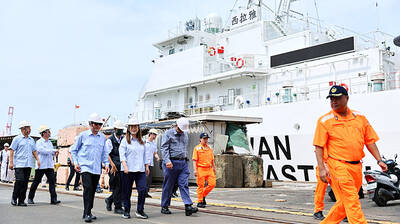
Ocean Affairs Council (OAC) Minister Kuan Bi-ling (管碧玲) on Wednesday said decommissioned coast guard vessels were given to the Philippines to enhance regional rescue capacity and would not affect Taiwanese fishers’ rights and benefits. Kuan made the remarks after confirmation on Tuesday that a 500-tonne Coast Guard Administration (CGA) patrol and rescue vessel would be given to the Philippine Coast Guard. The donation ceremony was reportedly done in Manila, but whether the vessel — previously numbered “CG123” and named Kinmen (金門) — has been handed over has yet to be confirmed. China’s Taiwan Affairs Office (TAO) on Wednesday criticized the donation for “taking
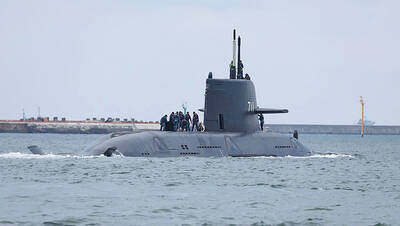
UPDATE: The submarine would need to undergo combined systems testing and crew training for navy personnel before it is ready for mission, an expert said Taiwan’s first domestically built submarine, the Hai Kun (Narwhal, 海鯤), could be delivered to the navy as early as next month, military expert and Taiwan Association for Security and Development chairman Chi Tung-yun (紀東昀) said yesterday. The submarine was yesterday morning observed departing for its 21st sea trial and its 15th submerged test. The vessel missed the initial delivery deadline of November last year due to “testing delays,” its primary contractor, shipbuilder CSBC Corp, Taiwan, said in June. The contractor also cited “political pressure from China” in procuring critical equipment. All testing operations are in the final stages, with the
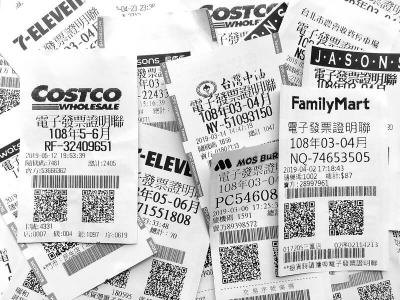
Six NT$10 million (US$315,527) special prizes and seven NT$2 million grand prizes in Taiwan's May-June uniform invoice lottery remained unclaimed as of today, including one NT$10 million winner who spent only NT$10 on an Uber Eats delivery order, the Ministry of Finance said. The ministry said the 13 winners need to claim their prizes by Nov. 5. The eight-digit serial number that won the NT$10 million special prize for May-June was 38548029, with 18 winning receipts in total. The NT$2 million grand prize number was 10138845, of which there were 22 winning receipts, the ministry said. In addition to the receipt issued for an


 RSS
RSS