


Three have died and nine others were in hospitals this morning after eating millet dumplings that may have contained toxic pesticides.
Yesterday evening, a woman surnamed Tseng (曾) in Taitung County’s Jinfeng Township (金峰) was taken to the hospital after developing convulsions, but was unable to be resuscitated.
About 30 friends and family came over that evening to observe her wake, where they ate the same millet dumplings with snails, bamboo shoots and taro that Tseng had made and consumed earlier.

Photo copied by Huang Ming-tang, Taipei Times
A total of 12 attendees began seeking medical attention starting at about 3am for vomiting and convulsions.
Six of them lost consciousness on the way to the hospital.
By 7am, two more had died and nine were still in hospitals receiving treatment.
Since many people were exhibiting the same symptoms, family members suspected it might have been food poisoning and sent the remaining millet dumplings and other food to a hospital for testing.
Tseng came in at about 9pm yesterday exhibiting a strange smell, Taitung Mackay Memorial Hospital emergency room director Liu En-jui (劉恩睿) told reporters.
Liu said he asked the family if it might have been food poisoning, but they said it was not likely and suspected it was an illness related to her advanced age.
Six more people came to the Mackay hospital throughout the night, two of whom exhibited the same smell, causing doctors to suspect food poisoning, Liu said.
It appeared to be a neurotoxin, potentially an organophosphate used in pesticides or another type found naturally in plants, he said, adding that the patients had constricted pupils and were trembling, with body stiffness and secretions from the mouth and nose.
Taitung County police this morning visited the village and questioned the man who collected the snails to ascertain their source.
County health officials have also visited Tseng’s family and the hospitals to gather samples and the remaining dumplings.

In a historic first, Taiwanese officials participated in this year’s Riga Strategic Communications Dialogue in Latvia from Wednesday to Friday last week, which debuted a breakout session focused on Taiwan The event organizer, the NATO Strategic Communications Center of Excellence, displayed Taiwan’s national flag and the officials’ formal titles on their Web site. Taiwanese attendees included National Security Council (NSC) Deputy Secretary-General Lin Fei-fan (林飛帆) and deputy head of the Taipei Representative Office in the UK, Chiang Ya-chi (江雅綺). In addition to the session discussing Taiwan titled “Taiwan: Navigating Strategic Communication in a Tense Environment,” the dialogue also included sessions
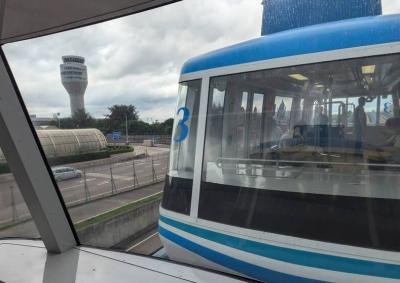
Taiwan Taoyuan International Airport is to suspend its automated Skytrain service connecting Terminal 1 and Terminal 2 starting on July 1 to facilitate connection works for the upcoming Terminal 3, the airport operator said today. Passengers and staff who need to travel between the two terminals after the suspension can instead use the Taoyuan MRT or the airport's 24-hour shuttle bus service, Taoyuan International Airport Corp said. The Taoyuan MRT Airport Line directly links the two terminals, while the shuttle buses are to operate around the clock, the company added. The Skytrain provides free transportation between the airport’s two terminals for travelers and
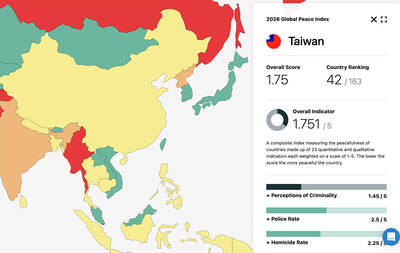
Taiwan ranked 42nd in terms of peacefulness among 163 countries, down five places from last year, according to this year’s Global Peace Index. With an overall score of 1.751, Taiwan dropped from 37th last year, the report published by the global Institute for Economics and Peace showed. The overall score measures a country’s level of peacefulness using 23 quantitative and qualitative indicators across three domains — ongoing domestic and international conflict, societal safety and security, and militarization. While Taiwan ranked 42nd worldwide, it was listed in ninth place among the 19 Asian-Pacific countries in the report, after New Zealand, Singapore, Japan, Malaysia,
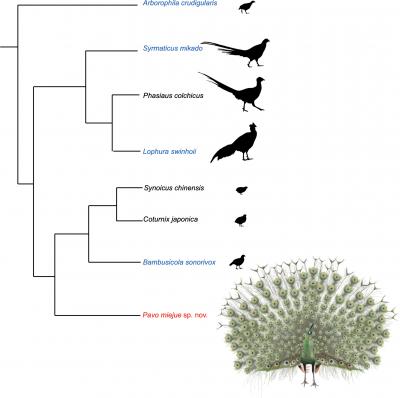
Through analyzing fossil evidence, a research team at National Taiwan University (NTU) discovered the largest endemic bird to have lived in Taiwan, naming it Pavo miejue, or extinct peafowl (滅絕孔雀). The Mikado pheasant, which is printed on the back of the NT$1,000 bank note, was previously believed to be the biggest endemic bird to Taiwan. The research team’s findings suggest that Pavo miejue lived during the Pleistocene epoch tens of thousands of years ago. It is the first endemic extinct bird species discovered and formally named in Taiwan. The study was coauthored by NTU Institute of Ecology and Evolutionary Biology professor Tsai Cheng-hsiu (蔡政修),


 RSS
RSS