


The Taiwan People’s Party (TPP) yesterday said the “KP Show” concert it held on July 29 last year was a commercial activity, following a political pundit’s questioning why earnings from the “fundraising” concert was not declared in the party’s political donation disclosure.
Citing the Control Yuan’s open data on political donations, political pundits and a city councilor last week questioned the TPP and its Chairman Ko Wen-je (柯文哲), who was also the party’s presidential candidate in the Jan. 13 election, about allegations of inaccurate disclosure of political donations.
Political pundit Kang Jen-chun (康仁俊) on Saturday afternoon in a post on Threads said that Ko last year said he needed money to run for president and he would organize a fundraising event.
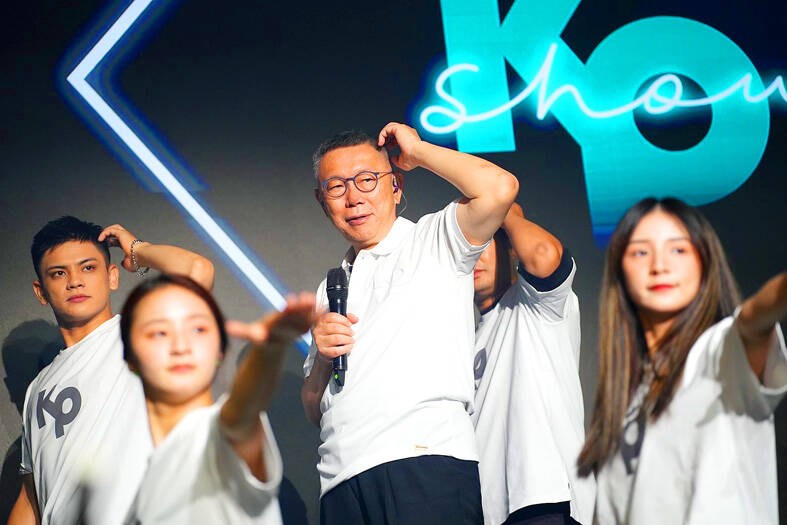
Photo courtesy of the Taiwan People’s Party
The KP Show was organized by the marketing company Muko (木可行銷公關), and commissioned to Neo Creative Marketing Production Co (尼奧創意行銷) for execution, which received NT$3,140,802 (US$96,819) for planning and holding the concert, he said.
Internet personality Liu Yu (劉宇), also known as Si Cha-mao (四叉貓), and political pundit Grace Woo (吳靜怡) last week questioned Muko’s allegedly opaque financial dealings with Ko’s campaign office.
They reported a woman surnamed Lee (李) from Muko was in charge. She is also the finance officer of Ko’s election campaign office, and her brother is Ko’s senior-high school classmate and former Taipei Rapid Transit Co chairman Lee Wen-tsung (李文宗), recruited by Ko when he was Taipei mayor.
The KP Show concert sold tickets for NT$8,800 for adults, NT$4,200 for people with disabilities, and online tickets for NT$500, and collected NT$5,310,400 from ticket sales, Liu wrote in his thread post.
Deducting the execution fee and other promotional fees, Muko made a net profit of NT$770,196, he said.
When reporters asked him why the tickets were so expensive last year, Ko replied that the concert was for “fundraising,” so he should explain where the NT$770,196 income had gone, Liu said.
TPP spokesperson Wu Yi-hsuan (吳怡萱) in a prerecorded video said that the concert was not for fundraising, but a pure commercial activity, which Ko’s campaign office had clarified before the election.
She said the concert was organized by Muko, which paid the expenses and collected the revenues, which was all done according to contract.
Meanwhile, the TPP on Saturday apologized for three records of political donation expenditure — one to OCT Entertainment Co (時樂) and two to Neo Creative — as it said that they were mistakes in accounting.
Chinese Nationalist Party (KMT) Taipei City Councilor Chung Hsiao-ping (鍾小平) yesterday said he was approached by OCT Entertainment, which said that it did not receive the receipt of about NT$9 million expenditure from Ko’s campaign office and suspected the office of using fake receipts.
Chung said he would head to the Taipei District Prosecutors’ Office today to file a complaint against Ko for alleged violation of the Political Donations Act (政治獻金法), breach of trust and causing a civil servant to make a false entry in public records.
Additional reporting by CNA

NATIONAL SECURITY: Authorities are working to confirm the identities of the military personnel involved and investigating possible illegal conduct and regulatory violations Authorities are probing possible national security implications after Kinmen police and immigration officers on Sunday found a Chinese woman allegedly posing as a tourist while engaging in prostitution involving more than 10 military personnel. The woman, surnamed Chen (陳), has since been deported, authorities said, adding that investigators are still working to confirm the identities of those implicated, as the records only listed code names and aliases. The case stemmed from a report received by the Kinmen District Prosecutors’ Office on Friday last week from the Jinhu Precinct of the Kinmen County Police Bureau. On Sunday, police, along with the National Immigration

GLOBALGIVING: ‘ Caving to external pressure is not acceptable for an organization that has cultivated justice reform and human rights for 30 years,’ one NGO said A slew of non-government organizations (NGOs) have withdrawn from the GlobalGiving fundraising platform after it announced it would use “Chinese Taipei” instead of “Taiwan” from next month. The Taiwan Good Rice Association wrote on Facebook on Friday that it was informed on April 28 via a teleconference call of the change, which was made because the platform wanted to operate in China. Taiwan Good Rice is to terminate all cooperative relationships with GlobalGiving in response to the platform’s “unilateral and non-negotiable” decision to remove references to Taiwan, the NGO said. “Taiwan is in the official name of Taiwan Good Rice Association and the

HEAVY WEATHER: Typhoon Jangmi is due to crash straight into the Ryukyus as airlines look to shift flights to larger aircraft or cancel flights to Okinawa entirely Taiwan’s international air carriers announced flight adjustments over the weekend as Typhoon Jangmi is forecast to hit the Ryukyu Islands today and tomorrow. The Central Weather Administration (CWA) upgraded Jangmi from a tropical storm to a typhoon at 8am yesterday, with the eye located 580km south of Naha city. It was moving north at 19kph. Today, China Airlines’ CI-120, CI-121, CI-122 and CI-123 flights between Taoyuan and Naha, Okinawa, have been canceled as well as CI-132 and CI-133 between Kaohsiung and Naha. EVA Air’s BR-112, BR-113, BR-186 and BR-185 flights between Taoyuan and Naha are also canceled. Low-cost carrier Tigerair Taiwan canceled IT-230,
Chinese Nationalist Party (KMT) Chairwoman Cheng Li-wun (鄭麗文) yesterday briefed her party’s Central Standing Committee regarding her scheduled visit to the US between Monday next week and June 16, saying that her purpose would be to persuade the US that the Republic of China (ROC) Constitution was a “one China” constitution that would foster stable and peaceful cross-strait relations. The ROC Constitution is the most important defense for all Taiwanese citizens, as it upholds our democracy and has contributed to our robust economy, which aligns with international and US interests, she said. “We would not be troublemakers and drag the US under,”


 RSS
RSS