


Members of several environmental non-governmental organizations (NGOs) focused on combating climate change yesterday called on the government to revise regulations affecting the development of offshore wind power.
The government should foster the development of sustainable energy, including by revising policies hindering offshore wind power development, particularly given the increasing power needs of Taiwan’s high-tech industries, the members told a news conference in Taipei yesterday.
The Presidential Office’s National Climate Change Response Committee is to hold its first meeting today.
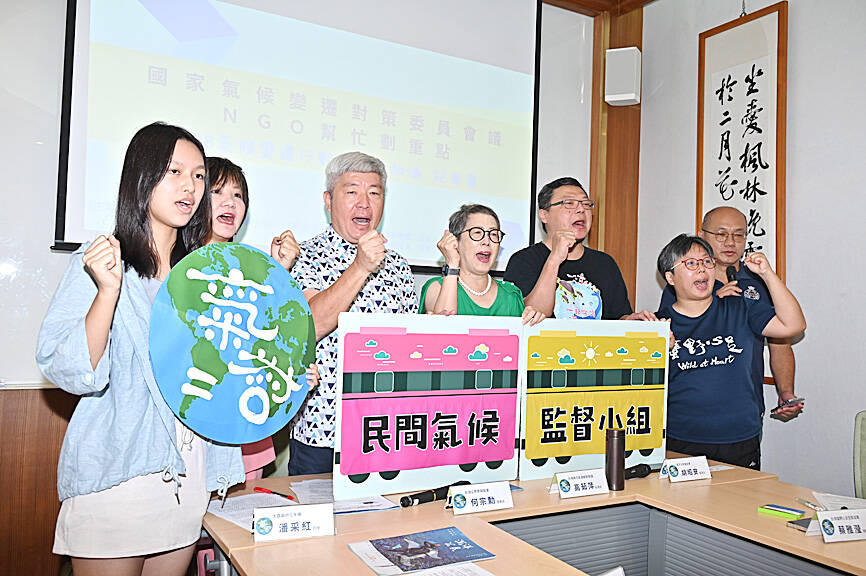
Photo: Tu Chien-de, Taipei Times
The NGO members said they hoped the issue of sustainable energy development would be addressed at the meeting.
“While the government supports the development of the power-intensive AI and semiconductor industries, it should also require such industries to increase the proportion of renewable energy they use,” Taiwan Renewable Energy Alliance founder Kao Ju-ping (高茹萍) said.
“It should require companies to disclose the amount of green energy they use, and require them to fulfill their corporate social responsibilities,” he said.
The government should investigate the shortcomings of the country’s renewable energy sector, Kao said.
“Recently, the EU has complained to the WTO that Taiwan’s offshore wind power policies overprotect the domestic industry,” he said, adding that the situation caused wind-farm developers to withdraw from Taiwan.
This proved that Taiwan’s energy woes were due to policy problems, and therefore would not be solved even if the country relied on nuclear power, he said.
Taiwan’s emissions reduction target for 2030 is 24 percent, which is far behind the international standard of 43 percent, Taiwan Citizen Participation Association director-general Ho Tsung-hsun (何宗勳) said.
The committee should propose more aggressive emissions reduction objectives, he said, adding that the issue of environmental justice should be taken more seriously.
“Taiwan Power Co [Taipower] once promised to relocate nuclear waste on Orchid Island (蘭嶼, Lanyu), but more than 20 years later it still has not done so,” he said.
Those living on Taiwan’s outlying islands often bear the brunt of climate disasters, despite producing very little of the country’s emissions, Penghu’s Citizens of the Ocean Foundation chairman Hu Chao-an (胡昭安) said.
For example, last month’s typhoon caused extensive flooding and damage on Orchid Island and elsewhere in southern Taiwan, he said.
He called on Lai to implement climate change adaptation and response measures for vulnerable areas, calling it a “national security issue.”
“Enterprises must also take responsibility for carbon reduction,” he said. “They cannot just write beautiful sustainability reports on the one hand, and on the other hand secretly obstruct the collection of carbon fees and rational adjustment of electricity prices.”

UPGRADE: The Kang Ding-class frigate is replacing its Chaparall missiles with Tien Chien II and Hua Yang VLS, which would provide it with long-range, 360° air defense Taiwan plans to produce 1,200 to 1,376 Hai Chien II missiles (海劍二, Sea Sword II) — also known as TC-2N — to serve as the standard air defense system of the navy’s surface combatant fleet, a source said yesterday. Last week, the Hai Chien II, the naval version of the Tien Kung II missile (天劍二, Sky Sword II), completed a live-fire test in waters off the National Chungshan Institute of Science and Technology’s Jiupeng facility (九鵬) in Pingtung County’s Manjhou Township (滿州). The MIM72 Chaparral and other dated air defense missiles that currently arm Taiwanese ships have inadequate range to combat Chinese

REASONS FOR TRAVEL: An assistant professor said that proposed amendments to penalize drivers if they used drugs overseas would not deter people from traveling People who operate a motor vehicle under the influence of marijuana would have their driver’s license revoked, even if they used the substance while overseas, the Ministry of Transportation and Communications said yesterday, citing proposed amendments to the Road Traffic Management and Penalty Act (道路交通管理處罰條例). The amendments would also authorize the government to revoke the licenses of people determined to have used Category 1 or Category 2 narcotics, even if they were not operating a vehicle while under the influence of drugs, as well as ban them from taking the license test for three years, the ministry said. People aged 18 or
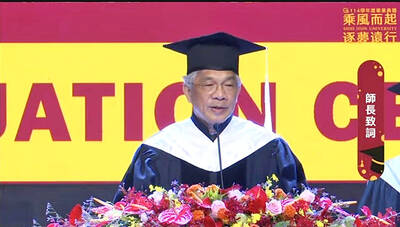
Shih Hsin University President Chen Ching-he (陳清河) yesterday issued a public apology for comments made in his commencement speech last week, stating that he has asked the school to suspend his duties and halt his wages for two months as a show of contrition. At the commencement ceremony on May 30, Chen said, “If you don’t manage your time well, or your own emotions, or your health, then I am telling every one of you — put a quick end to ‘you,’ because the world has no need for ‘you.’” The comments have sparked significant controversy online, and Chen through an open
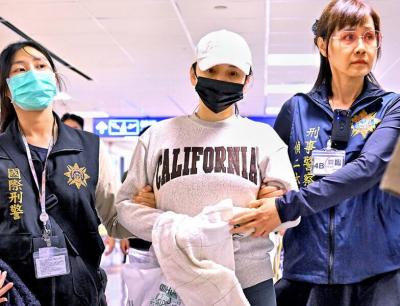
Johanne Liou (劉喬安), a Taiwanese woman who shot to unwanted fame during the Sunflower movement protests in 2014, returned to Taiwan last night after being deported from the US. She is to stand trial in Taiwan for charges involving embezzlement, fraud and drug crimes. The Criminal Investigation Bureau (CIB) said it took her into custody at Taiwan Taoyuan International Airport and would first question her before transferring her to the New Taipei District Prosecutors’ Office. She was arrested upon disembarking a flight from San Francisco that landed shortly before 7pm. Liou absconded to the US in 2019 after jumping bail


 RSS
RSS