


The National Fire Agency (NFA) is urging hikers to use a GPS tracking app to help navigate trails and to increase their chances of being rescued when lost or injured.
Last year, 513 search-and-rescue incidents were reported, with lost or missing hikers accounting for 44 percent of the cases, the NFA said.
Hiking in the mountains is popular, but after the government relaxed restrictions for mountaineering and hiking, the number of reported incidents, which are handled by local fire departments with emergency-response units, rose.
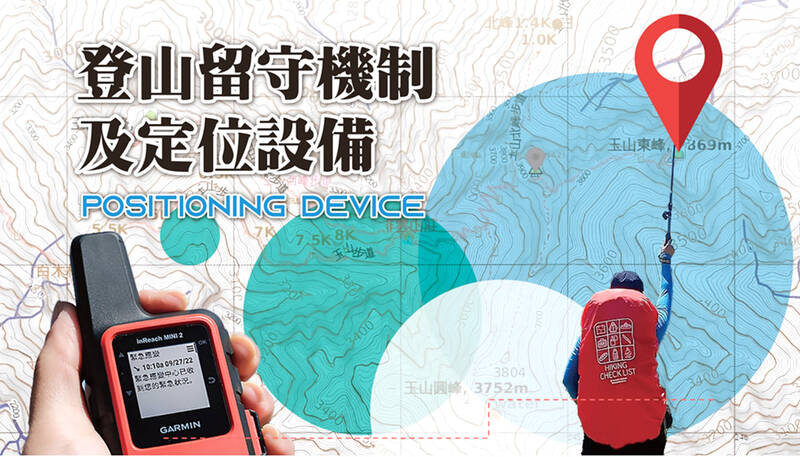
Photo courtesy of the National Fire Agency
Sixty percent of the lost or missing cases were due to self-organized trips among friends, or because the hikers had joined a group online with people they did not know or were led by a person who was not a certified hiking guide, the NFA said.
Most incidents involved groups comprised of senior citizens on self-organized mountain hiking trips without an experienced guide, it said.
In addition to proper gear, safety devices, and adequate food and water provisions, the NFA recommends that hikers download a GPS tracking app and register on the Hiking Guard platform (https://hiking-guard.web.app/), which links to a user’s account on the Line messaging app.
Hikers who cannot read Chinese can get a Taiwanese friend to help them register on Hiking Guard, the agency said.
The platform and a GPS rental service were developed and are provided in collaboration with TWN Mountain Education Association, Emson Social Enterprise, and the Rescue Technology Innovation and Consultant Association of Taiwan, it said.
If lost, hikers can follow the platform’s records to return to their starting point, the NFA said.
If injured or in an emergency situation, hikers can use the platform’s “SOS” button to call for help, which would be relayed to the local fire department, or nearby forestry or national park offices, which would dispatch a search team to the GPS location, it said.
Separately, an expert on Sunday said that the risk of a hornet attack had increased after forested areas were damaged by Typhoon Gaemi late last month.
Rain and strong winds from the typhoon knocked down tree branches and hornet nests, which are more difficult to see on the ground when covered by vegetation and branches, said Cheng Kun-yen (鄭琨諺), who has worked in pest control, including bees and hornets, for more than 10 years.
“We are into the summer season, when hornet nests are as large as a volleyball. In the fall, they can grow as large as a basketball,” he said, adding that late summer and autumn are hornets’ mating season, when they become more aggressive and are prone to attack people.
Hikers could accidentally approach hidden nests or even trample those knocked over in the storm and be stung in an attack, he said.
In hilly areas and mountains, most attacks are by black-tailed tiger hornets, which are territorial up to 100m, and can cause severe injury when they attack, Cheng said, adding that he had last year gone into shock and required medical treatment after he was stung by just one hornet.
“Hornet nests are found almost everywhere in the wild, on trees, on the ground and in bushes... When in forested areas, people should not wear perfume, should remain quiet and when they see one or two patrolling hornets, they should quietly walk away in the opposition direction,” he said.

TRAFFIC SAFETY RULES: A positive result in a drug test would result in a two-year license suspension for the driver and vehicle, and a fine of up to NT$180,000 The Ministry of Transportation and Communications is to authorize police to conduct roadside saliva tests by the end of the year to deter people from driving while under the influence of narcotics, it said yesterday. The ministry last month unveiled a draft of amended regulations governing traffic safety rules and penalties, which included provisions empowering police to conduct mandatory saliva tests on drivers. While currently rules authorize police to use oral fluid testing kits for signs of drug use, they do not establish penalties for noncompliance or operating procedures for officers to follow, the ministry said. The proposed changes to the regulations require

The Executive Yuan yesterday announced that registration for a one-time universal NT$10,000 cash handout to help people in Taiwan survive US tariffs and inflation would start on Nov. 5, with payouts available as early as Nov. 12. Who is eligible for the handout? Registered Taiwanese nationals are eligible, including those born in Taiwan before April 30 next year with a birth certificate. Non-registered nationals with residence permits, foreign permanent residents and foreign spouses of Taiwanese citizens with residence permits also qualify for the handouts. For people who meet the eligibility requirements, but passed away between yesterday and April 30 next year, surviving family members

China Airlines Ltd (CAL) yesterday morning joined SkyTeam’s Aviation Challenge for the fourth time, operating a demonstration flight for “net zero carbon emissions” from Taiwan Taoyuan International Airport to Bangkok. The flight used sustainable aviation fuel (SAF) at a ratio of up to 40 percent, the highest proportion CAL has achieved to date, the nation’s largest carrier said. Since April, SAF has become available to Taiwanese international carriers at Taipei International Airport (Songshan airport), Kaohsiung International Airport and Taoyuan airport. In previous challenges, CAL operated “net zero carbon emission flights” to Singapore and Japan. At a ceremony at Taoyuan airport, China Airlines chief sustainability

‘ONE CHINA’: A statement that Berlin decides its own China policy did not seem to sit well with Beijing, which offered only one meeting with the German official German Minister for Foreign Affairs Johann Wadephul’s trip to China has been canceled, a spokesperson for his ministry said yesterday, amid rising tensions between the two nations, including over Taiwan. Wadephul had planned to address Chinese curbs on rare earths during his visit, but his comments about Berlin deciding on the “design” of its “one China” policy ahead of the trip appear to have rankled China. Asked about Wadephul’s comments, Chinese Ministry of Foreign Affairs spokesman Guo Jiakun (郭嘉昆) said the “one China principle” has “no room for any self-definition.” In the interview published on Thursday, Wadephul said he would urge China to


 RSS
RSS