


Legal academics have called on the Constitutional Court to exercise restraint when reviewing a case about the constitutionality of amendments to government oversight laws passed by the Legislature at the end of May.
At a discussion on Friday co-hosted by the Republic of China Constitutional Law Society, attorney and Soochow University law professor Nigel Li (李念祖) said the legislature should be allowed sufficient latitude in crafting legislation.
A judicial ruling shackling the legislative body’s operations risks undermining the democratic system, Li said.
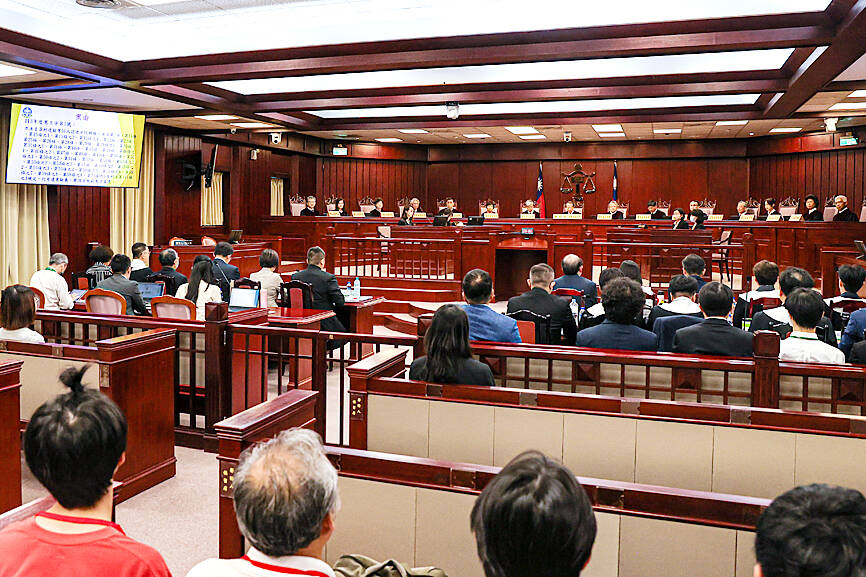
Photo: CNA
He was referring to the case brought by the Democratic Progressive Party (DPP) caucus, the Cabinet, President William Lai (賴清德) and the Control Yuan in a bid to reject oversight laws that took effect on June 26.
The Constitutional Court has already issued an injunction that halted enforcement of some of the revisions, including those that would have given legislators much broader investigative powers.
The amendments to the Act Governing the Legislative Yuan’s Power (立法院職權行使法) and the Criminal Code were pushed through by opposition Chinese Nationalist Party (KMT) and Taiwan People’s Party lawmakers, who together form a majority in the legislature.
The DPP-affiliated petitioners maintained that the deliberation that led up to the laws’ passage were unconstitutional, arguing that there was a lack of substantive discussions and that ruling party lawmakers were deprived of opportunities to express their views.
The petitioners also sought to challenge the constitutionality of many of the adopted measures, including those expanding the legislature’s investigative powers and requiring the president to address the legislature periodically and answer questions.
However, Li cited the court’s previous rulings, saying the court had in the past shown great respect for the “principle of legislative autonomy” provided that the legislative process did not contain “manifest and gross procedural flaws.”
The Constitutional Court, when trying to arbitrate constitutional disputes between top government agencies, as in the oversight law case, should refrain from assuming a “too active” role, he said.
Instead, the Constitutional Court should adopt a “minimalist” approach, he said, suggesting that the court render a ruling limited to the specific issues of the case and avoid setting broad precedents.
Political science professor Su Tzu-chiao (蘇子喬) and law professor Yang Chih-chieh (楊智傑) expressed similar views, saying the court should refrain from excessive intervention in the ongoing disputes between the opposition-led legislature and the petitioning agencies.
Su, also from Soochow University, said the new measures requiring the president’s presence at the legislature to deliver an annual state of the nation address and then answer questions would not undermine the constitutional system.
Rather, they would provide an opportunity to “clarify” the confusion in the division of responsibilities between the president and the premier, he said.
However, Lai has maintained that according to the Constitution, the president is not accountable to the Legislative Yuan and that the head of state can volunteer, but has no obligation, to address the legislature.
Friday’s discussion was cohosted by the National Policy Foundation — a think tank affiliated with the KMT — and the Taiwan Administrative Law Association.

Yangmingshan National Park authorities yesterday urged visitors to respect public spaces and obey the law after a couple was caught on a camera livestream having sex at the park’s Qingtiangang (擎天崗) earlier in the day. The Shilin Police Precinct in Taipei said it has identified a suspect and his vehicle registration number, and would summon him for questioning. The case would be handled in accordance with public indecency charges, it added. The couple entered the park at about 11pm on Thursday and began fooling around by 1am yesterday, the police said, adding that the two were unaware of the park’s all-day live

Fast food chain McDonald's is to raise prices by up to NT$5 on some products at its restaurants across Taiwan, starting on Wednesday next week, the company announced today. The prices of all extra value meals and sharing boxes are to increase by NT$5, while breakfast combos and creamy corn soup would go up by NT$3, the company said in a statement. The price of the main items of those meals, if ordered individually, would remain the same. Meanwhile, the price of a medium-sized lemon iced tea and hot cappuccino would rise by NT$3, extra dipping sauces for chicken nuggets would go up
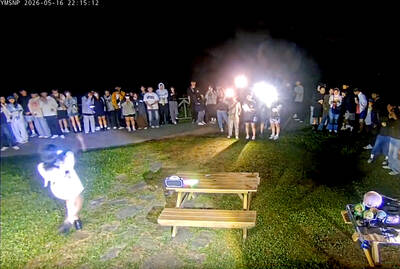
Yangmingshan National Park’s Qingtiangang (擎天崗) nature area has gone viral after a park livestream camera observed a couple in the throes of intimate congress, which was broadcast live on YouTube, drawing large late-night crowds and sparking a backlash over noise, bright lights and disruption to wildlife habitat. The area’s livestream footage appeared to show a couple engaging in sexual activity on a picnic table in the park on Friday last week, with the uncensored footage streamed publicly online. The footage quickly spread across social media, prompting a tide of visitors to travel to the site to “check in” and recreate the

Minister of Digital Affairs Lin Yi-ching (林宜敬) yesterday cited regulatory issues and national security concerns as an expert said that Taiwan is among the few Asian regions without Starlink. Lin made the remarks on Facebook after funP Innovation Group chief executive officer Nathan Chiu (邱繼弘) on Friday said Taiwan and four other countries in Asia — China, North Korea, Afghanistan and Syria — have no access to Starlink. Starlink has become available in 166 countries worldwide, including Ukraine, Malaysia, the Philippines and Vietnam, in the six years since it became commercial, he said. While China and North Korea block Starlink, Syria is not


 RSS
RSS