


Honor guards are to stop performing changing of the guard ceremonies around a statue of Chiang Kai-shek (蔣介石) to avoid “worshiping authoritarianism,” the Ministry of Culture said yesterday.
The fate of the bronze statue has long been the subject of fierce and polarizing debate in Taiwan, which has transformed from an autocracy under Chiang into one of Asia’s most vibrant democracies.
The changing of the guard each hour at the Chiang Kai-shek Memorial Hall in Taipei is a major tourist attraction, but starting from 9am on Monday, the ceremony is to be moved outdoors to Democracy Boulevard, outside the eponymous blue-and-white memorial hall.
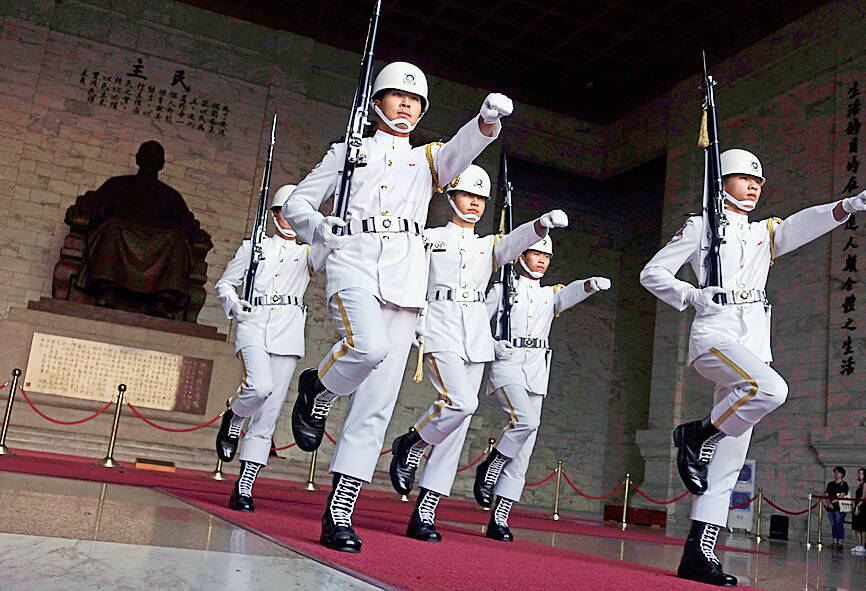
Photo: AFP
“Eliminating the worshipping of a cult personality and the worshipping of authoritarianism is the goal of promoting transitional justice,” the ministry said in a statement.
“The military honor guards’ sentry duty at the hall would be removed ... but their performances would be maintained, with the venue moving to the Democracy Boulevard,” it added.
The Ministry of National Defense said that a six-member honor guard would continue to conduct flag ceremonies and ceremonial patrols around the hall’s perimeter.
The guards at each hour would march out from the hall’s northern and southern portals in two equal teams to walk the perimeter and then converge in a drill on Democracy Boulevard before the main gate of the structure, it said.
The ceremonial patrols would be suspended on rainy days, while the flag would be raised at 9am and lowered at 5pm, it added.
Chiang is seen by many as the embodiment of a brutal military regime that exiled, imprisoned and killed thousands of opponents until his death in 1975.
For many young Taiwanese, he is also synonymous with the kind of authoritarianism seen in China.
Hundreds of other statues of Chiang have already been moved to Chiang Kai-shek Cihu Statue Park (慈湖蔣公銅像公園), a lakeside park close to his mausoleum in Taoyuan.
Additional reporting by Wu Che-yu
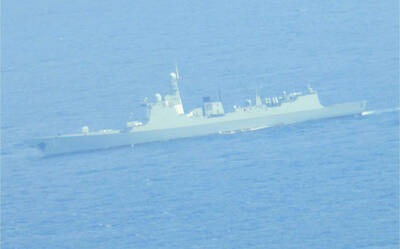
The military has spotted two Chinese warships operating in waters near Penghu County in the Taiwan Strait and sent its own naval and air forces to monitor the vessels, the Ministry of National Defense (MND) said. Beijing sends warships and warplanes into the waters and skies around Taiwan on an almost daily basis, drawing condemnation from Taipei. While the ministry offers daily updates on the locations of Chinese military aircraft, it only rarely gives details of where Chinese warships are operating, generally only when it detects aircraft carriers, as happened last week. A Chinese destroyer and a frigate entered waters to the southwest

A magnitude 6.1 earthquake struck off the coast of Yilan County at 8:39pm tonight, the Central Weather Administration (CWA) said, with no immediate reports of damage or injuries. The epicenter was 38.7km east-northeast of Yilan County Hall at a focal depth of 98.3km, the CWA’s Seismological Center said. The quake’s maximum intensity, which gauges the actual physical effect of a seismic event, was a level 4 on Taiwan’s 7-tier intensity scale, the center said. That intensity level was recorded in Yilan County’s Nanao Township (南澳), Hsinchu County’s Guansi Township (關西), Nantou County’s Hehuanshan (合歡山) and Hualien County’s Yanliao (鹽寮). An intensity of 3 was

Japanese Prime Minister Sanae Takaichi’s comment last year on Tokyo’s potential reaction to a Taiwan-China conflict has forced Beijing to rewrite its invasion plans, a retired Japanese general said. Takaichi told the Diet on Nov. 7 last year that a Chinese naval blockade or military attack on Taiwan could constitute a “survival-threatening situation” for Japan, potentially allowing Tokyo to exercise its right to collective self-defense. Former Japan Ground Self-Defense Force general Kiyofumi Ogawa said in a recent speech that the remark has been interpreted as meaning Japan could intervene in the early stages of a Taiwan Strait conflict, undermining China’s previous assumptions
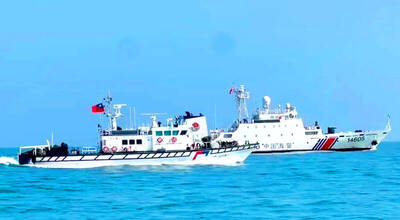
Instead of focusing solely on the threat of a full-scale military invasion, the US and its allies must prepare for a potential Chinese “quarantine” of Taiwan enforced through customs inspections, Stanford University Hoover fellow Eyck Freymann said in a Foreign Affairs article published on Wednesday. China could use various “gray zone” tactics in “reconfiguring the regional and ultimately the global economic order without a war,” said Freymann, who is also a nonresident research fellow at the US Naval War College. China might seize control of Taiwan’s links to the outside world by requiring all flights and ships entering or leaving Taiwan


 RSS
RSS