


Heavy rain over Taipei and New Taipei City yesterday afternoon flooded multiple areas in Daan (大安) and Xinyi (信義) districts, prompting the Taipei City Government to upgrade the alert status to level two.
Taipei City Councilor Hsu Shu-hua (許淑華) of the Chinese Nationalist Party (KMT) shared multiple pictures of flooding in Xinyi and urged the public to be careful.
People in Nangang District (南港) complained of flooding, saying that the water level in some areas was about half the height of a scooter and the amount of rain was reminiscent of a typhoon, KMT Taipei City Councilor Lee Ming-hsien (李明賢) said.
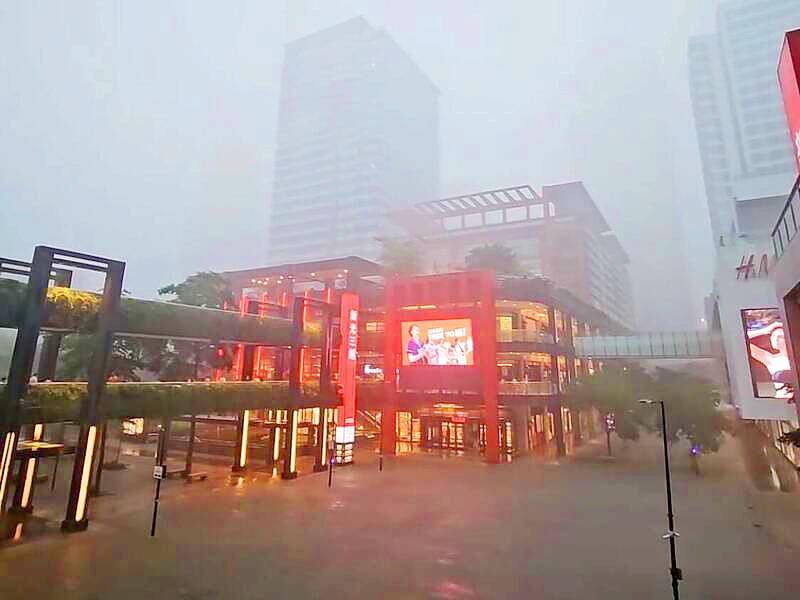
Photo courtesy of a reader
Heavy rains test the city’s drainage system, Lee said, calling on the city’s flood-related units to be on standby.
The Taipei City Government said that all four of its weather stations reported rainfall exceeding 100mm, and the Central Weather Administration had issued a heavy rain alert for Taipei and New Taipei City.
Although the convection cell was slowly moving out of Taipei in a northeasterly direction in the afternoon, Shilin (士林), Beitou (北投) and Neihu (內湖) districts still experienced sporadic rainfall, the Taipei City Government said.
Wenshan (文山) and Zhongzheng (中正) districts also experienced heavy rainfall, while New Taipei City’s Sijhih District (汐止) issued a level one flood alert in the afternoon.
Flood alerts indicate when water levels reach the flooding point or the top of the dikes. Level two alerts mean it would take five hours before the flooding point is reached, while level one alerts indicate that it would take two hours.
Taipei International Airport (Songshan airport) paused all ground staff activities at about 1:35pm and lifted the alert by 2:30pm.
Songshan Airport said that the pause in ground staff duties affected 15 flights and led to delays at airports serving it.
The Civil Aviation Administration urged travelers and those collecting people from airports to pay close attention for any changes in flight information.
The sudden heavy rain had “drowned” parts of Xinyi, and afterward, it became a “surfing area,” Taipei residents said.
Yesterday afternoon, people at Xinyi shopping district said the rain had inundated the district’s sky bridges and turned the pedestrian paths into “rivers.”

Fast food chain McDonald's is to raise prices by up to NT$5 on some products at its restaurants across Taiwan, starting on Wednesday next week, the company announced today. The prices of all extra value meals and sharing boxes are to increase by NT$5, while breakfast combos and creamy corn soup would go up by NT$3, the company said in a statement. The price of the main items of those meals, if ordered individually, would remain the same. Meanwhile, the price of a medium-sized lemon iced tea and hot cappuccino would rise by NT$3, extra dipping sauces for chicken nuggets would go up

Nvidia Corp CEO Jensen Huang (黃仁勳) arrived in Taiwan yesterday ahead of upcoming AI and technology events, saying he plans to meet with clients and Taiwan Semiconductor Manufacturing Co Chairman C.C. Wei (魏哲家) during his visit. After landing at Taipei Songshan Airport, Huang posed for photos with fans and handed out Yakult drinks to reporters and supporters waiting at the scene, saying he has “a lot to do” during the trip. Asked about reports that Nvidia’s planned headquarters site in Taipei’s Beitou Shilin Technology Park could break ground on May 27, Huang said that if the company holds an event, he would

FUKUOKA SITUATION: Japanese media reported that the pathogen is expected to be identified by the summer, while the CDC downplayed the idea that it was hMPV A “mysterious cold-like illness” reported in Japan’s Fukuoka Prefecture does not seem to be a new disease, but Japanese authorities have been asked about the situation, the Centers for Disease Control (CDC) said yesterday. The Fukuoka Prefectural Medical Association on Wednesday told a news conference that a “mystery cold” that has become a hot topic on social media is “highly likely to be caused by some kind of viral infection,” Japan’s KBC News reported. “Many people are experiencing symptoms starting with a sore throat, followed by a runny nose, phlegm and a severe cough,” KBC News reported, citing association officials. Health authorities are

Carrefour Taiwan is to begin using a new name from the start of July, but it cannot divulge the name until then, the chairman of the supermarket chain's parent company said today. President Chain Store Co chairman Lo Chih-hsien (羅智先) was asked by reporters after a shareholders' meeting to confirm whether the company has settled on a new name for the supermarket brand. In March, the government-registered name of two Carrefour Taiwan branches was quietly changed to "Le Chia Kang" (樂家康) in Chinese, raising speculation that has been selected as the name. Lo said that because of local regulations and contractual obligations, the


 RSS
RSS