


Taipei city councilors yesterday said that Taipei Mayor Chiang Wan-an (蔣萬安) was “sleeping on the job,” and that he had done nothing to address the color of the Taipei Dome’s bleacher seats, which had caused issues during a baseball game on Sunday.
“We already knew it would cause problems when the white bleacher seats were installed two years ago ... but Chiang has done nothing, and did not push Farglory Group (遠雄集團) to make changes, or to amend the numerous other problems at the dome,” Democratic Progressive Party Taipei City Councilor Hsu Shu-hua (許淑華) said.
“As city councilors, we have to wake up Chiang,” Hsu said.
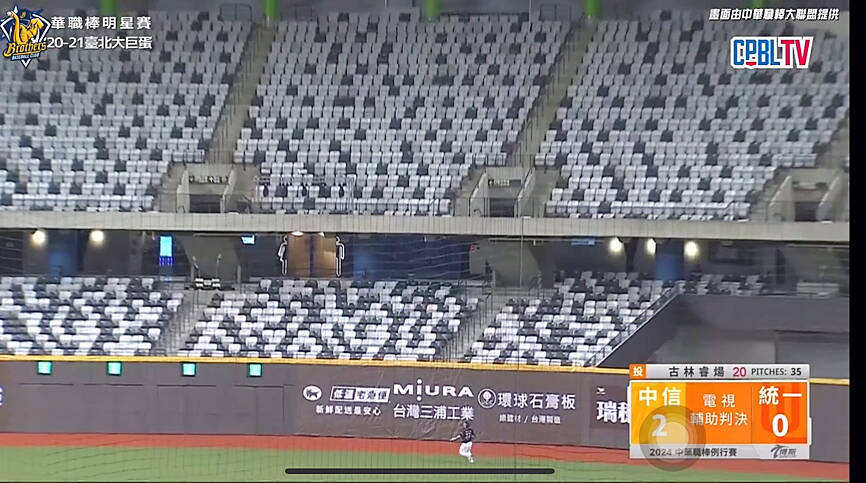
Photo courtesy of Taiwan People’s Party Taipei City Councilor Chen Yu-cheng’s office
Farglory Group built and operates the Taipei Dome.
It is known that a baseball can blend into a white background, and create confusion for players and officials tracking the ball’s flight, Hsu said.
During a CPBL baseball game between the CTBC Brothers and the Uni-President Lions on Sunday night, a high fly ball bounced off the outfield wall. Umpires believed it had gone over the wall and rebounded off the bleacher seats before landing in the outfield.
The game was in its third inning, and the Brothers had a man on second base. The umpires awarded a two-run homer, but the Uni-President Lions demanded a review, and a video replay showed that the ball hit the top of the cushioned outfield wall, and bounced back in, making it a ground rule double.
The umpires stood by their original decision, prompting Lions manager Lin Yueh-ping (林岳平) to storm out onto the field and protest the call.
The Lions were still angry after the game, as they would not have lost 2-1 if the two-run homer had not been awarded.
Chiang yesterday said that the white bleacher seats were installed in July 2022, during then-Taipei mayor Ko Wen-je’s (柯文哲) administration.
“When I assumed the [position of mayor] and inspected the Taipei Dome for the first time last year, we were told about the problem. We consulted experts, and later on asked Farglory Group to remedy it and fix other deficiencies,” Chiang said.
However, Taiwan People’s Party (TPP) Taipei City Councilor Chen Yu-cheng (陳宥丞) said Chiang was pinning the responsibility on Ko, the TPP’s chairman.
The problem must be fixed now, because it is affecting the outcome of CPBL games, Chen said, adding that Taipei is also to host the World Baseball Softball Confederation Premier 12 tournament’s Group B games in November.
“Chiang’s city government must stop turning the Taipei Dome into a political dispute,” Chen said.
Taipei can order Farglory Group to fix the issue, but it has not been rectified since the venue started hosting sports games late last year, Chen added.
Fast food chain McDonald's is to raise prices by up to NT$5 on some products at its restaurants across Taiwan, starting on Wednesday next week, the company announced today. The prices of all extra value meals and sharing boxes are to increase by NT$5, while breakfast combos and creamy corn soup would go up by NT$3, the company said in a statement. The price of the main items of those meals, if ordered individually, would remain the same. Meanwhile, the price of a medium-sized lemon iced tea and hot cappuccino would rise by NT$3, extra dipping sauces for chicken nuggets would go up

Nvidia Corp CEO Jensen Huang (黃仁勳) arrived in Taiwan yesterday ahead of upcoming AI and technology events, saying he plans to meet with clients and Taiwan Semiconductor Manufacturing Co Chairman C.C. Wei (魏哲家) during his visit. After landing at Taipei Songshan Airport, Huang posed for photos with fans and handed out Yakult drinks to reporters and supporters waiting at the scene, saying he has “a lot to do” during the trip. Asked about reports that Nvidia’s planned headquarters site in Taipei’s Beitou Shilin Technology Park could break ground on May 27, Huang said that if the company holds an event, he would

FUKUOKA SITUATION: Japanese media reported that the pathogen is expected to be identified by the summer, while the CDC downplayed the idea that it was hMPV A “mysterious cold-like illness” reported in Japan’s Fukuoka Prefecture does not seem to be a new disease, but Japanese authorities have been asked about the situation, the Centers for Disease Control (CDC) said yesterday. The Fukuoka Prefectural Medical Association on Wednesday told a news conference that a “mystery cold” that has become a hot topic on social media is “highly likely to be caused by some kind of viral infection,” Japan’s KBC News reported. “Many people are experiencing symptoms starting with a sore throat, followed by a runny nose, phlegm and a severe cough,” KBC News reported, citing association officials. Health authorities are
Carrefour Taiwan is to begin using a new name from the start of July, but it cannot divulge the name until then, the chairman of the supermarket chain's parent company said today. President Chain Store Co chairman Lo Chih-hsien (羅智先) was asked by reporters after a shareholders' meeting to confirm whether the company has settled on a new name for the supermarket brand. In March, the government-registered name of two Carrefour Taiwan branches was quietly changed to "Le Chia Kang" (樂家康) in Chinese, raising speculation that has been selected as the name. Lo said that because of local regulations and contractual obligations, the


 RSS
RSS