


The Democratic Progressive Party (DPP) is hindering cross-strait relations, while the Chinese Nationalist Party (KMT) has to keep “putting out fires” the DPP started, KMT Deputy Chairman Sean Lien (連勝文) said.
Lien was in China to attend the 16th Straits Forum as the head of a KMT delegation. He made the remarks in an interview with Chinese media on Friday, when asked about his views on “how the DPP is damaging cross-strait relations.”
“It is absurd that the ones setting fire [to cross-strait relations] are sometimes considered heroes, while those putting out the fires are derided,” Lien said.
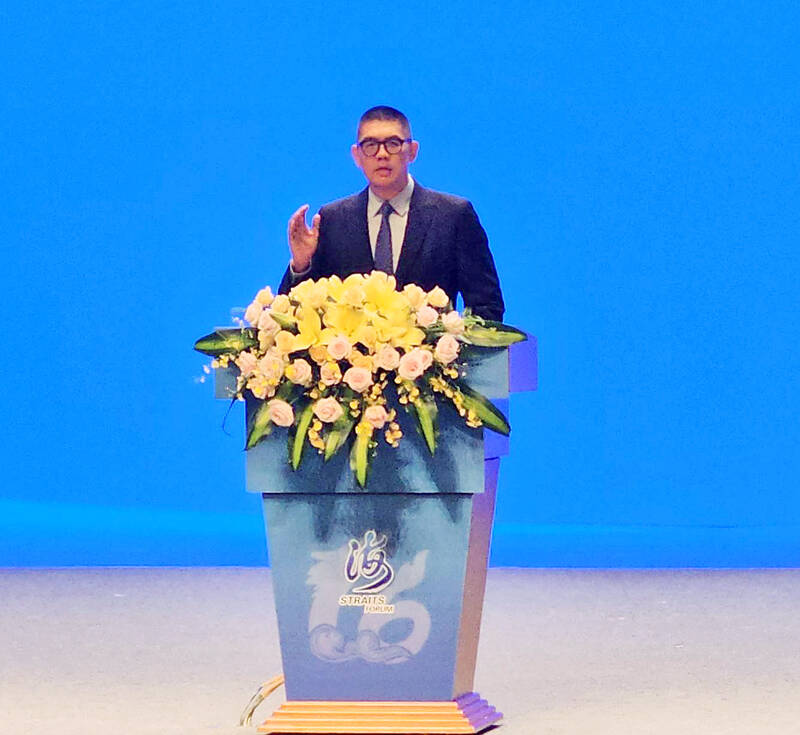
Photo: screen grab from Bloomberg Television’s YouTube channel
The KMT hopes to make Taiwanese aware that the KMT, through actual interactive platforms such as the Straits Forum, “is the one party genuinely making an effort to ensure Taiwan’s safety and democracy,” he said.
Asked “what is most critical to developing peaceful cross-strait relations,” Lien said that mutual understanding is vital.
Information on cross-strait relations is fragmented, and sometimes bite-sized information would lead to overgeneralization, he said.
Much of the Internet-based commentary is polarizing and biased, leading to miscommunication and misunderstandings, Lien said, adding that the best way is to meet in person and communicate.
In his opening remarks at the Straits Forum yesterday, Lien reiterated the KMT’s commitment to cross-strait peace and exchanges on equal footing, and stressed the party’s adherence to the “1992 consensus” and opposition to Taiwan independence.
The so-called “1992 consensus” — a term that former Mainland Affairs Council chairman Su Chi (蘇起) in 2006 admitted making up in 2000 — refers to a tacit understanding between the KMT and the Chinese government that both sides of the Taiwan Strait acknowledge there is “one China,” with each side having its own interpretation of what “China” means.
Lien also said that people on both sides of the Strait are a part of the Zhonghua minzu (中華民族, Chinese ethnic group) and are all heirs to its history.
“Since ancient times, Taiwan has belonged to China. Taiwanese compatriots are naturally a part of the Zhonghua minzu. History brooks no distortion, and one’s ancestry cannot be changed,” Chinese People’s Political Consultative Conference Chairman Wang Huning (王滬寧) said.
The “1992 consensus” and the “one China principle” are important to ensuring peace across the Taiwan Strait, Wang added.
The Straits Forum is known as a China-hosted platform which aims to deliver a “united front” rhetoric and sow discord within Taiwan, the Mainland Affairs Council said.
The government supports cross-strait interactions without predetermined political stances, but is against events that attempt political manipulation, the agency said.
Additional reporting by CNA

Yangmingshan National Park authorities yesterday urged visitors to respect public spaces and obey the law after a couple was caught on a camera livestream having sex at the park’s Qingtiangang (擎天崗) earlier in the day. The Shilin Police Precinct in Taipei said it has identified a suspect and his vehicle registration number, and would summon him for questioning. The case would be handled in accordance with public indecency charges, it added. The couple entered the park at about 11pm on Thursday and began fooling around by 1am yesterday, the police said, adding that the two were unaware of the park’s all-day live

Fast food chain McDonald's is to raise prices by up to NT$5 on some products at its restaurants across Taiwan, starting on Wednesday next week, the company announced today. The prices of all extra value meals and sharing boxes are to increase by NT$5, while breakfast combos and creamy corn soup would go up by NT$3, the company said in a statement. The price of the main items of those meals, if ordered individually, would remain the same. Meanwhile, the price of a medium-sized lemon iced tea and hot cappuccino would rise by NT$3, extra dipping sauces for chicken nuggets would go up

Yangmingshan National Park’s Qingtiangang (擎天崗) nature area has gone viral after a park livestream camera observed a couple in the throes of intimate congress, which was broadcast live on YouTube, drawing large late-night crowds and sparking a backlash over noise, bright lights and disruption to wildlife habitat. The area’s livestream footage appeared to show a couple engaging in sexual activity on a picnic table in the park on Friday last week, with the uncensored footage streamed publicly online. The footage quickly spread across social media, prompting a tide of visitors to travel to the site to “check in” and recreate the

Minister of Digital Affairs Lin Yi-ching (林宜敬) yesterday cited regulatory issues and national security concerns as an expert said that Taiwan is among the few Asian regions without Starlink. Lin made the remarks on Facebook after funP Innovation Group chief executive officer Nathan Chiu (邱繼弘) on Friday said Taiwan and four other countries in Asia — China, North Korea, Afghanistan and Syria — have no access to Starlink. Starlink has become available in 166 countries worldwide, including Ukraine, Malaysia, the Philippines and Vietnam, in the six years since it became commercial, he said. While China and North Korea block Starlink, Syria is not


 RSS
RSS