


Taiwan is deepening economic integration with other democracies and working with partners, including the US, to deter Chinese President Xi Jinping (習近平) from ordering an invasion of the nation, Taipei’s envoy to Washington said.
“China — will they act or not? We don’t know,” Representative to the US Alexander Yui said in an interview on Bloomberg Television. “We want to make sure that every day, when Xi Jinping wakes up and looks at the mirror before he shaves, he goes, ‘Not today.’”
Yui said China is preparing for the possibility of aggression against Taiwan, but that Taiwan’s government is also getting ready with the help of “many friends, including the US.”
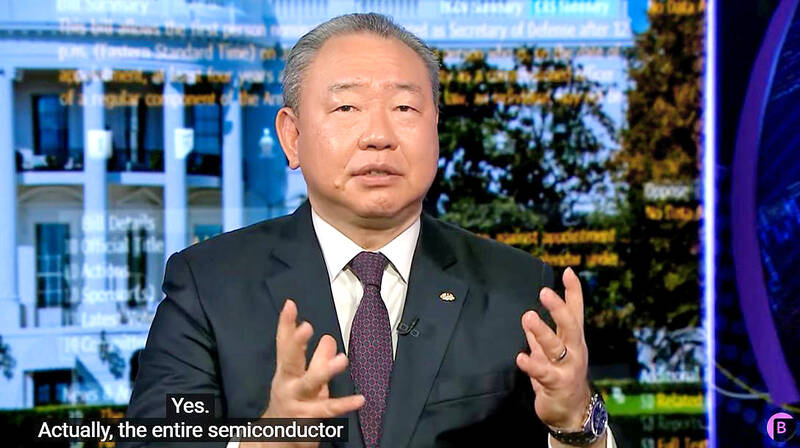
Photo: screen grab from Bloomberg Television’s YouTube channel
China launched military drills after the May 20 inauguration of President William Lai (賴清德), with Xinhua news agency saying they were designed to send a “stern warning against the interference and provocation by external forces” — a reference to the US.
The diplomat said he is still hopeful about the prospects for legislation that he characterized as “bogged down” in the US Senate to prevent double taxation of Taiwanese firms in the US.
Such a law could usher in more investment from smaller companies that work with large firms such as Taiwan Semiconductor Manufacturing Co, he added.
Yui, who assumed his post in December, also said he is in touch with US officials about the lag in defense orders caused in part by supply chain disruptions — which some Republicans have blamed on US President Joe Biden’s ongoing support for Ukraine.
“Many of them we already made the necessary payments and are still awaiting delivery,” Yui said regarding US weapons systems.
“That’s an issue we’re constantly talking [about], coordinating with the US administration,” he said.
Asked whether Beijing was overreacting to the new administration in Taipei, Yui said China was “just trying to find excuses to act up against Taiwan.”
These include responding aggressively to political developments in Taipei and visits by US officials, such as then-US House of Representatives speaker Nancy Pelosi’s visit in 2022, Yui said.
It is not Taiwan or Washington that are fueling regional tensions, he said.
“It’s Beijing who is sending the ships, it’s Beijing who is sending fighters around Taiwan — it’s them who are creating all the tensions in the Taiwan Strait,” Yui said. “They have to treat us with respect, as equals.”
Yui said he hopes Taiwan and the US can reach a second trade agreement on issues such as agriculture, labor and the environment under an initiative that already saw them clinch a deal to reduce some regulatory red tape.
“Negotiating in an election year, the nearer we come to November, the more difficult it will become,” he said. “We would like to have this as soon as possible.”

Considering that most countries issue more than five denominations of banknotes, the central bank has decided to redesign all five denominations, the bank said as it prepares for the first major overhaul of the banknotes in more than 24 years. Central bank Governor Yang Chin-lung (楊金龍) is expected to report to the Legislative Yuan today on the bank’s operations and the redesign’s progress. The bank in a report sent to the legislature ahead of today’s meeting said it had commissioned a survey on the public’s preferences. Survey results showed that NT$100 and NT$1,000 banknotes are the most commonly used, while NT$200 and NT$2,000

The Centers for Disease Control (CDC) yesterday reported the first case of a new COVID-19 subvariant — BA.3.2 — in a 10-year-old Singaporean girl who had a fever upon arrival in Taiwan and tested positive for the disease. The girl left Taiwan on March 20 and the case did not have a direct impact on the local community, it said. The WHO added the BA.3.2 strain to its list of Variants Under Monitoring in December last year, but this was the first imported case of the COVID-19 variant in Taiwan, CDC Deputy Director-General Lin Ming-cheng (林明誠) said. The girl arrived in Taiwan on

ANNUAL EVENT: Two massive Pokemon balloons are to be set up in Daan Park, with an event zone operating from 10am to 6pm This year’s Taipei Floral Picnic is to be held at Daan Park today and tomorrow, featuring an exclusive Pokemon Go event, a themed food market, a coffee rave picnic area and stage performances, the Taipei Department of Information and Tourism said yesterday. Two massive Pokemon balloons are to be set up in the park as attractions, with an exclusive event zone operating from 10am to 6pm, it said. Participants who complete designated tasks on-site would have a chance to receive limited-edition souvenirs, it added. People could also try the newly launched game Pokemon Pokopia in the trial area, the department said. Three PokeStops are

South Korea is planning to revise its controversial electronic arrival card, a step Taiwanese officials said prompted them to hold off on planned retaliatory measures, a South Korean media report said yesterday. A Yonhap News Agency report said that the South Korean Ministry of Foreign Affairs is planning to remove the “previous departure place” and “next destination” fields from its e-arrival card system. The plan, reached after interagency consultations, is under review and aims to simplify entry procedures and align the electronic form with the paper version, a South Korean ministry official said. The fields — which appeared only on the electronic form


 RSS
RSS