


President William Lai (賴清德) is to preside over a round of celebrations to be staged on Sunday at the Republic of China (ROC) Military Academy to mark the 100th anniversary of its founding, the nation’s armed forces announced yesterday.
To mark the academy’s centennial, the Kaohsiung-based academy is to hold its main celebrations in the morning with a large-scale march featuring military cadets, Army Chief of Staff Lieutenant General Chen Chien-yi (陳建義) said at a Ministry of National Defense news conference.
Along with the cadets, ROC Military Academy honor graduates would be dressed in a range of the academy’s former uniforms, including those worn when the academy was based in China, to pay tribute to its founding and 100 years of tradition, Chen said.
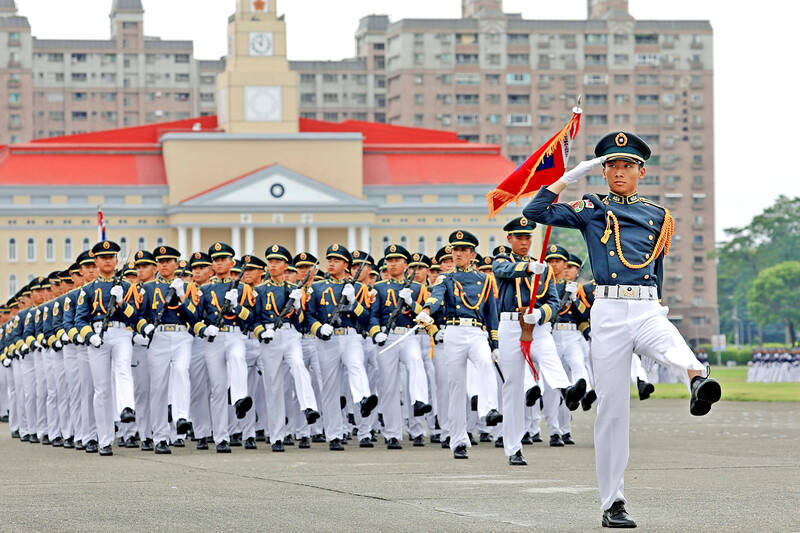
Photo courtesy of the Army Command Headquarters via CNA
Lai is to preside over the celebrations, while special guests, including former ROC Military Academy superintendents, ex-defense ministers, representatives from military academies in allied countries and others, are also scheduled to attend, Chen added.
The academy is to hold an open-house event in the afternoon featuring a series of exhibitions on its history and achievements over the past century, Chen said.
Previously known as the Whampoa Military Academy, the military educational institute was founded on June 16, 1924, in Whampoa — also known as Huangpu, Guangzhou, in China’s Guangdong Province.
The academy later relocated to Nanjing and Chengdu. At the end of the Chinese Civil War in 1949, together with the ROC government, the academy relocated to Taiwan.
It reopened in 1950 in southern Kaohsiung’s Fongshan District (鳳山) under the name the ROC Military Academy. The original Guangzhou site is now a museum.
Separately yesterday, Veterans Affairs Council Minister Yen De-fa (嚴德發) confirmed that China’s Central Military Commission has approached retired generals in Taiwan and invited them to attend its centennial celebration of the Whampoa Military Academy as part of its “united front” campaign.
Local media reports said that a number of retired generals are set to visit the academy’s former site in Guangzhou where the Chinese government is to mark the institution’s centennial on Sunday.
Yen was asked by reporters whether the government had prepared for the possibility of retired generals attending the celebration in Guangzhou being used by China as propaganda.
The minister said that the commission had approached some retired generals and invited them to attend the event.
The council sees this as a “united front” tactic by the Chinese government, he added.
The council has contacted some veterans who plan to attend the celebration in Guangzhou, reminding them not to give interviews or attend political events, and to be careful not to leak personal information, he said.
Veterans visiting Guangzhou for the occasion do so as individuals, and the council has not heard of any retired military personnel going as part of a tour group, he said.
Yen called on retired generals attending the Guangzhou event to heed the Act Governing Relations Between the People of the Taiwan Area and the Mainland Area (臺灣地區與大陸地區人民關係條例) and national security laws.
Article 9-3 of the act stipulates that nobody who previously held the rank of major general or higher shall participate in any ceremony or activity held by a Chinese political party, government agency or the Chinese military that could compromise Taiwan’s national dignity.
Conduct harmful to national dignity refers to acts such as saluting the flag or emblems of the People’s Republic of China, singing its national anthem or honoring other symbols of its political authority.
Those found to have contravened this rule risk having their pensions suspended or stripped and recalled, in addition to a potential fine of NT$20,000 to NT$10 million (US$619 to US$309,310).

REASONS FOR TRAVEL: An assistant professor said that proposed amendments to penalize drivers if they used drugs overseas would not deter people from traveling People who operate a motor vehicle under the influence of marijuana would have their driver’s license revoked, even if they used the substance while overseas, the Ministry of Transportation and Communications said yesterday, citing proposed amendments to the Road Traffic Management and Penalty Act (道路交通管理處罰條例). The amendments would also authorize the government to revoke the licenses of people determined to have used Category 1 or Category 2 narcotics, even if they were not operating a vehicle while under the influence of drugs, as well as ban them from taking the license test for three years, the ministry said. People aged 18 or

GLOBALGIVING: ‘ Caving to external pressure is not acceptable for an organization that has cultivated justice reform and human rights for 30 years,’ one NGO said A slew of non-government organizations (NGOs) have withdrawn from the GlobalGiving fundraising platform after it announced it would use “Chinese Taipei” instead of “Taiwan” from next month. The Taiwan Good Rice Association wrote on Facebook on Friday that it was informed on April 28 via a teleconference call of the change, which was made because the platform wanted to operate in China. Taiwan Good Rice is to terminate all cooperative relationships with GlobalGiving in response to the platform’s “unilateral and non-negotiable” decision to remove references to Taiwan, the NGO said. “Taiwan is in the official name of Taiwan Good Rice Association and the

HEAVY WEATHER: Typhoon Jangmi is due to crash straight into the Ryukyus as airlines look to shift flights to larger aircraft or cancel flights to Okinawa entirely Taiwan’s international air carriers announced flight adjustments over the weekend as Typhoon Jangmi is forecast to hit the Ryukyu Islands today and tomorrow. The Central Weather Administration (CWA) upgraded Jangmi from a tropical storm to a typhoon at 8am yesterday, with the eye located 580km south of Naha city. It was moving north at 19kph. Today, China Airlines’ CI-120, CI-121, CI-122 and CI-123 flights between Taoyuan and Naha, Okinawa, have been canceled as well as CI-132 and CI-133 between Kaohsiung and Naha. EVA Air’s BR-112, BR-113, BR-186 and BR-185 flights between Taoyuan and Naha are also canceled. Low-cost carrier Tigerair Taiwan canceled IT-230,
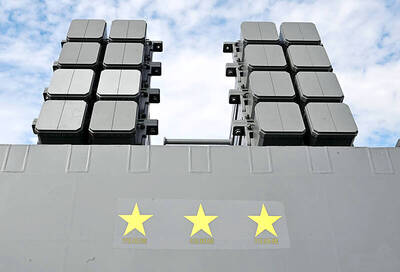
UPGRADE: The Kang Ding-class frigate is replacing its Chaparall missiles with Tien Chien II and Hua Yang VLS, which would provide it with long-range, 360° air defense Taiwan plans to produce 1,200 to 1,376 Hai Chien II missiles (海劍二, Sea Sword II) — also known as TC-2N — to serve as the standard air defense system of the navy’s surface combatant fleet, a source said yesterday. Last week, the Hai Chien II, the naval version of the Tien Kung II missile (天劍二, Sky Sword II), completed a live-fire test in waters off the National Chungshan Institute of Science and Technology’s Jiupeng facility (九鵬) in Pingtung County’s Manjhou Township (滿州). The MIM72 Chaparral and other dated air defense missiles that currently arm Taiwanese ships have inadequate range to combat Chinese


 RSS
RSS