


Guatemala reaffirmed its support for Taiwan during a meeting between Guatemalan Minister of Foreign Affairs Carlos Ramiro Martinez and Japanese Minister of Foreign Affairs Yoko Kamikawa on Wednesday.
After attending President William Lai’s (賴清德) inauguration ceremony in Taiwan on Monday, Martinez’s delegation left for Japan on Wednesday.
Although Guatemalan President Bernardo Arevalo was unable to attend the ceremony personally, he requested a videoconference with Lai on Tuesday to convey his congratulations, Latin American and Caribbean Affairs Department Deputy Director-General Chang Tzu-hsin (張自信) told a regular news briefing.
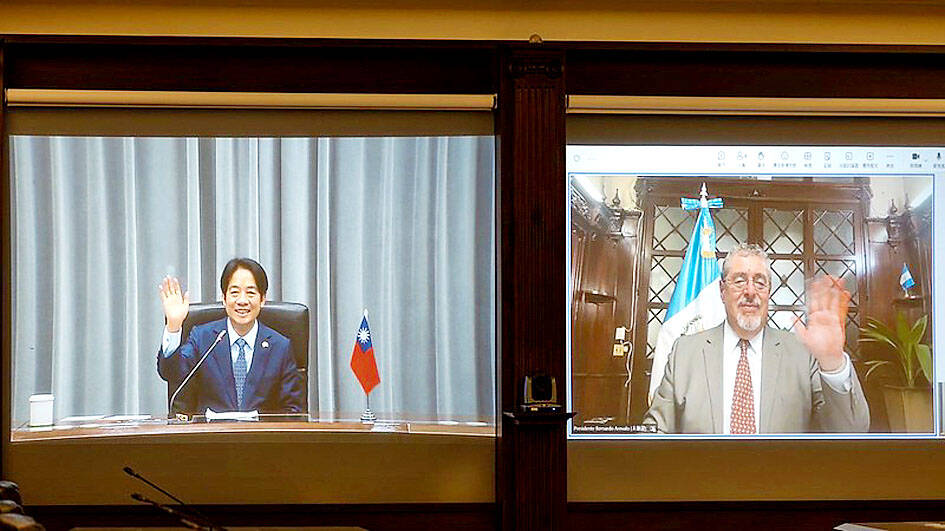
Photo courtesy of the Presidential Office
Arevalo told Lai that he looked forward to further strengthening the friendship between Taiwan and Guatemala, he added.
Martinez and Kamikawa had a meeting on Wednesday for about 30 minutes, which was followed by a working dinner that lasted about 70 minutes, the Japanese Ministry of Foreign Affairs said.
The two foreign ministers exchanged views on cooperation in the international arena, including the situation in East Asia, Russia’s invasion of Ukraine and the Israeli-Palestinian conflict, it said.
Martinez made particular mention of Taiwan, saying that “Guatemala’s support for Taiwan remains unchanged” and that next year would mark the 90th anniversary of diplomatic relations between the two sides, it said.
Martinez’s visit to Japan drew attention from local media as Guatemala maintains diplomatic ties with Taiwan while other Central American nations Panama and Honduras have switched recognition from Taipei to Beijing in recent years, the Sankei Shimbun reported.
If Guatemala, which accounts for about half the population and economy of the 12 countries that officially recognize Taiwan, were to sever diplomatic relations with Taiwan, Taiwan’s “international presence would be cut in half,” the paper cited a senior official at the Japanese Ministry of Foreign Affairs as saying.
A decline in Taiwan’s international presence could have an impact on Japan’s security, which is why Japan attaches great importance to Guatemala, it said.
Japanese Prime Minister Fumio Kishida’s visit to Paraguay, the only country in South America that recognizes Taiwan, earlier this month was due to a similar concern, it said.
Kishida and Paraguayan President Santiago Pena agreed during their meeting to cooperate in maintaining and strengthening a free and open international order, and voiced opposition to China’s attempt to unilaterally change the “status quo.”
Separately, Saint Vincent and the Grenadines and Saint Kitts and Nevis established diplomatic relations with Palau in the presence of Lai, the ministry said yesterday.
The two Taiwanese diplomatic allies in the Caribbean sent delegations to the nation to attend Lai’s inauguration ceremony on Monday and signed the documents with another of Taiwan’s allies during their visit, Chang said.
It is hoped that Taiwan could be the starting point for democracies around the world to work with and support each other to safeguard democracy and freedom, he said.

Considering that most countries issue more than five denominations of banknotes, the central bank has decided to redesign all five denominations, the bank said as it prepares for the first major overhaul of the banknotes in more than 24 years. Central bank Governor Yang Chin-lung (楊金龍) is expected to report to the Legislative Yuan today on the bank’s operations and the redesign’s progress. The bank in a report sent to the legislature ahead of today’s meeting said it had commissioned a survey on the public’s preferences. Survey results showed that NT$100 and NT$1,000 banknotes are the most commonly used, while NT$200 and NT$2,000

The Centers for Disease Control (CDC) yesterday reported the first case of a new COVID-19 subvariant — BA.3.2 — in a 10-year-old Singaporean girl who had a fever upon arrival in Taiwan and tested positive for the disease. The girl left Taiwan on March 20 and the case did not have a direct impact on the local community, it said. The WHO added the BA.3.2 strain to its list of Variants Under Monitoring in December last year, but this was the first imported case of the COVID-19 variant in Taiwan, CDC Deputy Director-General Lin Ming-cheng (林明誠) said. The girl arrived in Taiwan on

South Korea is planning to revise its controversial electronic arrival card, a step Taiwanese officials said prompted them to hold off on planned retaliatory measures, a South Korean media report said yesterday. A Yonhap News Agency report said that the South Korean Ministry of Foreign Affairs is planning to remove the “previous departure place” and “next destination” fields from its e-arrival card system. The plan, reached after interagency consultations, is under review and aims to simplify entry procedures and align the electronic form with the paper version, a South Korean ministry official said. The fields — which appeared only on the electronic form

The Ministry of Foreign Affairs (MOFA) is suspending retaliation measures against South Korea that were set to take effect tomorrow, after Seoul said it is updating its e-arrival system, MOFA said today. The measures were to be a new round of retaliation after Taiwan on March 1 changed South Korea's designation on government-issued alien resident certificates held by South Korean nationals to "South Korea” from the "Republic of Korea," the country’s official name. The move came after months of protests to Seoul over its listing of Taiwan as "China (Taiwan)" in dropdown menus on its new online immigration entry system. MOFA last week


 RSS
RSS