


The US Department of State has called on Beijing to act with restraint and not use Taiwan’s transition of government as a pretext for provocative or coercive actions following the inauguration of President William Lai (賴清德).
In an e-mailed statement, a department spokesperson welcomed the comments by Lai in his inaugural address in Taipei on Monday, noting his commitment to peace and stability across the Taiwan Strait and to maintaining the “status quo.”
The inauguration was part of a normal, routine democratic process and if Beijing escalates tensions or pressures Taiwan as a result, it should be seen as the provocateur, the statement said.

Photo: Carlos Garcia Rawlins, Reuters
US policy toward Taiwan has not changed, opposing unilateral changes to the “status quo” by either side in line with its long-standing commitment to maintaining peace and stability across the Taiwan Strait, it said.
The US also does not support Taiwanese independence, but encourages cross-strait dialogue and expects that differences would be resolved peacefully and in a manner acceptable to people on both sides of, it said.
China’s Taiwan Affairs Office spokesman Chen Binhua (陳斌華) said that the speech delivered by “the leader of the Taiwan region,” had “stubbornly insisted on the position of Taiwanese independence,” Xinhua news agency reported.
Chen, who did not mention Lai by name, said that the speech contained “separatist fallacies” and attempted to “incite division” among people on both sides of the Taiwan Strait.
China also criticized US Secretary of State Antony Blinken for extending his congratulations to Lai and separately sanctioned former US representative Mike Gallagher for his support of Taipei.
Blinken on Monday congratulated Lai shortly after the inauguration ceremony.
The US looks forward to working with Lai and others in Taiwan “to advance our shared interests and values,” Blinken said.
“It’s a serious violation of the political commitment made by the US to maintain only cultural, commercial and other unofficial relations with the Taiwan region,” Chinese Ministry of Foreign Affairs spokesman Wang Wenbin (汪文斌) said yesterday.
The remarks by the US’ top diplomat sent “a seriously wrong signal to the Taiwan separatist forces,” Wang said, adding that Beijing had filed a diplomatic complaint with Washington, and called on “the US to immediately correct their mistakes.”
In Taipei, the Mainland Affairs Council called on Beijing to be receptive to an overture expressed by Lai on Monday.
In a news release on Monday, the council said that Lai had extended “the greatest goodwill gesture” in the address by calling for engagements between the two sides of the Taiwan Strait for mutual benefit and joint prosperity.
The council urged China to respond to that overture positively and hence meet the expectations of the people on both sides of the Strait and the international community.
It would closely monitor the situation across the Taiwan Strait and promote, with prudence, cross-strait exchanges in accordance with the Constitution, the council said.

NATIONAL SECURITY: Authorities are working to confirm the identities of the military personnel involved and investigating possible illegal conduct and regulatory violations Authorities are probing possible national security implications after Kinmen police and immigration officers on Sunday found a Chinese woman allegedly posing as a tourist while engaging in prostitution involving more than 10 military personnel. The woman, surnamed Chen (陳), has since been deported, authorities said, adding that investigators are still working to confirm the identities of those implicated, as the records only listed code names and aliases. The case stemmed from a report received by the Kinmen District Prosecutors’ Office on Friday last week from the Jinhu Precinct of the Kinmen County Police Bureau. On Sunday, police, along with the National Immigration

GLOBALGIVING: ‘ Caving to external pressure is not acceptable for an organization that has cultivated justice reform and human rights for 30 years,’ one NGO said A slew of non-government organizations (NGOs) have withdrawn from the GlobalGiving fundraising platform after it announced it would use “Chinese Taipei” instead of “Taiwan” from next month. The Taiwan Good Rice Association wrote on Facebook on Friday that it was informed on April 28 via a teleconference call of the change, which was made because the platform wanted to operate in China. Taiwan Good Rice is to terminate all cooperative relationships with GlobalGiving in response to the platform’s “unilateral and non-negotiable” decision to remove references to Taiwan, the NGO said. “Taiwan is in the official name of Taiwan Good Rice Association and the

HEAVY WEATHER: Typhoon Jangmi is due to crash straight into the Ryukyus as airlines look to shift flights to larger aircraft or cancel flights to Okinawa entirely Taiwan’s international air carriers announced flight adjustments over the weekend as Typhoon Jangmi is forecast to hit the Ryukyu Islands today and tomorrow. The Central Weather Administration (CWA) upgraded Jangmi from a tropical storm to a typhoon at 8am yesterday, with the eye located 580km south of Naha city. It was moving north at 19kph. Today, China Airlines’ CI-120, CI-121, CI-122 and CI-123 flights between Taoyuan and Naha, Okinawa, have been canceled as well as CI-132 and CI-133 between Kaohsiung and Naha. EVA Air’s BR-112, BR-113, BR-186 and BR-185 flights between Taoyuan and Naha are also canceled. Low-cost carrier Tigerair Taiwan canceled IT-230,
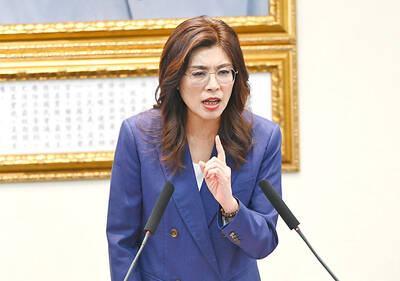
Chinese Nationalist Party (KMT) Chairwoman Cheng Li-wun (鄭麗文) yesterday briefed her party’s Central Standing Committee regarding her scheduled visit to the US between Monday next week and June 16, saying that her purpose would be to persuade the US that the Republic of China (ROC) Constitution was a “one China” constitution that would foster stable and peaceful cross-strait relations. The ROC Constitution is the most important defense for all Taiwanese citizens, as it upholds our democracy and has contributed to our robust economy, which aligns with international and US interests, she said. “We would not be troublemakers and drag the US under,”


 RSS
RSS