


Chinese Nationalist Party (KMT) caucus members yesterday said they do not plan to attend president-elect William Lai’s (賴清德) inauguration on Monday next week, citing a preoccupation with official work duty.
KMT caucus secretary-general Hung Mong-kai (洪孟楷) said that the event falls on a Monday, a working day for everyone, and they as lawmakers have legislative committee sessions to attend.
“We are elected legislators and so the official business in the Legislature takes priority over everything else,” KMT Legislator Lo Chih-chiang (羅智強) said.
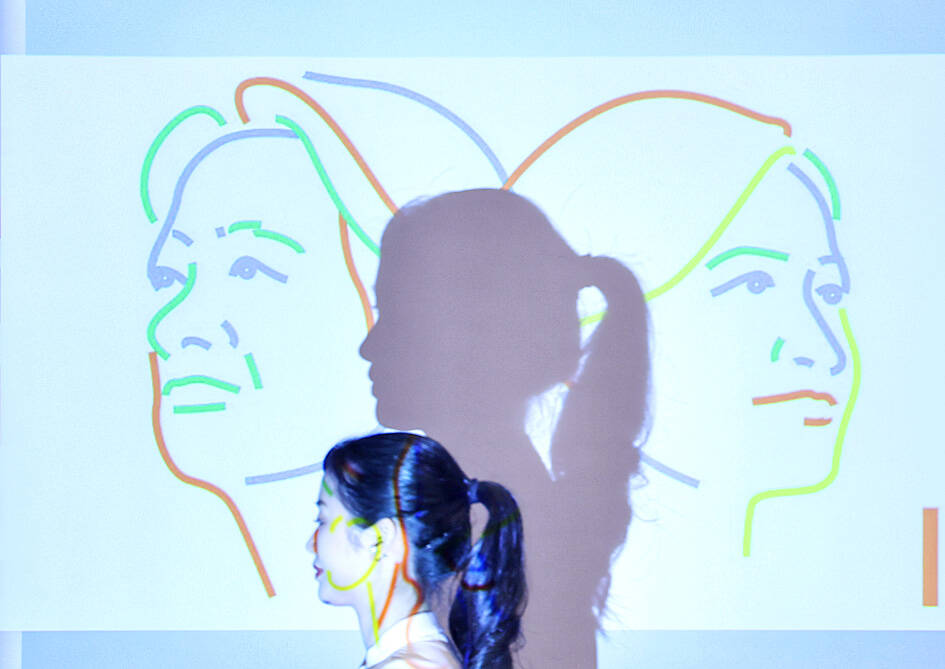
Photo: CNA
A KMT member speaking on condition of anonymity said that “Democratic Progressive Party (DPP) lawmakers have shown unwillingness to communicate with us. In these circumstances, it is meaningless for us to attend. For KMT legislators to go or not, it will not change anything.”
As of yesterday, KMT Chairman Eric Chu (朱立倫) would not say whether he would attend the inauguration, while Taipei Mayor Chiang Wan-an (蔣萬安) and New Taipei City Mayor Hou You-yi (侯友宜), both members of the KMT, said they would not attend, citing scheduled city government activities.
On the other hand, KMT Taichung Mayor Lu Shiow-yen (盧秀燕) said she would be attending. Her city government officials said the city council has an interpellation session on Monday next week, and Lu has agreed with city councilors to take a half-day off for her to attend the event in Taipei.
The Taiwan People’s Party (TPP) said its chairman Ko Wen-je (柯文哲) would attend, adding that its eight lawmakers are free to decide on their own accord.
TPP caucus whip Huang Kuo-chang (黃國昌) said he would attend at least the first half of the ceremony, adding that he would be occupied with that day’s legislative committee sessions for the other half.
DPP Legislator Hsu Chih-chieh (許智傑) called on all lawmakers from the governing and opposition parties to attend the inauguration ceremony.
“Winning or losing in the election is only for the time being, but our nation’s development is for the long term. We hope the KMT could put off the political wrangling, and join with TPP members at the event.”
DPP caucus secretary-general Rosalia Wu (吳思瑤) questioned the KMT lawmakers’ reasoning.
“KMT legislators willingly headed overseas on a visit to Beijing when our legislature was in session, and 20 KMT and TPP legislators have signed up to visit Itu Aba Island (Taiping Island, 太平島),” she said.
“Why would KMT legislators refuse to attend the inauguration ceremony, which is held a few minutes from the Legislative Yuan in front of the Presidential Office Building?” Wu asked.
Additional reporting by Tsai Shu-yuan and Jason Pan
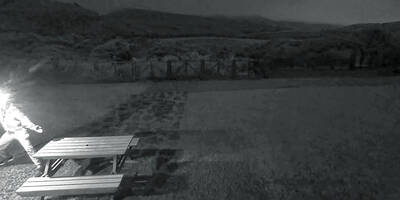
Yangmingshan National Park authorities yesterday urged visitors to respect public spaces and obey the law after a couple was caught on a camera livestream having sex at the park’s Qingtiangang (擎天崗) earlier in the day. The Shilin Police Precinct in Taipei said it has identified a suspect and his vehicle registration number, and would summon him for questioning. The case would be handled in accordance with public indecency charges, it added. The couple entered the park at about 11pm on Thursday and began fooling around by 1am yesterday, the police said, adding that the two were unaware of the park’s all-day live

Fast food chain McDonald's is to raise prices by up to NT$5 on some products at its restaurants across Taiwan, starting on Wednesday next week, the company announced today. The prices of all extra value meals and sharing boxes are to increase by NT$5, while breakfast combos and creamy corn soup would go up by NT$3, the company said in a statement. The price of the main items of those meals, if ordered individually, would remain the same. Meanwhile, the price of a medium-sized lemon iced tea and hot cappuccino would rise by NT$3, extra dipping sauces for chicken nuggets would go up
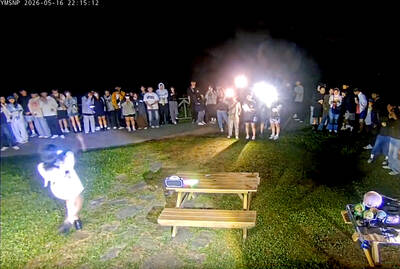
Yangmingshan National Park’s Qingtiangang (擎天崗) nature area has gone viral after a park livestream camera observed a couple in the throes of intimate congress, which was broadcast live on YouTube, drawing large late-night crowds and sparking a backlash over noise, bright lights and disruption to wildlife habitat. The area’s livestream footage appeared to show a couple engaging in sexual activity on a picnic table in the park on Friday last week, with the uncensored footage streamed publicly online. The footage quickly spread across social media, prompting a tide of visitors to travel to the site to “check in” and recreate the

Minister of Digital Affairs Lin Yi-ching (林宜敬) yesterday cited regulatory issues and national security concerns as an expert said that Taiwan is among the few Asian regions without Starlink. Lin made the remarks on Facebook after funP Innovation Group chief executive officer Nathan Chiu (邱繼弘) on Friday said Taiwan and four other countries in Asia — China, North Korea, Afghanistan and Syria — have no access to Starlink. Starlink has become available in 166 countries worldwide, including Ukraine, Malaysia, the Philippines and Vietnam, in the six years since it became commercial, he said. While China and North Korea block Starlink, Syria is not


 RSS
RSS