


Medical industry representatives on Monday urged the government to shift the National Health Insurance (NHI) “expenditure cap” system to an “expenditure target” system.
The representatives called for the transition to an “expenditure target” system with a service volume target and fixed point value to payment ratio, during a public hearing in Taipei.
“Extra expenditure” could be reimbursed at a reduced rate, they said, adding that these changes would require an additional budget of about NT$60 billion (US$1.85 billion), lower than the authorities’ estimate of NT$70 billion to NT$100 billion.
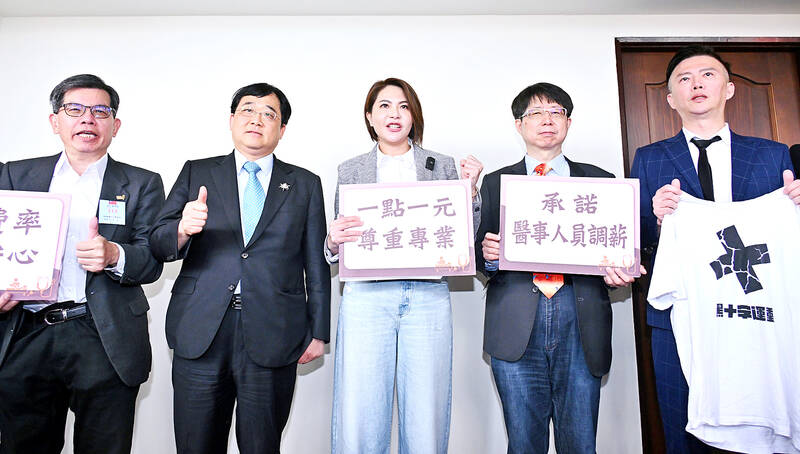
Photo: Fang Pin-chao, Taipei Times
This year, the budget for the NHI system is about NT$870 billion.
Under the expenditure cap system, the NHI has an annual fixed budget that covers five major categories of medical services: treatments provided in hospitals, clinics and dialysis centers, and by dentists and Chinese medicine practitioners.
The NHI reimburses healthcare facilities for services provided through a point value system. A point is convertible to New Taiwan dollars and the rate changes quarterly to align overall expenditure with the predetermined budget. Therefore, higher service volume results in a lower point value and lower payments to providers.
From 2018 to 2022, the average point-to-payout ratio for the five major categories of medical services ranged from about one-to-NT$0.8 to one-to-NT$1.2, but was about one-to-NT$0.91 most of the time.
This meant that many healthcare facilities were not fully reimbursed for their services.
Since the implementation of the NHI’s Global Budget Payment System about 20 years ago, the gap between medical demand and budget shortfall has been borne by medical institutions, Taiwan College of Healthcare Executives chairman Hung Tzu-jen (洪子仁) said.
There are pros and cons to the expenditure target system, National Health Insurance Administration Director-General Shih Chung-liang (石崇良) said.
For example, a hospital could opt to decrease the number of treatments offered to people when it nears its expenditure target to mitigate the costs associated with being reimbursed at a reduced rate, he said.
However, a uniform point value system, where the point-to-payout ratio remains the same, might lead to an unnecessary surge in services provided due to profit motives, Shih added.
The hearing came after Chinese Nationalist Party (KMT) lawmakers recently proposed two draft amendments to the National Health Insurance Act (全民健康保險法).
The amendments stipulate that one point should be worth no less than NT$0.95 or be equal to NT$1, and that any expenditure that goes over budget should be covered by the public purse — not medical institutions.
Minister of Health and Welfare Hsueh Jui-yuan (薛瑞元) on Thursday last week said he anticipated that if the bill were to pass, the fees for next year’s NHI could increase.

Yangmingshan National Park authorities yesterday urged visitors to respect public spaces and obey the law after a couple was caught on a camera livestream having sex at the park’s Qingtiangang (擎天崗) earlier in the day. The Shilin Police Precinct in Taipei said it has identified a suspect and his vehicle registration number, and would summon him for questioning. The case would be handled in accordance with public indecency charges, it added. The couple entered the park at about 11pm on Thursday and began fooling around by 1am yesterday, the police said, adding that the two were unaware of the park’s all-day live
Fast food chain McDonald's is to raise prices by up to NT$5 on some products at its restaurants across Taiwan, starting on Wednesday next week, the company announced today. The prices of all extra value meals and sharing boxes are to increase by NT$5, while breakfast combos and creamy corn soup would go up by NT$3, the company said in a statement. The price of the main items of those meals, if ordered individually, would remain the same. Meanwhile, the price of a medium-sized lemon iced tea and hot cappuccino would rise by NT$3, extra dipping sauces for chicken nuggets would go up

Yangmingshan National Park’s Qingtiangang (擎天崗) nature area has gone viral after a park livestream camera observed a couple in the throes of intimate congress, which was broadcast live on YouTube, drawing large late-night crowds and sparking a backlash over noise, bright lights and disruption to wildlife habitat. The area’s livestream footage appeared to show a couple engaging in sexual activity on a picnic table in the park on Friday last week, with the uncensored footage streamed publicly online. The footage quickly spread across social media, prompting a tide of visitors to travel to the site to “check in” and recreate the

Minister of Digital Affairs Lin Yi-ching (林宜敬) yesterday cited regulatory issues and national security concerns as an expert said that Taiwan is among the few Asian regions without Starlink. Lin made the remarks on Facebook after funP Innovation Group chief executive officer Nathan Chiu (邱繼弘) on Friday said Taiwan and four other countries in Asia — China, North Korea, Afghanistan and Syria — have no access to Starlink. Starlink has become available in 166 countries worldwide, including Ukraine, Malaysia, the Philippines and Vietnam, in the six years since it became commercial, he said. While China and North Korea block Starlink, Syria is not


 RSS
RSS