


Authorities yesterday questioned the owner, his son and executives of a telecommunications services company at the center of a corruption scandal in Taipei over alleged insider trading.
The Taipei District Prosecutors’ Office questioned Tai Tung Communication Co (台通光電) employees and executives — including its owner, Lee Ching-huang (李慶煌), and his son, Lee Chia-hao (李嘉豪), who was placed in pretrial detention with restricted communication.
The New Taipei City-based firm is the parent company of Taiwan Intelligent Fiber Optic Network Consortium (Taifo, 台灣智慧光網), which investigators last month accused of providing kickbacks to Taipei City Councilor Chen Chung-wen (陳重文) of the Chinese Nationalist Party (KMT) related to a city government project to install police surveillance systems and provide networking and data transmission services.
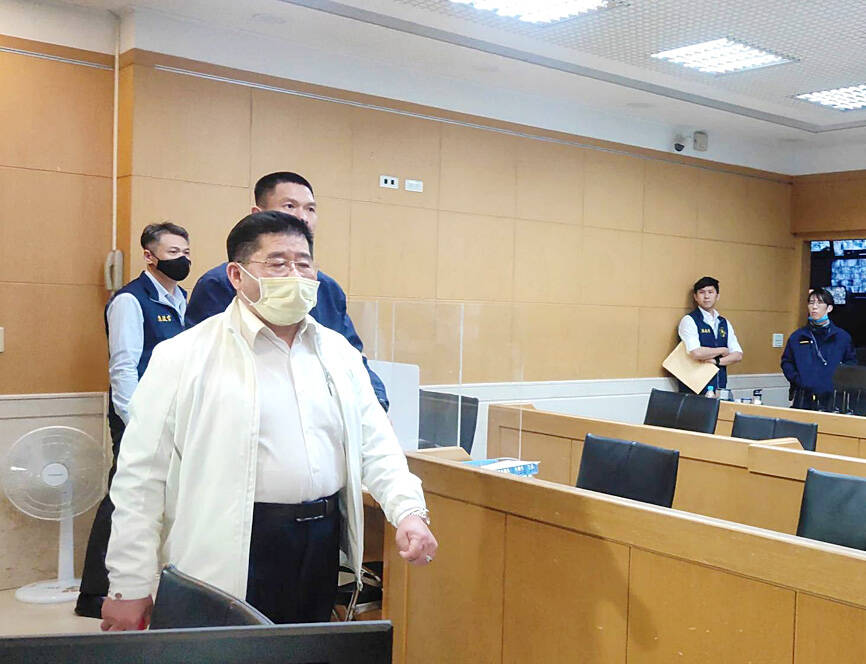
Photo: CNA
Yesterday, Agency Against Corruption units and Taipei prosecutors searched nine Tai Tung offices and employee residences, while serving summonses to executives related to alleged insider trading that led to profits of about NT$100 million (US$3.07 million), prosecutors said.
The agency and prosecutors alleged that Tai Tung, a publicly listed company on the Taiwan Stock Exchange, had announced a stock buyback on March 8, but that Lee Ching-huang, members of his family and some employees had prior knowledge of the deal, enabing them to purchase stock ahead of time.
A bail court hearing approved the pretrial detention of Lee Chia-hao, who holds the title of special assistant to the owner.
Prosecutors listed him as facing possible charges for contravening the Securities and Exchange Act (證券交易法) and requested that he be detained due to the possibility of collusion and tampering with evidence, a bail court hearing filing said.
Lee Ching-huang’s wife, Hsieh Yen-chun (謝燕春), was released on NT$3 million bail, while his ex-wives, surnamed Huang (黃) and Lee (李), were released on bail of NT$3.5 million and NT$2 million respectively. A company executive surnamed Shih (石) was released on NT$500,000 bail, while Lee Ching-huang was released without posting bail.
The Agency Against Corruption said that the investigation into insider trading stemmed from an earlier probe into reported corruption and kickbacks at Taifo, which had secured a NT$550 million contract with the Taipei City Government to supply police surveillance systems and networking and data transmission services.
An investigation found evidence that Chen had questioned officials and allegedly pressured the government to approve a higher budget for the contract with Taifo, whose chairman is Lee Ching-huang.
Investigators said that several million dollars in alleged kickbacks had flowed to accounts controlled by Chen.
The agency and prosecutors on March 14 initiated searches related to that investigation, detaining and questioning Chen and Lee Ching-huang in the process, along with other suspects.
Chen was detained as telephone records indicated he had called witnesses in an attempt to collude with them, while Lee Chiang-huang was released on a NT$3.5 million bill, prosecutors said.
The alleged insider trading activity was found while examining money flows and bank transactions in that case, prosecutors said.
Additional reporting by CNA

NATIONAL SECURITY: Authorities are working to confirm the identities of the military personnel involved and investigating possible illegal conduct and regulatory violations Authorities are probing possible national security implications after Kinmen police and immigration officers on Sunday found a Chinese woman allegedly posing as a tourist while engaging in prostitution involving more than 10 military personnel. The woman, surnamed Chen (陳), has since been deported, authorities said, adding that investigators are still working to confirm the identities of those implicated, as the records only listed code names and aliases. The case stemmed from a report received by the Kinmen District Prosecutors’ Office on Friday last week from the Jinhu Precinct of the Kinmen County Police Bureau. On Sunday, police, along with the National Immigration

GLOBALGIVING: ‘ Caving to external pressure is not acceptable for an organization that has cultivated justice reform and human rights for 30 years,’ one NGO said A slew of non-government organizations (NGOs) have withdrawn from the GlobalGiving fundraising platform after it announced it would use “Chinese Taipei” instead of “Taiwan” from next month. The Taiwan Good Rice Association wrote on Facebook on Friday that it was informed on April 28 via a teleconference call of the change, which was made because the platform wanted to operate in China. Taiwan Good Rice is to terminate all cooperative relationships with GlobalGiving in response to the platform’s “unilateral and non-negotiable” decision to remove references to Taiwan, the NGO said. “Taiwan is in the official name of Taiwan Good Rice Association and the

HEAVY WEATHER: Typhoon Jangmi is due to crash straight into the Ryukyus as airlines look to shift flights to larger aircraft or cancel flights to Okinawa entirely Taiwan’s international air carriers announced flight adjustments over the weekend as Typhoon Jangmi is forecast to hit the Ryukyu Islands today and tomorrow. The Central Weather Administration (CWA) upgraded Jangmi from a tropical storm to a typhoon at 8am yesterday, with the eye located 580km south of Naha city. It was moving north at 19kph. Today, China Airlines’ CI-120, CI-121, CI-122 and CI-123 flights between Taoyuan and Naha, Okinawa, have been canceled as well as CI-132 and CI-133 between Kaohsiung and Naha. EVA Air’s BR-112, BR-113, BR-186 and BR-185 flights between Taoyuan and Naha are also canceled. Low-cost carrier Tigerair Taiwan canceled IT-230,

Chinese Nationalist Party (KMT) Chairwoman Cheng Li-wun (鄭麗文) yesterday briefed her party’s Central Standing Committee regarding her scheduled visit to the US between Monday next week and June 16, saying that her purpose would be to persuade the US that the Republic of China (ROC) Constitution was a “one China” constitution that would foster stable and peaceful cross-strait relations. The ROC Constitution is the most important defense for all Taiwanese citizens, as it upholds our democracy and has contributed to our robust economy, which aligns with international and US interests, she said. “We would not be troublemakers and drag the US under,”


 RSS
RSS